
Tag: Business and finance
Economists grapple with the future of the labour market
WHY is productivity growth low if information technology is advancing rapidly? Prominent in the 1980s and early 1990s, this question has in recent years again become one of the hottest in economics. Its salience has grown as techies have become convinced that machine learning and artificial intelligence will soon put hordes of workers out of work (among tech-moguls, Bill Gates has called for a robot tax to deter automation, and Elon Musk for a universal basic income). A lot of economists think that a surge in productivity that would leave millions on the scrapheap is unlikely soon, if at all. Yet this year’s meeting of the American Economic Association, which wound up in Philadelphia on January 7th, showed they are taking the tech believers seriously. A session on weak productivity growth was busy; the many covering the implications of automation were packed out.
Recent history seems to support productivity pessimism. From 1995 to 2004 output per hour worked grew at an annual average pace of 2.5%; from 2004 to 2016 the pace was just 1%. Elsewhere in the G7 group of rich countries, the pace has been slower still. An obvious explanation is that the financial crisis of 2007-08 led firms to defer productivity-boosting investment. Not so, say John Fernald, of the Federal Reserve Bank of San Francisco, and co-authors, who estimate that in America, the slowdown began in…Continue reading
A new market for old and ugly fruit and vegetables takes shape

NO ONE knows quite how much fruit and vegetable produce never reaches the grocery checkout till. A fifth perhaps—or maybe twice that—is judged to be beneath commercial standards. So it is put to use as animal-feed or compost, or simply thrown away in a landfill. This infuriates those appalled at waste. Their outrage, however, has not been enough to create for unwanted fruit and vegetable the kind of sophisticated market that exists for products with more obvious uses, such as securities, currencies, metals, oil and unsullied agriculture. That is starting to change.
At least two companies, Imperfect produce (whose logo is a misshapen potato that looks like a heart) and Hungry Harvest (whose slogan is “Rescued Produce. Delivered”), now provide boxes of subpar stuff directly to retail customers, one concentrating on the west coast of America, the other on the east. Another company, Full Harvest, has the wholesale market in its sights,…Continue reading
Should internet firms pay for the data users currently give away?

YOU have multiple jobs, whether you know it or not. Most begin first thing in the morning, when you pick up your phone and begin generating the data that make up Silicon Valley’s most important resource. That, at least, is how we ought to think about the role of data-creation in the economy, according to a fascinating new economics paper. We are all digital labourers, helping make possible the fortunes generated by firms like Google and Facebook, the authors argue. If the economy is to function properly in the future—and if a crisis of technological unemployment is to be avoided—we must take account of this, and change the relationship between big internet companies and their users.
Artificial intelligence (AI) is getting better all the time, and stands poised to transform a host of industries, say the authors (Imanol Arrieta Ibarra and Diego Jiménez Hernández, of Stanford University, Leonard Goff, of Columbia University, and Jaron Lanier and Glen Weyl, of Microsoft). But, in order to learn…Continue reading
As gyms hit peak season, the market does the splits
EVERY year, like clockwork, swathes of humanity go through the same routine. On December 26th and January 1st, as the fog of cheese, chocolate oranges and champagne lifts, remorse creeps in. Online searches for “get fit” and “lose weight” surge (see chart). Health clubs of all shapes and sizes stand ready to respond. “Intent typically takes seven to 14 days to turn into reality,” notes Humphrey Cobbold, chief executive of Pure Gym, Britain’s largest gym chain. So this week will be one of the busiest for the gym industry globally.
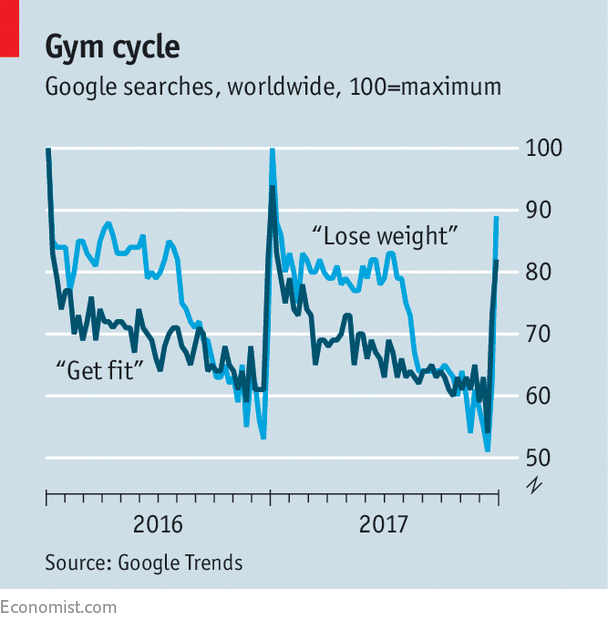
There will be other ripple effects, too. According to recent data from Cardlytics, which monitors spending in Britain, people spend 18% more in sports shops the week before joining a gym (compared with the week prior), and 16% more in speciality health shops. Spending on fashion items also increases around the time of joining a gym.
Many gym recruits will wear their new togs for an ordeal known as high-intensity interval training. In the basement of…Continue reading
Bitcoin is no longer the only game in crypto-currency town
IT STARTED as a joke. Dogecoin was launched in 2013 as a bitcoin parody, using as its mascot a Japanese shiba inu dog, a popular internet meme. The crypto-currency was never really used, except for tipping online, and one of its founders has called it quits. But recently its price has soared: on January 7th the dollar value of all Dogecoins in circulation reached $2bn, a sign of how crazy crypto-currency markets have become. It is also a reminder that, for all the focus on bitcoin, it is no longer the only game in town. Its market capitalisation now amounts to only about one-third of the crypto-market (see chart).
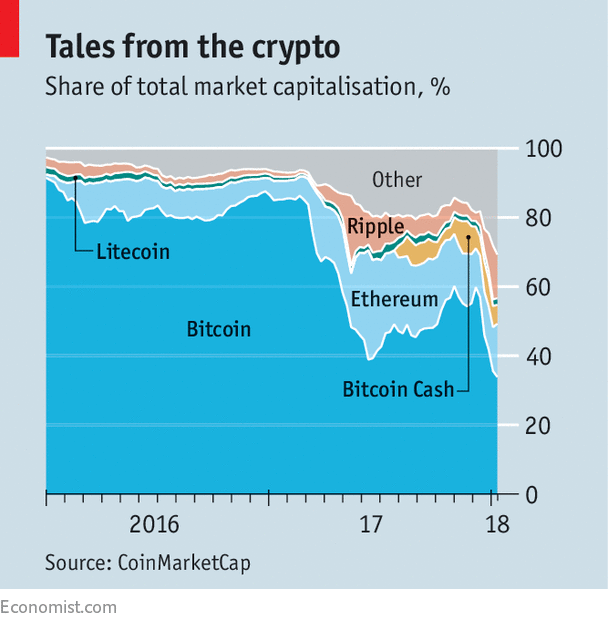
A new crypto-currency is born almost daily, often through an “initial coin offering” (ICO), a form of online crowdfunding. CoinMarketCap, a website, lists about 1,400 digital coins or tokens, including UFO Coin, PutinCoin, Sexcoin and InsaneCoin (worth $7m). Most are no more than curiosities, but by January 10th, around 40 had a market capitalisation of more than…Continue reading
BlackRock v Blackstone

THE two most successful entrepreneurs on Wall Street of the past two decades work on opposite sides of Park Avenue. Larry Fink, 65, is a Democrat whose hand is glued to a Starbucks cup and who runs BlackRock from 52nd Street. Stephen Schwarzman, 70, is a Republican who wears striped shirts with plain collars and runs Blackstone from between 51st and 52nd. The two are ex-colleagues, but have sharply opposing views on investment and management. Their trajectories illustrate how finance is changing. Mr Fink, once the underdog, is on top.
His firm, BlackRock, is the world’s largest asset manager, with $6trn of assets. It stands for computing power, low fees and scale, and is booming. Mr Schwarzman’s firm, Blackstone, is the largest “alternative” manager, focused on private equity and property, with $387bn of assets. It stands for a time-honoured formula of brain power, high fees and specialisation. Lately, it has trod water.
When Mr Fink was a securities trader in his 30s he joined…Continue reading
Predicting doom for the bond market
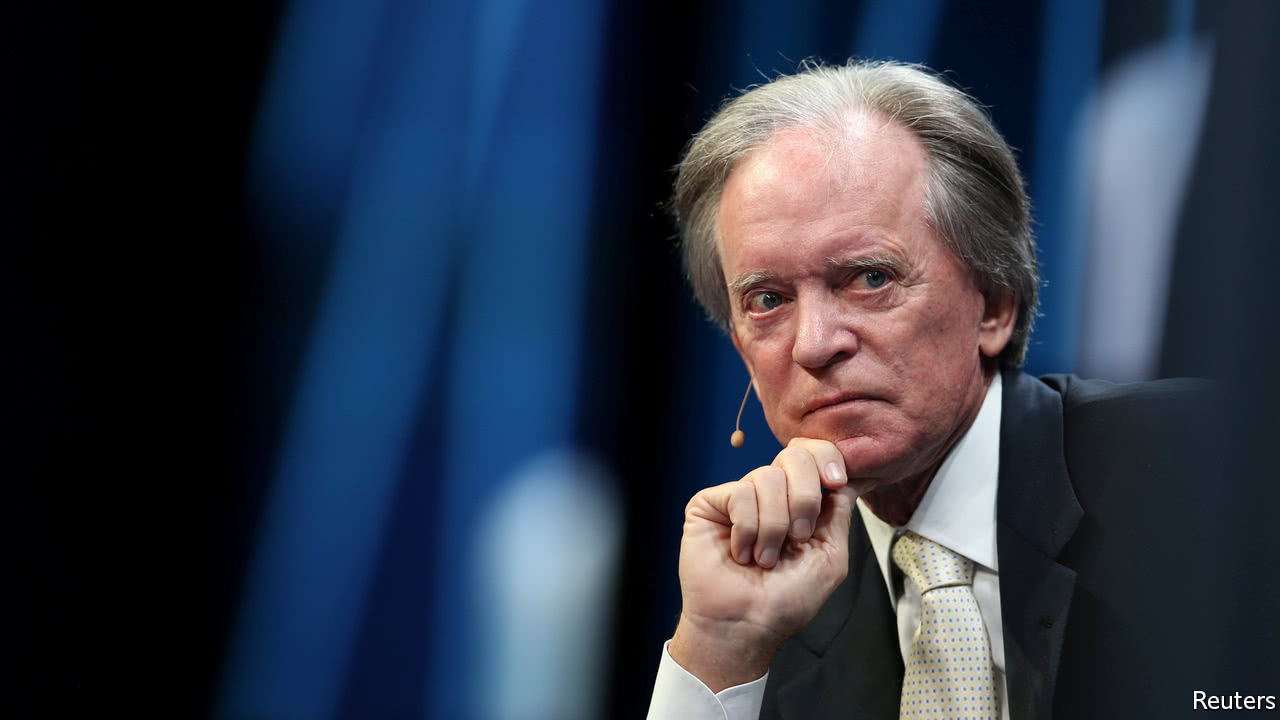
INVESTORS are dragging their attention away from the stockmarket for a moment to figure out what is going on in the other main part of their portfolios: government bonds. Yields have been rising so far this year and Bill Gross, one of the sector’s gurus, has said the long bull market (which dates back to the early 1980s) is finally over.
This certainly seems to be the month for big calls; the noted equity bear Jeremy Grantham has already pointed to the potential for a «melt-up» in the stockmarket. Mr Gross, who runs money for Janus but made his name at Pimco, said that the 25-year trend lines had been broken for both the five- and ten-year bonds.
The end of the bond bull market has been called many times, dating back at least to September 2011. There…Continue reading
Investment banks’ cull of company analysts brings dangers

THEY are not extinct, nor even on the endangered-species list. But company analysts, once among the most prestigious professionals in the stockmarket, are being culled. New European rules, with the catchy name of MiFID2, have just dealt analysts another blow. A study by Greenwich Associates estimates that the research budget may drop by 20% this year.
In their heyday in the late 1980s and early 1990s, analysts could make and break corporate reputations. A “buy” or “sell” recommendation from the leading two or three analysts in an industry could move a share price substantially. Fund managers, and many financial journalists, relied on analysts to spot those companies that were on a rising trajectory, and those where the accounts revealed signs of imminent trouble. And the best analysts were very well paid.
But that golden age was built on some rusty foundations. Analysts were well paid because they worked for the big investment banks. But those big banks made money…Continue reading
Supersonic jets may be about to make a comeback

IN OCTOBER 2003, the age of supersonic passenger travel came to an inauspicious end. That month British Airways withdrew from service its last Concorde jet, a Franco-British aircraft from the 1970s that could fly at twice the speed of sound. Since the 1940s executives in the aerospace industry had predicted that the future of passenger travel would be supersonic. But since the retirement of Concorde there have been no passenger jets that can fly that fast in service. Worse still, even conventional sub-sonic jetliners these days fly slower than their equivalents from the 1960s.
In 2017 the race to break the sound barrier gained new momentum. In December Aerion, an aerospace start-up from Nevada, Lockheed Martin, a defence giant, and GE Aviation, an enginemaker, announced a joint venture to develop what they are calling the world’s first supersonic business jet, the AS2. Aerion’s executive chairman, Brian Barents, has said that he hopes the jet will be able to carry up to 12 passengers at 1.4 times the speed of sound—about 60 percent faster…Continue reading
Where did the inflation go?

THE strength of the global economy is one reason why the stockmarket has started 2018 in buoyant mood (with the Dow passing 25,000). At some point, in any expansion, businesses find it harder to recruit workers or get the materials they need; these bottlenecks cause wages and prices to rise. Central banks then start to tighten monetary policy, a process that can eventually turn the market (and the economy) down.
After many years of ultra-low interest rates, the Federal Reserve has started to tighten monetary policy. There were three rate rises in 2017, and three are expected this year. The idea is to tighten gradually and (keep ahead of the curve) so that inflation does not accelerate so fast that a very sharp monetary tightening is needed.
The problem is that inflation remains hard to spot.