
Tag: Business and finance
Is the bubble only starting?

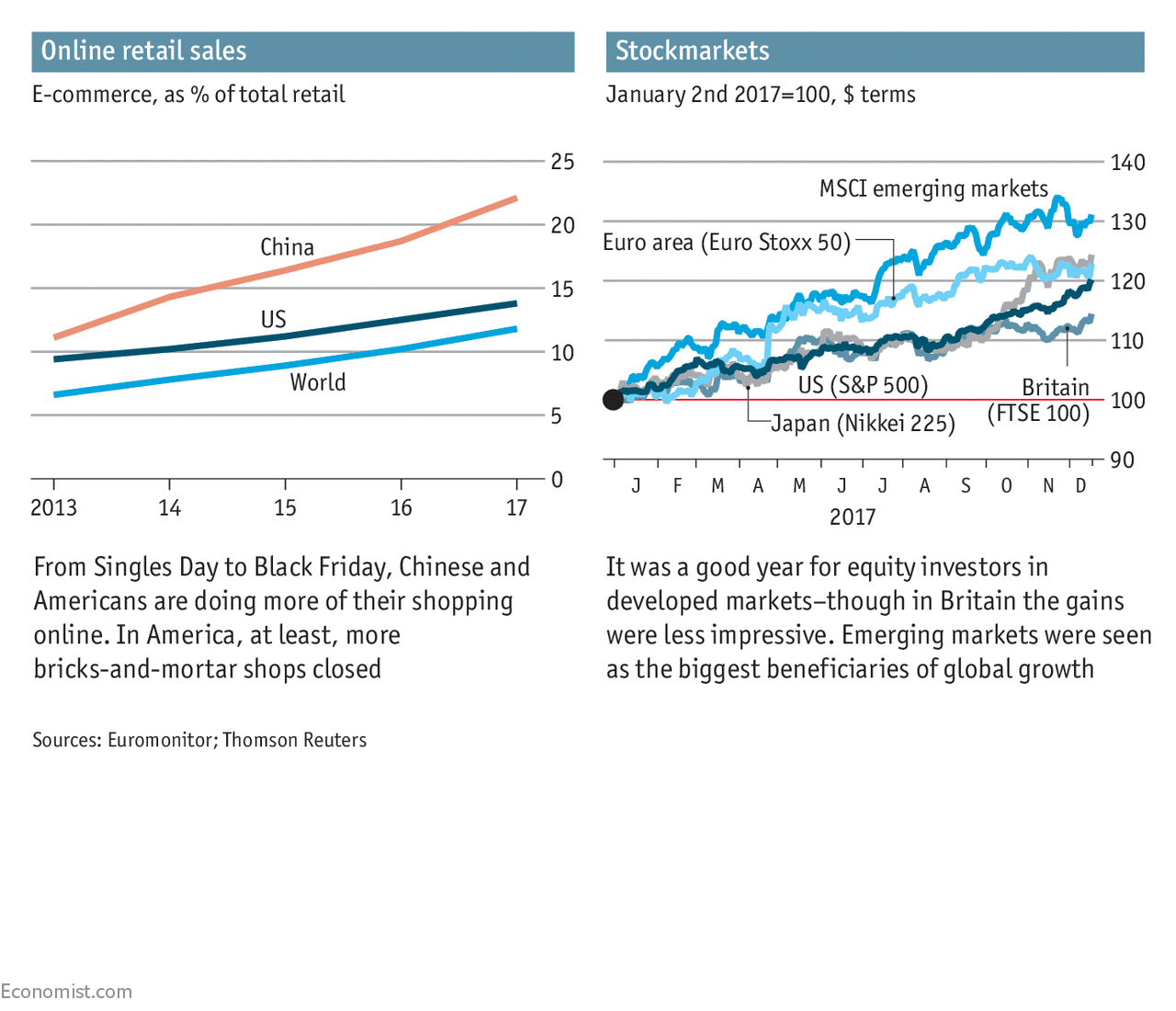
READY for a melt-up? Investors are generally upbeat about the prospects for equity markets this year but one intrepid fund manager thinks it is likely that American share prices could rise by 50% in the next six months to two years. Perhaps the biggest surprise is the identity of that pundit: Jeremy Grantham.
Mr Grantham, one of the founders of the fund management group GMO, is best known for a cautious approach to valuations. He was one of the investors who got out of the dotcom boom well before the top. His firm’s most recent prediction for seven-year returns are for an annual loss of 2% from American largecap equities; indeed among all the asset categories, only cash and emerging market equities and bonds are expected to produce a positive real return over the seven-year period.
So how can Mr Grantham justify his views? He does not…Continue reading
2018 will be the year that large, incumbent companies take on big tech
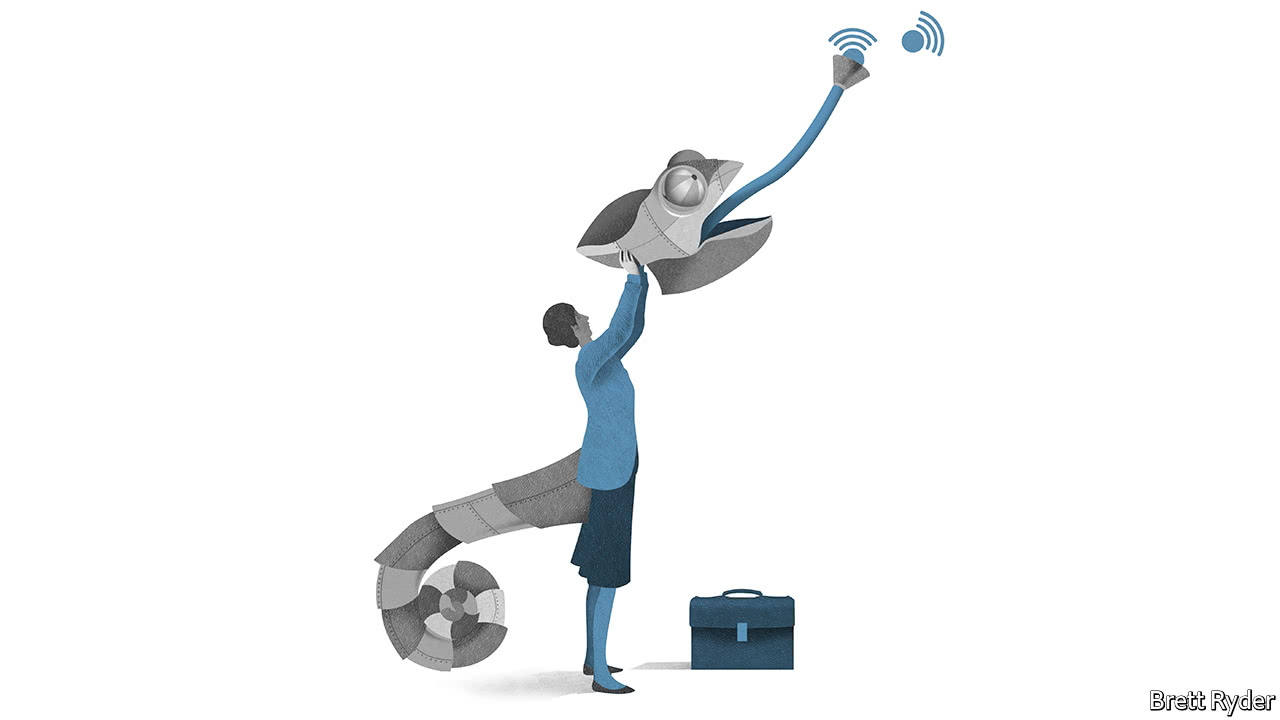
ACCORDING to Ginni Rometty, IBM’s boss, the digital revolution has two phases. In the first, Silicon Valley firms make all the running as they create new markets and eviscerate weak firms in sleepy industries. This has been the story until now. Tech firms have captured 42% of the rise in the value of America’s stockmarket since 2014 as investors forecast they will win an ever-bigger share of corporate profits. A new, terrifying phrase has entered the lexicon of business jargon: being “Amazoned”.
The second phase favours the incumbents, Ms Rometty believes, and is starting about now. They summon the will to adapt, innovate to create new, digital, products and increase efficiency. The schema is plainly self-serving. IBM is itself fighting for survival against cloud-based tech rivals and most of its clients are conventional firms. Yet she is correct that incumbents in many industries are at last getting their acts together on technology.
Enough time has elapsed for even…Continue reading
New research reveals simmering misunderstanding under the tree
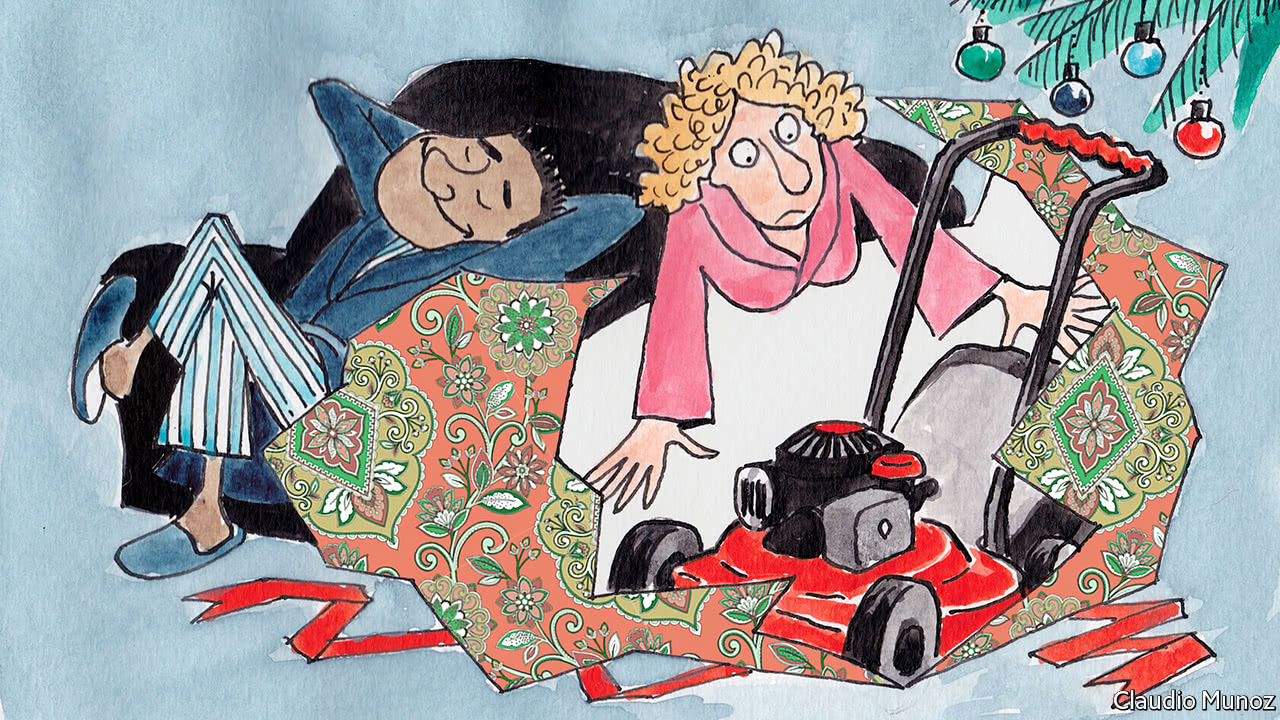
IS THERE any other time of year when good intentions and materialism converge so tightly? The caring, the artistic and the diligent spend their days before Christmas wrapping gifts. Whatever lies inside, their love for the recipients will also be expressed through paper, tape, bows and ribbon.
Then it all goes horribly wrong. New research* into the unwrapping of presents by two professors at the Yale School of Management and one at the University of Miami bravely applies rigour where sentimentality has long ruled. Their paper draws on a half-century of studies by scores of economists and psychologists as well as fresh field trials using hundreds of people from three universities.
The result is, for wrappers, a distressing discovery. Americans spend $3.2bn a year on wrapping paper. Yet their work not only fails to enhance joy, it creates unrealistic expectations that lead to discontent. Gift wrappers may think they are transforming the mundane into the magnificent; recipients seem…Continue reading
America’s Department of Commerce imposes a tariff of 292% on Bombardier’s C-Series jets

A YEAR ago Dennis Muilenburg, the chief executive of Boeing, the American aerospace giant, had a problem. Tweets written by Donald Trump, America’s newly elected president, were hitting Boeing’s share price. Initially buoyed by Mr Trump’s promise of extra spending on defence, the firm’s share price fell in December 2016 when he suggested in a tweet that an order for new presidential planes worth $4bn should be cancelled. After the president elect picked a fight with Lockheed Martin, a rival planemaker, Boeing’s executives were left in fear of being the next target.
And so, it seemed, Mr Muilenburg came up with a plan. Boeing would snuggle up to Mr Trump’s “America First” agenda to avoid the flack. Boeing started to stress in its press releases how many American jobs it was creating; it asked the president to unveil the first 787-10 jet produced in February. In April it filed a trade case against Bombardier, alleging that its Canadian…Continue reading
Russia’s dysfunctional funeral business gets a makeover

THE calls began shortly after Yulia’s grandmother died. The undertaker offered help arranging the funeral, for 47,000 roubles ($800) in cash. She then travelled to Moscow’s Khovanskoe Cemetery, where she was offered a discount on a gravesite—150,000 roubles off—if she could bring cash within three hours and sign a receipt saying she had paid half that amount. Yulia (whose name has been changed) and her family gave in. “We knew we were paying a bribe, but what else could we do?”
To bury a loved one in Russia often means entering an underworld of corruption and red tape. The myriad goods and services needed, from preparing the body for burial to funeral arrangements to carving a headstone, all represent opportunities for extortion in a largely informal market. “Instead of a funeral as a commercial service, the consumer is offered a strange sort of quest,” writes Sergei Mokhov, editor of The Archaeology of…Continue reading

An experiment with in-home deliveries is under way

AFTER staying at home one afternoon for a delivery of discounted toilet disinfectant that never came, Valentin Romanov, a Stockholm IT manager, installed a special lock on his flat’s entrance. When no one is in, deliverymen unlock the door and slip packages inside. Four months on, Mr Romanov has doubled his spending online and says he cannot imagine life without in-home deliveries. These are sweet words for delivery firms and online retailers, Amazon included, that are setting up partnerships with lock manufacturers to overcome a big hurdle for e-commerce.
Conventional deliveries fail so often that a parcel is driven to a home an average of 1.5 times in the Nordic region, says Kenneth Verlage, head of business development at PostNord, a logistics giant operating in Denmark, Finland, Norway and Sweden. It is an expensive inefficiency made worse, he says, by the fact that recipients have still often had to wait for a failed delivery. Some couriers leave packages on doorsteps, but this invites theft….Continue reading
Combustible cigarettes kill millions a year. Can Big Tobacco save them?

BESIDE a serene lake in Switzerland sits a modern glass building called the Cube. Wide-leafed tobacco plants grow in the lobby. In one room machines that can “smoke” more than a dozen cigarettes at a time dutifully puff away, measuring the chemicals that consumers would inhale. The research centre is run by Philip Morris International (PMI), which sells Marlboro and other brands around the world. The facility’s purpose is not to assess the risks of smoking, but to determine whether this huge cigarette-maker might get out of selling cigarettes altogether.
André Calantzopoulos, PMI’s chief executive, talks about moving to a “smoke-free future”, with the firm’s business comprised entirely of alternatives to cigarettes. “We are crystal clear where we are going as a company: we want to move out of cigarettes as soon as possible,” he says. Mr Calantzopoulos has the boldest goals in this regard, but he is not the only tobacco executive to tout a new direction. Nicandro Durante, chief…Continue reading
A vote on “net neutrality” has intensified a battle over the internet’s future
A DAY before the Federal Communications Commission (FCC) voted to rescind “net neutrality” regulations designed to ensure that internet-service providers do nothing to favour some types of online content over others, Ajit Pai, its chairman, tweeted a short video reassuring Americans. “You can still post photos of cute animals,” he says in it, posing with a dog. He also wields a light sabre, which prompted Mark Hamill, the actor who portrays Luke Skywalker in the “Star Wars” films, to criticise Mr Pai on Twitter for siding with giant corporations. Ted Cruz, a Republican senator, then asserted in Mr Pai’s defence that Darth Vader supported government regulation of the web; further jabs followed.
It made for a silly treatment of an arcane subject. But net neutrality is a serious business. The state of New York’s attorney-general said he would lead a multi-state suit against the FCC; in Congress Democrats and Republicans are expected to propose competing bills on the subject in 2018. Broadband and wireless companies such as AT&T responded to fears about their increased power by questioning whether internet firms like Google have too much. Google, Facebook, Amazon and other platform companies in turn put out statements in support of an open internet. So rather than end the struggle over how the internet is regulated in America, the FCC’s vote has…Continue reading
Have yourself a dismal Christmas


ONLY an economist would think to ask whether Christmas is efficient. In 1993 Joel Waldfogel, then a professor at Yale University, turned a lunchtime conversation with colleagues into a paper entitled “The deadweight loss of Christmas”, which argued that, no, it is not. That gift-giving might actually be bad is the kind of opinion which breeds a deep mistrust of economists—loathing is perhaps too strong—among those not schooled in the dismal science. It is also just the sort of analytical insight on which economists pride themselves: counterintuitive, irreverent and interesting. But they should perhaps be less pleased with themselves. The way they think about the most festive time of the year reveals something important about the shortcomings of the field’s approach to human behaviour.
Mr Waldfogel’s notion was a clever one. Massive amounts of money are spent on holiday presents; it makes sense to ask whether such spending leaves the world better off. In buying gifts, people do their best…Continue reading