
Tag: Business and finance
For American Express, competition will only intensify
HE IS leaving with the share price rising and the announcement, on October 18th, of earnings that were largely well received. Better still, Kenneth Chenault, American Express’s chief executive for 16 years, accomplished a feat rare in the upper reaches of American finance: to stand down without an obvious helping shove. No grandstanding senators hounded him out (see Wells Fargo). No boardroom coup hastened the end (Citigroup). The financial crisis left him untouched (take your pick). His successor, Stephen Squeri, promoted from within and apparently groomed for the job, takes over in February.
For all that, Mr Chenault’s long tenure has not been an unequivocal triumph. Though generating strong returns on assets and equity, American Express has continued its slide within the fast-changing and competitive payments industry. According to Nilson, an industry bible, in 1974 the amount of money for purchases channelled through American Express was equivalent to 50% of what went through…Continue reading
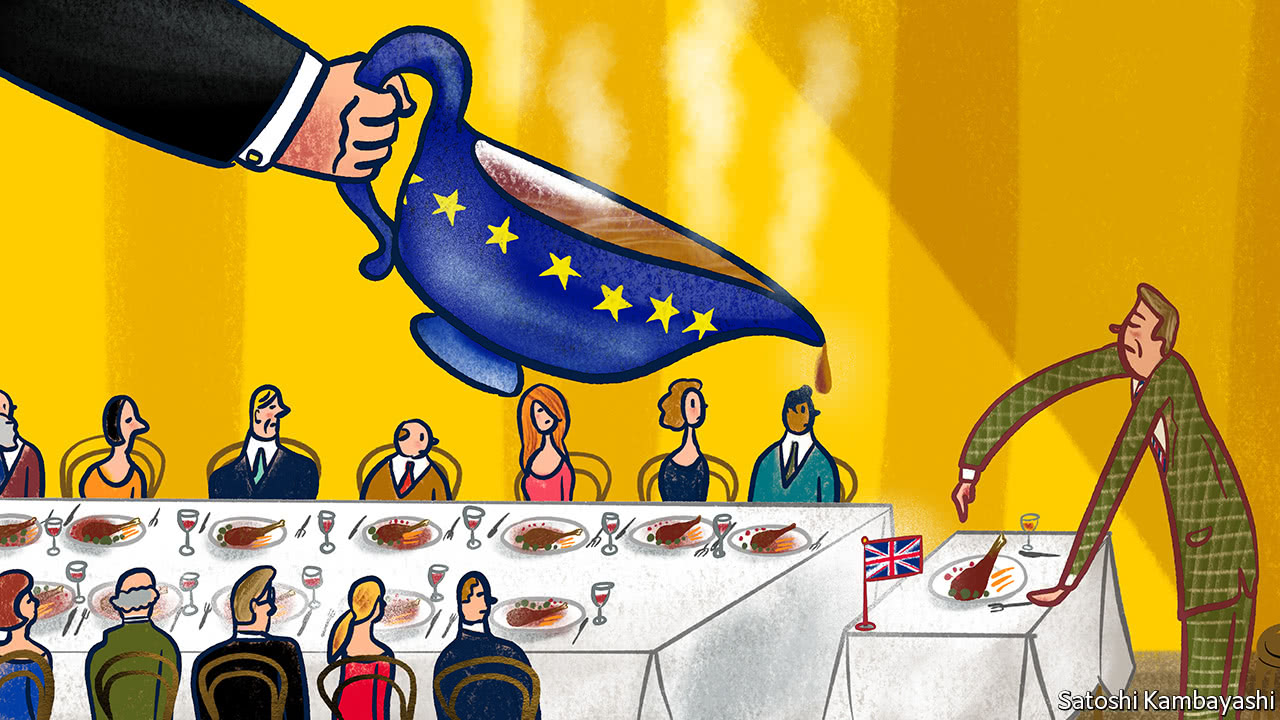
Sauce for a Brussels goose
DIVORCES are rarely easy. In the 16 months since Britain voted to leave the EU in a referendum, the negotiations have made little progress. One of the trickiest aspects is the amount that Britain should pay to meet its existing spending commitments for EU programmes.
This is not analogous to dividing up the bill in a restaurant, and deciding who had the lobster and who stuck to the mixed green salad. Take the cost of EU officials’ pensions. The tricky bit in calculating it is that pensions are long-term commitments; a bureaucrat who starts work in Brussels today might still be collecting a pension 70 years from now. Working out the cost is fiendishly complicated, requiring estimates of how much wages will rise (if the pension is linked to salary) and how long employees will live. Then the sum of future benefits has to be discounted at some rate to work out the current cost; the higher the discount rate, the lower the presumed expense.
The EU doesn’t pre-fund pensions for…Continue reading
Aldi and Lidl grow despite ignoring the internet

THE aisles are wide, the lights bright and shelves low. Most obviously, however, the apples shine and the broccoli beckons. For those used to the cramped, dimly lit Aldi stores of yore, all expense spared, the new supermarket in Herten, Germany, is almost shocking.
Opened in April this is the prototype for a vast new renovation and expansion programme across Europe, Britain and America. It is the discount giant’s big bet on the future of shopping, all the more daring as the money is going almost entirely on bricks and mortar. Defying the conventional wisdom that customers want both in-store and online shopping (“omnichannel” in the jargon) Aldi wants to conquer the retail world by ignoring the internet. As too, to a lesser extent, does its great German rival Lidl. Plenty of other grocers reckon this may be the miscalculation that eventually brings them down.
Founded in 1945 and 1973 respectively, Aldi (split into two legally separate companies, Aldi Nord and Aldi Süd)…Continue reading
American business schools dominate our MBA ranking
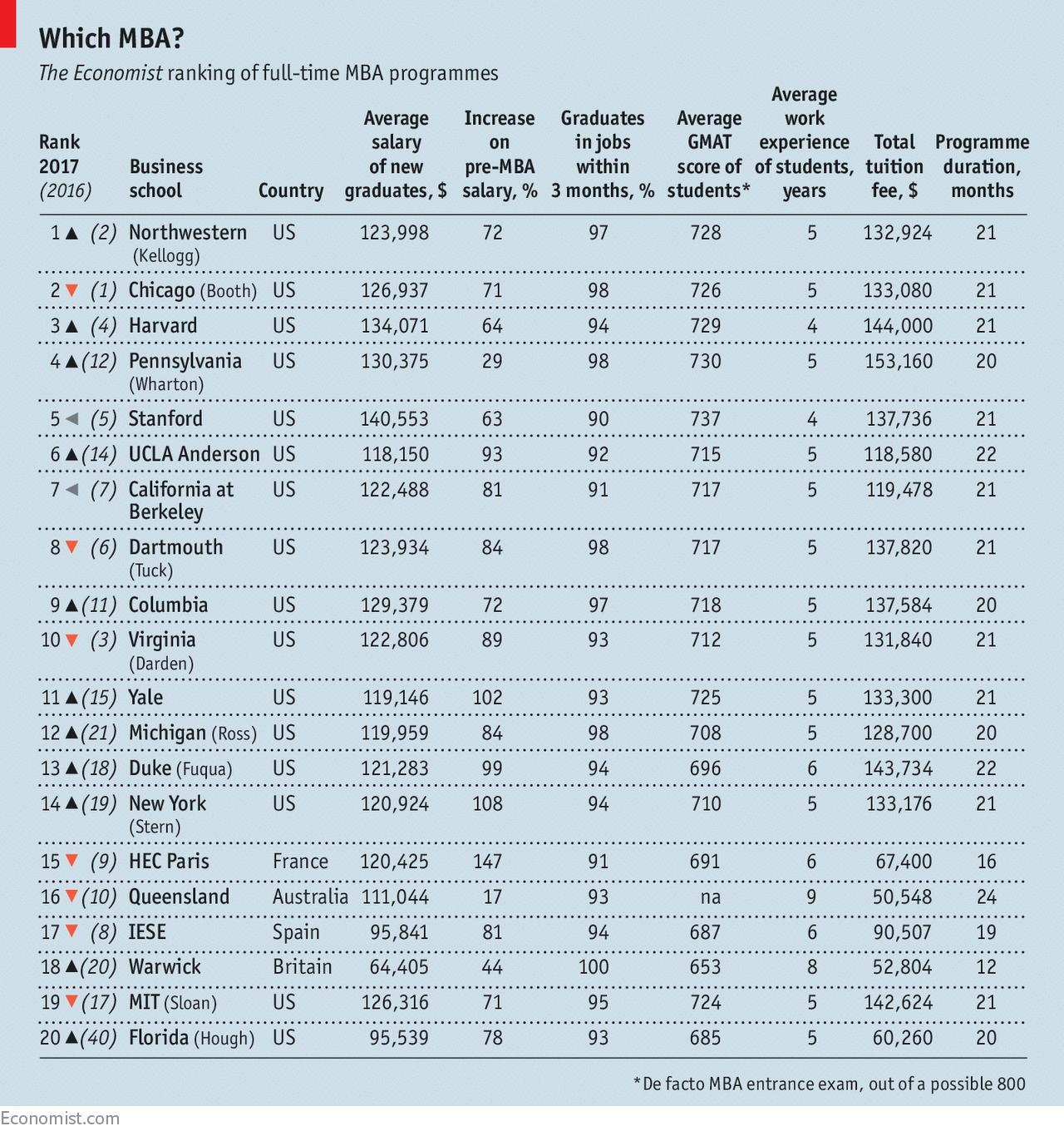
American business schools dominate The Economist’s 2017 Which MBA? ranking, taking 16 of the top 20 places. Northwestern University’s Kellogg School of Management returns to the top spot for the first time since 2004. Kellogg students praise its facilities and collaborative culture. Their career opportunities are among the best, thanks in part to one of the largest alumni networks in the world; 97% of students find a job within three months of graduation, pocketing a 72% pay bump. All of the top ten slots in the ranking are now occupied by large, prestigious American schools, for which students are happy to pay extra. Their average tuition fee is $134,600, and has risen quickly in recent years. Employers, too, are willing to shell out for the best students. Their average basic salary was $127,300, a 70% increase on their pre-MBA pay cheques. But life, like rankings, isn’t just about money. So we weight data according to what students tell us is important. The four categories covered are: opening new career…Continue reading
Apple should shrink its finance arm before it goes bananas

IT IS fashionable to say that tech firms will conquer the financial services industry. Yet in the case of Apple, it seems that the opposite is happening and finance is taking over tech by stealth. Since the death of Steve Jobs, its co-founder, in 2011, the world’s biggest firm by market value has sold hundreds of millions of phones with bionic chips and know-it-all digital assistants. But it has also grown a financial operation that is already, on some measures, roughly half the size of Goldman Sachs.
Apple does not organise its financial activities into one subsidiary, but Schumpeter has lumped them together. The result—call it “Apple Capital”—has $262bn of assets, $108bn of debt, and has traded $1.6trn of securities since 2011. It appears to be run fairly cautiously and is part of a thriving firm, but it still deserves scrutiny. Companies have a history of being hurt by their financial arms; think General Electric (GE) or General Motors (GM).
Apple Capital has lots…Continue reading
India’s new aviation policies are breathing life into a once-ailing sector

WHY would one of the world’s fastest-growing airlines buy a ten-seat propeller plane, when most of its customers fly on 200-seat jets? Switching to smaller, less efficient aircraft defies commercial logic. But it is an appealing thought for those living in isolated communities far from big airports. That is what India’s new regional connectivity scheme, Ude Desh Ka Aam Nagrik (UDAN) or “let the common man fly”, promises to offer. It uses subsidies to improve the commercial viability of seldom-used routes. It also caps half of the fares on such routes at 2,500 rupees ($38) per hour of travel. If properly implemented and funded, the scheme could become a powerful tool for spreading India’s economic wealth more evenly.
When Gulliver last reported on the aviation policies of Narendra Modi, India’s prime minister, there was little cause for optimism. At the time, Mr Modi was stonewalling a new policy aimed at resuscitating the ailing sector. Airlines…Continue reading
Fears that Xi Jinping is bad for private enterprise are overblown

FOR a moment it seemed China was reverting to Maoist economic management. On the sidelines of the Communist Party congress this month, an official told Xi Jinping that her village distillery sells baijiu, a potent spirit, for 99 yuan ($15) a bottle. Mr Xi, China’s most powerful leader since Mao, remarked that this seemed a bit dear. The chastened official thanked him and pledged to follow his guidance. But Mr Xi gestured her to stop. “This is a market decision,” he chuckled. “Don’t cut the price to 30 yuan just because I said so.” The audience, perhaps relieved that Mr Xi had no intention of dictating the price of booze, broke into laughter.
This rare spot of levity at the dreary five-yearly congress was telling. The occasion cemented Mr Xi’s unrivalled position at China’s apex. For companies, the question is what he will do with it. His vision can seem ominous. “North, south, east and west—the party is leader of all,” he intoned in a speech laying out his…Continue reading
The financial markets are not the whole economy

DONALD TRUMP is fond of pointing out that the stockmarket has reached many record highs under his presidency. It is a capricious measure to boast about, and one that may not fully reflect the concerns of those who voted for him and probably care more about real wage growth. A look at the ratio of stockmarket capitalisation relative to GDP shows that this measure is close to a record high. That led me to reflect on a sentence I wrote a few years ago: we are better at creating new claims on wealth than at creating wealth itself.
That sentence was written in the context of the huge rise in debt in the 40 years leading up to the 2008 crisis, and on the multiplication of obscure financial instruments that preceded it. It reflected the…Continue reading
Public-relations woes may be catching up with Uber
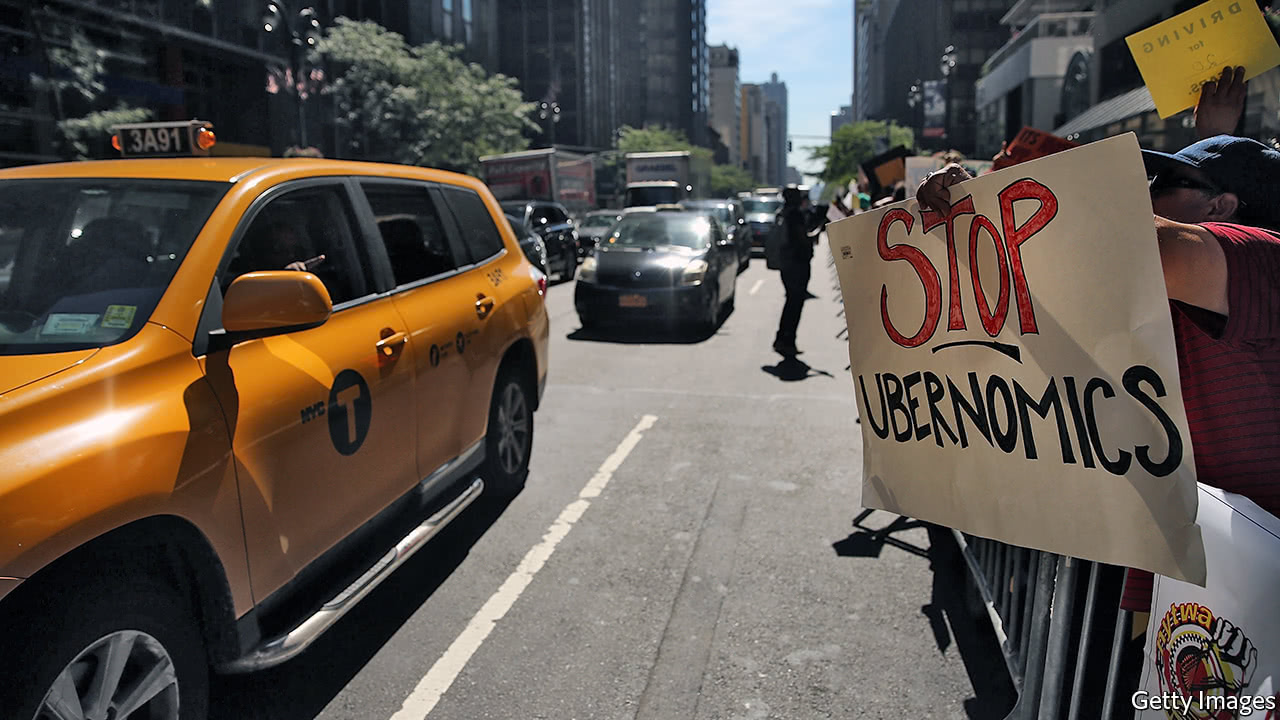
UBER has had a tough year. It has fired staff on the back of sexual-harassment allegations and faced reports of a hostile workplace culture. It has been sued for allegedly stealing self-driving-car technology. It lost customers when it flouted a New York taxi boycott in protest of President Donald Trump’s travel ban. And, amid all the turmoil, its boss resigned. But despite all this, the company continued to win more and more customers, including business travellers.
Now, however, there are signs that the tide may be turning. Certify, an expense-management software company, has released its latest quarterly report on business-travel spending in America. And for the first time since it started collecting data in 2013, Uber has seen a decline in use among business travellers.
Uber and other ride-hailing apps still dominate the business-travel market for ground transport, accounting for around two-thirds of it. And they are growing at the expense of traditional services. The market share of taxis and rental cars…Continue reading
Hotels are employing fewer concierges
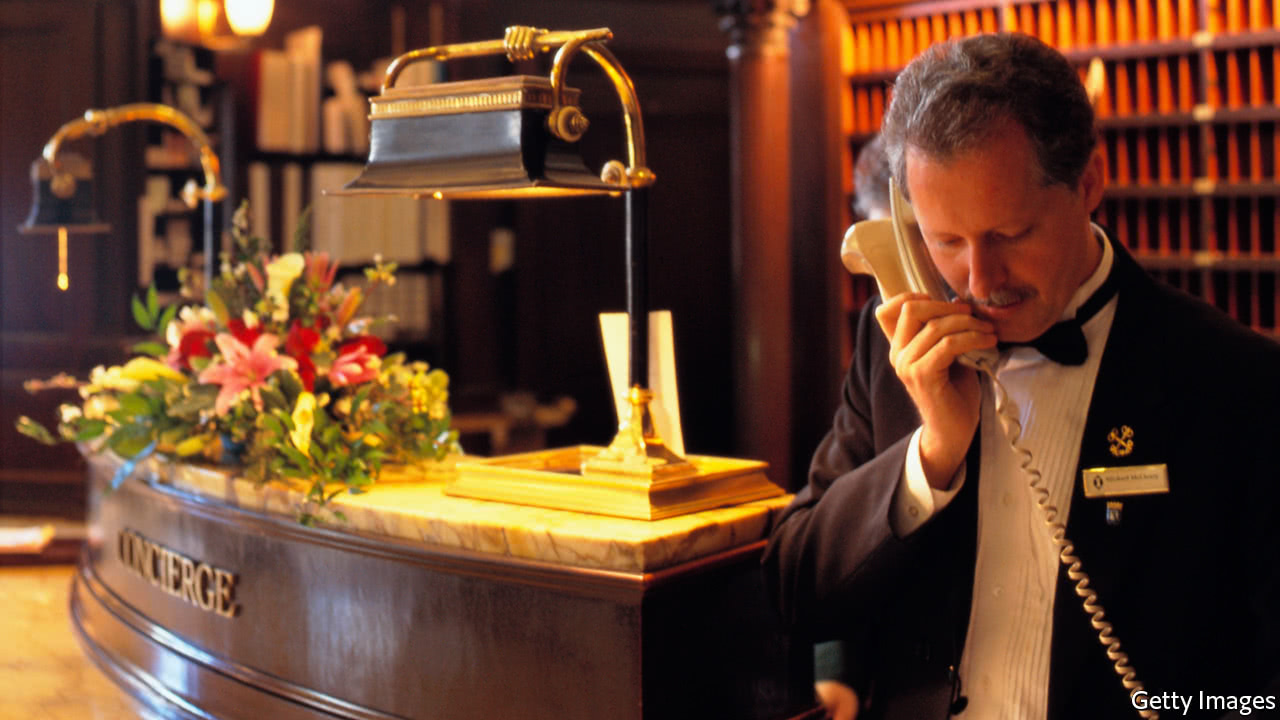
IF BUSINESS travellers need to reserve a table at a restaurant, they may use OpenTable, a website. If they wish to find a nearby museum, a Google search will probably be their first port of call. And if they want transport into town, they can easily hail an Uber. Given that so many services are just one swipe away, is there a need for a hotel concierge anymore?
Increasingly hoteliers think that there is not. The share of American hotels with concierges has fallen from 27% in 2010 to 20% last year, according to a report by the American Hotel and Lodging Association, a trade group. Since 2014 the number of luxury hotels that employ a concierge has declined by 20%.
Though concierges are not extinct quite yet, those that remain tend to work in upmarket establishments. In America 82% of luxury hotels employ concierges, as do 76% of “upper upscale” hotels, the second most glamourous category. After that concierges are a much rarer sight. Just 16% of “upscale” hotels have them. For…Continue reading