
Tag: Business and finance
How should recessions be fought when interest rates are low?

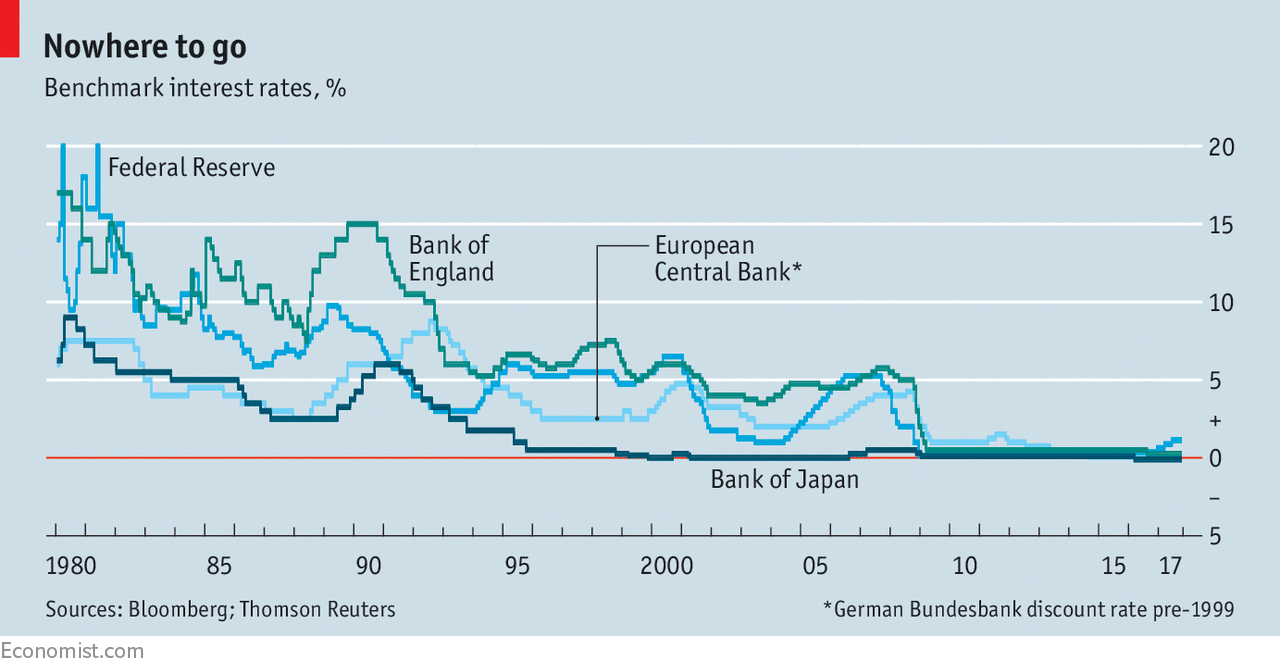
ONE day, perhaps quite soon, it will happen. Some gale of bad news will blow in: an oil-price spike, a market panic or a generalised formless dread. Governments will spot the danger too late. A new recession will begin. Once, the response would have been clear: central banks should swing into action, cutting interest rates to boost borrowing and investment. But during the financial crisis, and after four decades of falling interest rates and inflation, the inevitable occurred (see chart). The rates so deftly wielded by central banks hit zero, leaving policymakers grasping at untested alternatives. Ten years on, despite exhaustive debate, economists cannot agree on how to handle such a world.
Politics ensnares South Africa’s biggest asset manager

THE rot in South African politics, which has eaten away at state companies, is spreading. This week McKinsey, a consultancy, apologised for the “distress” it had caused the South African people. Political mud had already drowned Bell Pottinger, a British public-relations firm, and forced resignations at KPMG, an auditor. So the shenanigans at the government-owned Public Investment Corporation (PIC), have set off alarm bells. One concern is an apparent attempt to oust Dan Matjila, its boss. A linked worry is whether PIC funds will be used to prop up state businesses.
The PIC is a lucrative prize: it is Africa’s largest money manager, controlling 1.9trn rand ($140bn) of assets, mostly the pensions of state employees, and holding 11% of shares in South Africa’s biggest 25 companies. So anonymous allegations against Mr Matjila, including the claim that he had misdirected funds to his girlfriend’s business, naturally provoked a furore. On…Continue reading
Higher taxes can lower inequality without denting economic growth
INEQUALITY is one of the big political issues of the 21st century, with many commentators citing it as a significant factor behind the rise of populism. After all, nothing could be more indicative of the triumph of the common man than the elevation of a property billionaire to the American presidency.
A new IMF report* looks at how fiscal policy can help tackle inequality. In advanced economies, taxation already has an impact. The Gini coefficient (a standard measure of income inequality) is around a third lower after taxes and transfers than it is before them. But whereas such policies offset around 60% of the change in market inequality between 1985 and 1995, they have had barely any impact since.
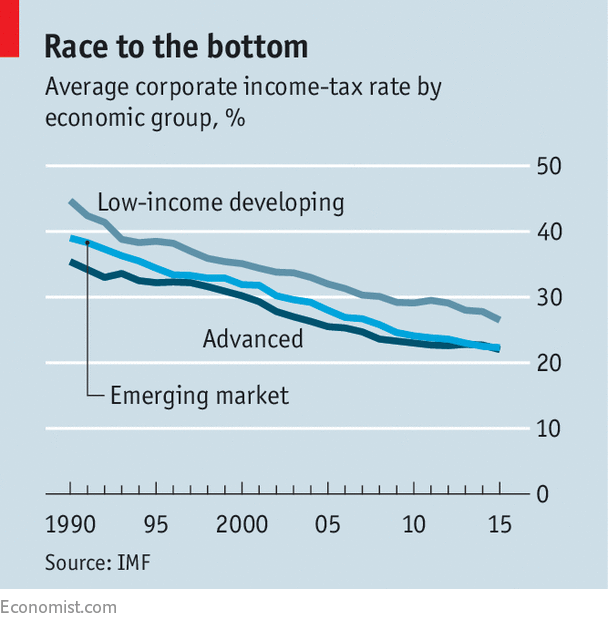
That is because of a change in policy direction. Across the West, taxes on higher incomes have generally fallen. This could be for a number of reasons, the IMF says. The tax take from high earners could have become more “elastic” (ie, sensitive to rate changes); in a mobile…Continue reading
Companies that burn up $1bn a year are sexy, dangerous, and statistically doomed
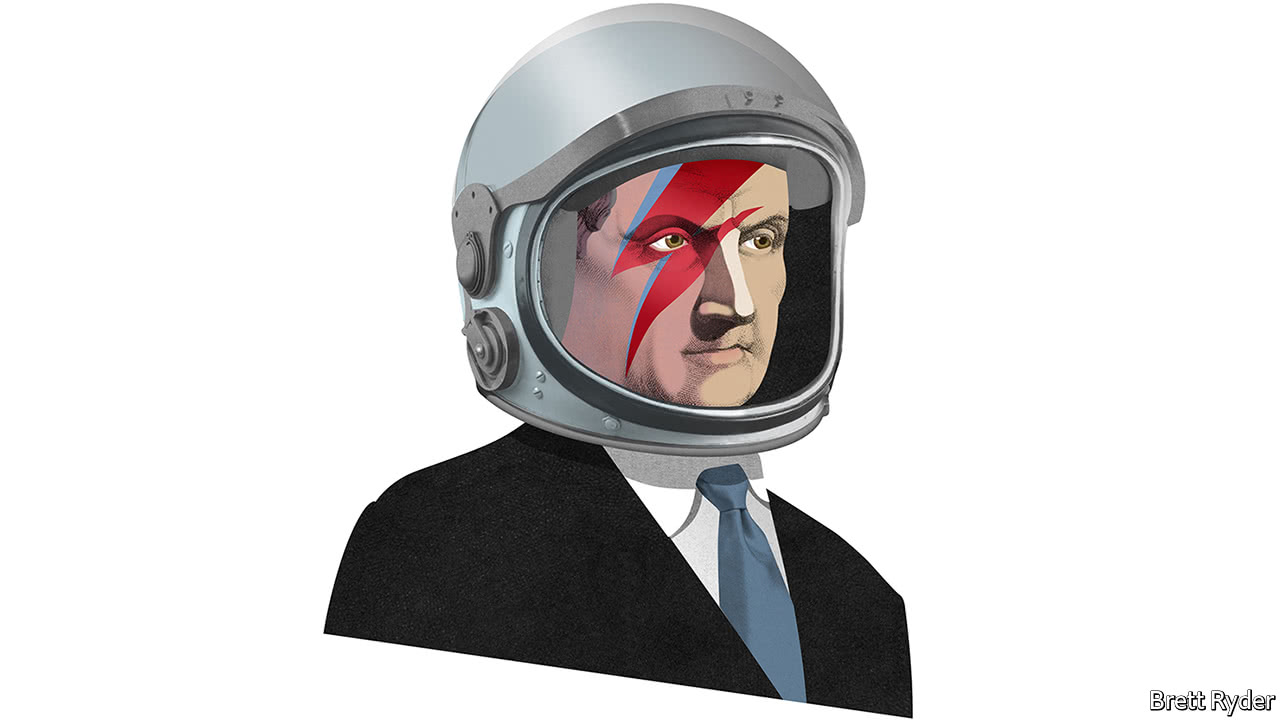
YVES SAINT LAURENT, Lady Gaga, David Bowie. Some people do not operate by the same rules as everyone else. Might the same be true of companies? Most bosses complain of being slaves to short-term profit targets. Yet a few flout the orthodoxy in flamboyant fashion. Consider Tesla, a maker of electric cars. This year, so far, it has missed its production targets and lost $1.8bn of free cashflow (the money firms generate after capital investment has been subtracted). No matter. If its founder Elon Musk muses aloud about driverless cars and space travel, its shares rise like a rocket—by 66% since the start of January. Tesla is one of a tiny cohort of firms with a licence to lose billions pursuing a dream. The odds of them achieving it are similar to those of aspiring pop stars and couture designers.
Investing today for profits tomorrow is what capitalism is all about. Amazon lost $4bn in 2012-14 while building an empire that now makes money. Nonetheless, it is rare for big companies to…Continue reading
Firms that burn up $1bn a year are sexy but statistically doomed
YVES SAINT LAURENT, Lady Gaga, David Bowie. Some people do not operate by the same rules as everyone else. Might the same be true of companies? Most bosses complain of being slaves to short-term profit targets. Yet a few flout the orthodoxy in flamboyant fashion. Consider Tesla, a maker of electric cars. This year, so far, it has missed its production targets and lost $1.8bn of free cashflow (the money firms generate after capital investment has been subtracted). No matter. If its founder Elon Musk muses aloud about driverless cars and space travel, its shares rise like a rocket—by 66% since the start of January. Tesla is one of a tiny cohort of firms with a licence to lose billions pursuing a dream. The odds of them achieving it are similar to those of aspiring pop stars and couture designers.
Investing today for profits tomorrow is what capitalism is all about. Amazon lost $4bn in 2012-14 while building an empire that now makes money. Nonetheless, it is rare for big companies to…Continue reading
On NAFTA, America, Canada and Mexico are miles apart

THESE are troubling times for Roberto Santana Flores, a Mexican maker of charro shirts, a modern take on the Mexican cowboy aesthetic. He recalls life before the North American Free-Trade Agreement (NAFTA), a trade deal linking Mexico with America and Canada. He remembers his shirts incurred a whopping 37.5% tariff if exported to America. Now they cross the border duty-free. But his dream of expanding his factory and his American customer base is under threat. He scours the newspapers daily for news of the NAFTA negotiations. They tell of conflict. Some even warn the deal may collapse. Since it covers trade worth more than $1trn a year, that is alarming for many more than Mr Flores.
On October 17th trade representatives of the three countries gathered to mark the end of the fourth round of talks. A collapse does not seem imminent. Robert Lighthizer, the United States Trade Representative (pictured, centre), denied that abandoning the deal was even being discussed,…Continue reading
When the revolution eats itself
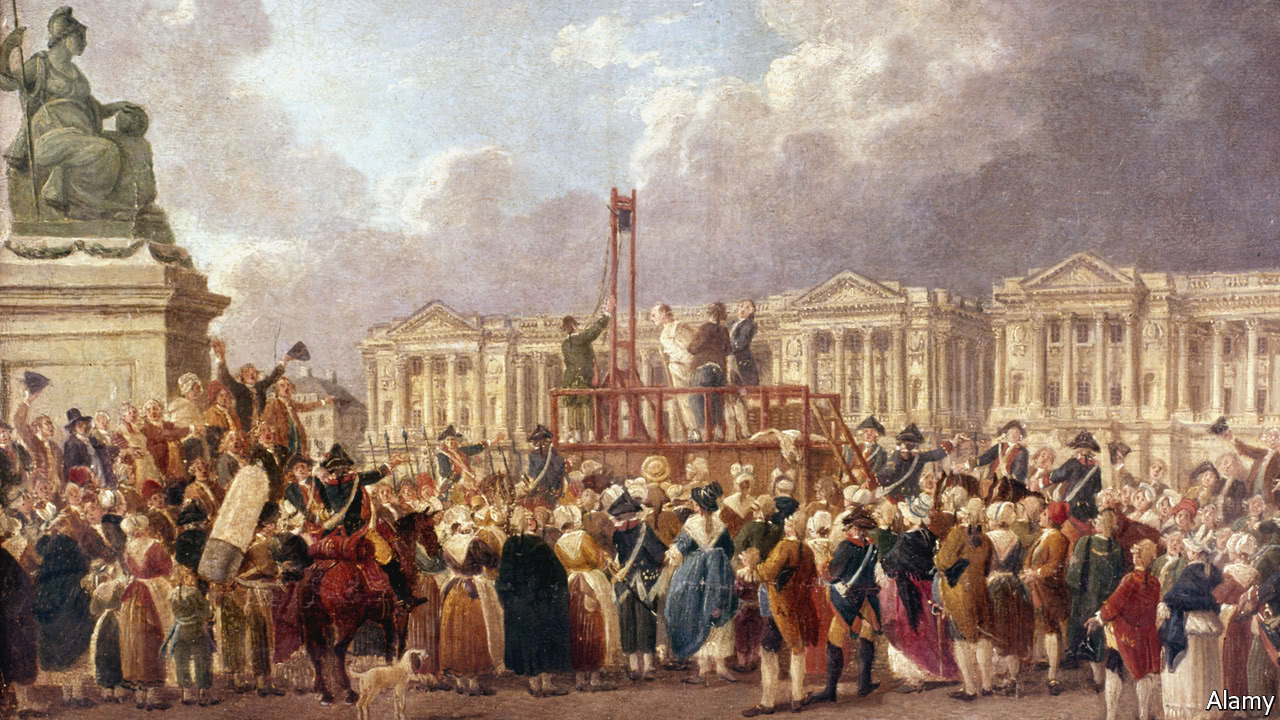
WHEN a revolution happens, the consequences are not obvious straight away. The British referendum on EU membership in June 2016 was seen as a revolt of ordinary people against a globalised elite. The politicians who led the Leave campaign did not seem to expect to win; as wags remarked, they were like «the dog that caught the car».
This helps to explain the general chaos that has enveloped British policy since the result. The Leave campaign had contained two contradictions. The first was that Britain could have all the advantages of EU membership without the bother of actually belonging; the country could «have its cake and eat it» as Boris Johnson, Leave campaigner and now foreign secretary put it. The second was the split between the free market, Liberal brexiters, who envisaged Britain as open to the world, and the nativist camp led by Nigel Farage.
Theresa…Continue reading
Economic optimism drives stockmarket highs
BARELY a day goes by at the moment without Wall Street hitting a new record high. The market has kept marching upwards despite all the headlines about the North Korean nuclear threat, a potential break-up of NAFTA, and natural disasters like hurricanes.
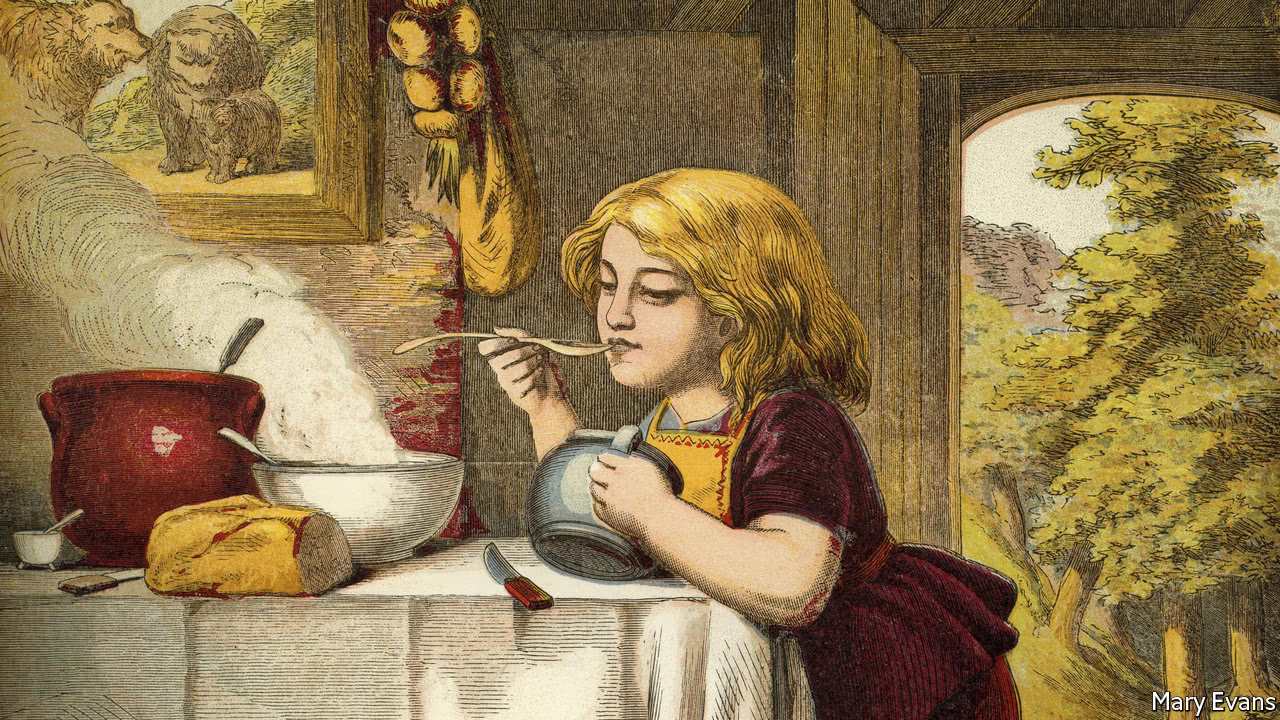
If you want to know why the market keeps rising, just look at the latest poll of global fund managers by Bank of America Merrill Lynch. Almost half of all the managers now expect above-trend growth and below-trend inflation, what is dubbed the Goldilocks economy (she wanted porridge that was not too hot, or too cold, but just right). That is the highest proportion recorded in the history of the survey. Indeed, for the last six years, a plurality of managers have taken the view that both inflation and growth would be below trend.
A net 41% of those managers think global growth will strengthen over the next 12 months. Putting their money behind those beliefs, a net 45% are overweight (have a higher holding than usual) in equities. A remarkable 85% of managers think bond…Continue reading
More airlines are offering free Wi-Fi for messaging services

AT A time when all aspects of air travel seem to come with a price tag, one service quite suddenly has become free. And it is not in-flight dining or checking in a bag or securing an exit-row seat.
The increasingly common free service is onboard messaging. Earlier this month, Delta Airlines began allowing passengers to use its Wi-Fi system to send free messages on third-party apps, such as iMessage, WhatsApp, and Facebook Messenger. Passengers can do so on their smartphones, laptops or tablets. (Mobile-network services, like 4G, tend to be unreliable after lift off). Delta is following the lead of Alaska Airlines, which rolled out a similar service earlier this year, as the Los Angeles Times reports, and American Airlines which announced its own plans to offer messaging in the near future.
Sadly, this is still a far cry from a free internet service. Airlines still charge for browsing and they have a…Continue reading
Carriers in America are doubling down on budget airfares

GLEN HAUENSTEIN, the president of Delta, is optimistic about the future of basic economy. On a conference call this week, he boasted that the stripped-down airfares actually act as an incentive for passengers to upgrade to the more expensive standard economy tickets. Despite Mr Hauenstein describing it as a product that “people don’t really want”, the airline says it will expand the revenue-boosting basic-fares system in 2018.
Delta was the first carrier to roll out basic economy fares—sometimes called “last class”—in America in 2012. Since then the model has caught on. Both American and United quickly introduced similar services on some domestic routes. By taking away a perk here and adding another there, each airline has created a unique version of the same miserable experience.
The new fare system is not without its critics. Many have