
Tag: Business and finance
Foreign executives need to get their feet dirty to succeed in Africa

NAIROBI, Kenya’s capital, is also known as the “Green City in the Sun”. It might as well be called the city of malls: it has never had such a wide choice. The newest outlet, named Two Rivers, sits on a road near the American embassy and contains no less than three different malls in the space of a square mile or so. Here, you can scoff a Burger King before wandering around a huge new Carrefour supermarket to stock up on French cheese, British-made breakfast cereals and Turkish-made clothes. The owners proudly proclaim that it is sub-Saharan Africa’s biggest mall. It is certainly among the glitziest.
And yet walking into Two Rivers is an odd experience. The scale is huge, but the place is eerily quiet. More than a few shopfronts are empty, with hoardings instead of windows. Those that are occupied have a mere trickle of customers, and the goods they sell—furniture, clothes, electronics—are ambitiously priced. Two Rivers feels a bit like a Potemkin village, projecting an illusion…Continue reading
America’s uncompetitive markets harm its economy
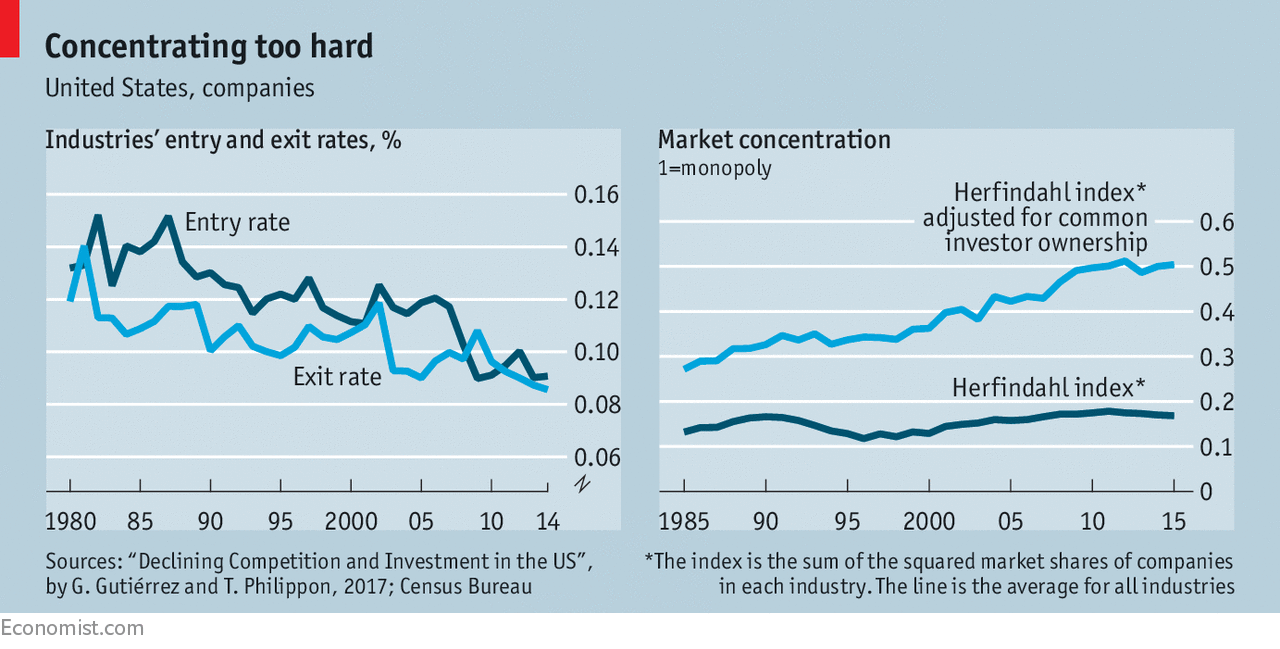
“THE best of all monopoly profits is a quiet life,” wrote Sir John Hicks, a British economist. Without competitors breathing down their necks, monopolists find it easy to make large profits: just ask the 46m American households served by only one fast-broadband provider, who pay high prices for poor service. As a result, trustbusting is one of those rare causes that can unite raging populists with sober academics. So the wonks may well have agreed with the sentiment, if not the fine detail, when Senate Democrats unveiled a fresh pledge on July 24th to make America competitive again as part of their economic agenda. “This economy is rigged,” insisted Senator Elizabeth Warren of Massachusetts. It is not quite that bad. But more than three-quarters of industries are more concentrated than they were two decades ago, and the economy is also seeing less turnover of firms (see charts).
It is easy enough for consumers to see the consequences when monopolists entrench themselves in one…Continue reading
The euro’s obituaries were premature
FIVE years ago, Mario Draghi, head of the European Central Bank, pledged to do “whatever it takes” to save the euro. At the time, many people were predicting that the euro zone would break up. But Mr Draghi pulled off the trick; no countries have left the single currency. Borrowing costs have come down and even Greece has been able to tap the markets.
Keeping the euro together may have been the aim of the game, but was it worth it? As M&G, the fund management group, points out, the record has been mixed. Economic growth has rebounded to a respectable 1.5% year-on-year. This is not stellar but it is hard for the euro zone to grow rapidly when its population is ageing; the IMF suggests a greater proportion of older workers may weigh on productivity growth.
Of course, the euro zone could get more of the current…Continue reading
A high-speed rail connection between Hong Kong and the mainland is proving controversial

ON JULY 1st Hong Kong marked 20 years of mainland rule with a rare visit from Xi Jinping, the Chinese premier. Mr Xi arrived on an Air China flight from Beijing. The next visit by a Chinese president is unlikely to take place until 2022, when Hong Kong will be half way through its 50-year transition period between British and Chinese rule. Then, perhaps, he will travel by high-speed rail, and arrive at a smart terminal being built in West Kowloon.
Hong Kong is in the midst of an infrastructure-building boom. Work on a third runway at Chek Lap Kok airport began last year. Just outside, the finishing touches are being made to a 40-kilometre (25-mile) bridge-and-tunnel road linking Hong Kong, Macau and Zhuhai. And by next year a new rail line will connect Hong Kong to Guangdong and the rest of China’s high-speed network.
Trains on the “XRL” can travel up to 350km/h (although it is estimated that it will take 14 minutes to travel the 26km between Kowloon and Futian, making the actual speed more like 110km/h at first). The…Continue reading
Has Ryanair become too nice?
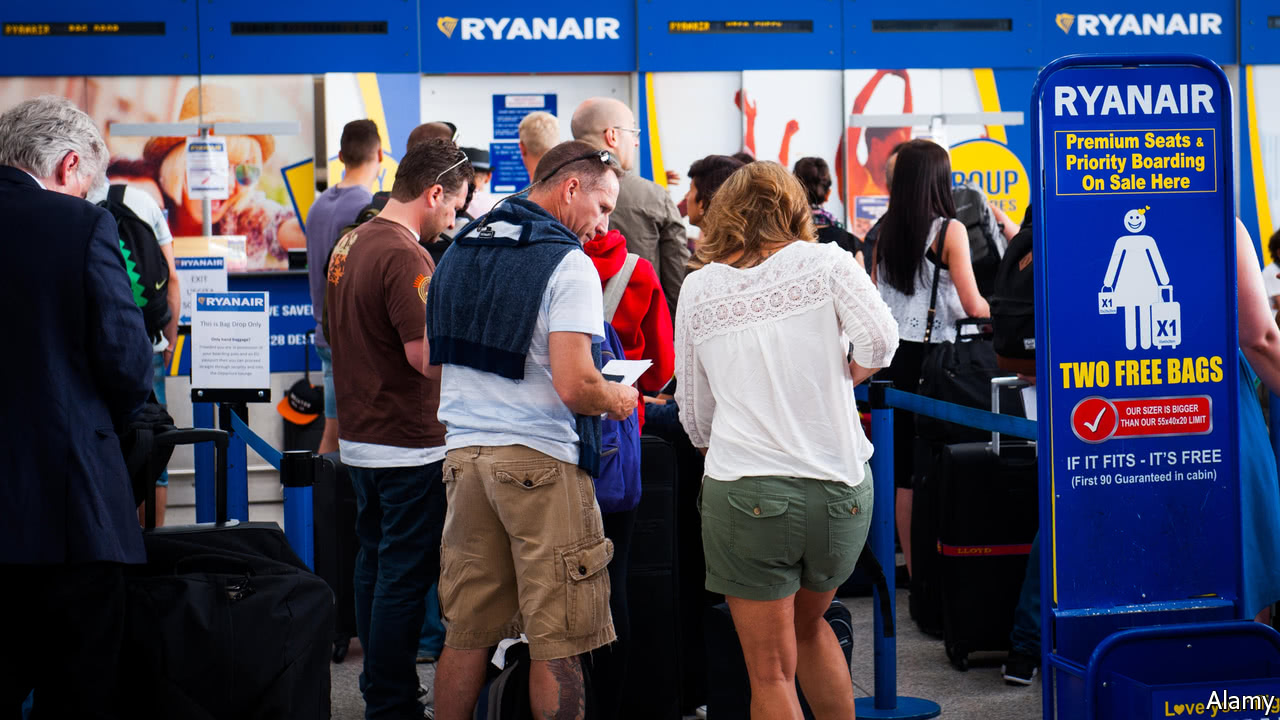
THREE years ago, Ryanair, Europe’s biggest budget airline, made the sudden decision to be nicer to its customers. Before that, brusqueness had been part of its strategy. Fares were low, but check-in staff were famously ruthless. One family was charged €600 ($701) to print their forgotten boarding passes (“idiots” according to Michael O’Leary, the airline’s boss, when they complained). Gatekeepers would obsessively check carry-on bags, demanding huge fees for those a smidgen over the limit. That culture started at the top. Mr O’Leary liked to berate his passengers, the second their expectations rose. “You’re not getting a refund so fuck off. We don’t want to hear your sob stories. What part of ‘no refund’ don’t you understand?», he once told them.
It was a highly successful, perhaps even clever, strategy. The airline went from being an insignificant Irish operator to Europe’s second largest carrier after Lufthansa, regularly reporting juicy profits. Every time Mr O’Leary mooted the idea of installing…Continue reading
Thanks to streaming services, China’s consumers have begun paying for music

HONEST souls intent on paying full whack for the music they listen to used to have a hard time in China. In the era of compact discs, rare was the shop which did not sell counterfeits. The same held true when discs turned into downloads and online streams of songs: hardly any service charged money.
Slowly but surely, China is becoming a market where people pay for music. Over the past five years, digital-music revenues for the recording industry nearly quadrupled, to $195m; most of that amount comes from music streaming (see chart). That sum may still be a tiny fraction of the global total of $7.8bn, but streaming has clearly taken off in China.
 Continue reading
Climate change might prevent airlines from flying full planes

THIS summer America has experienced some of the most intense heatwaves in decades. In parts of southern Arizona the mercury has climbed to a sweltering 48°C. That has had an impact on the state’s infrastructure. Last month, a single day’s heatwave grounded dozens of planes. As global temperatures climb higher, such incidents are likely to increase.
Climate change could have a dramatic impact on aviation across the world, according to a recently released paper by a team from Columbia University and Logistics Management Institute, a consulting firm. The researchers predict that as early as the middle of the century, some 30% of flights departing during the most blistering parts of the day will not be able to take off at their maximum weight because the hotter, less dense air will not provide enough lift.
Of the 19 airports examined, Dubai and LaGuardia in New York are expected to see some of the worst effects. During the harshest…Continue reading
Climate change might prevent airlines flying full planes
THIS summer America has experienced some of the most intense heatwaves in decades. In parts of southern Arizona the mercury has climbed to a sweltering 48°C. That has had an impact on the state’s infrastructure. Last month, a single day’s heatwave grounded dozens of planes. As global temperatures climb higher, such incidents are likely to increase.
Climate change could have a dramatic impact on aviation across the world, according to a recently released paper by a team from Columbia University and Logistics Management Institute, a consulting firm. The researchers predict that as early as the middle of the century, some 30% of flights departing during the most blistering parts of the day will not be able to take off at their maximum weight because the hotter, less dense air will not provide enough lift.
Of the 19 airports examined, Dubai and LaGuardia in New York are expected to see some of the worst effects. During the harshest…Continue reading
Reform of China’s ailing state-owned firms is emboldening them
ACCORDING to company lore, Yunnan Baiyao, a musty-smelling medical powder, played a vital role during the Long March. As China’s Communist troops fled from attacks in the 1930s, trekking thousands of miles to a new base, they spread its yellow granules on their wounds to stanch bleeding. To this day, instructions on the Yunnan Baiyao bottle recommend application after being shot or stabbed. Many Chinese households keep some in stock to deal with more run-of-the-mill cuts. But the government has recently put its maker into service to treat a different kind of ailment: the financial weakness of state-owned enterprises (SOEs).
Yunnan Baiyao has emerged as a poster-child of China’s new round of SOE reform. The company, previously owned by the south-western province of Yunnan, sold a 50% stake to a private investor earlier this year. The same firm had tried to buy a slice of Yunnan Baiyao in 2009 but was blocked. Its success this time has been held up in the official press as proof that a…Continue reading
Could bond funds break the market?
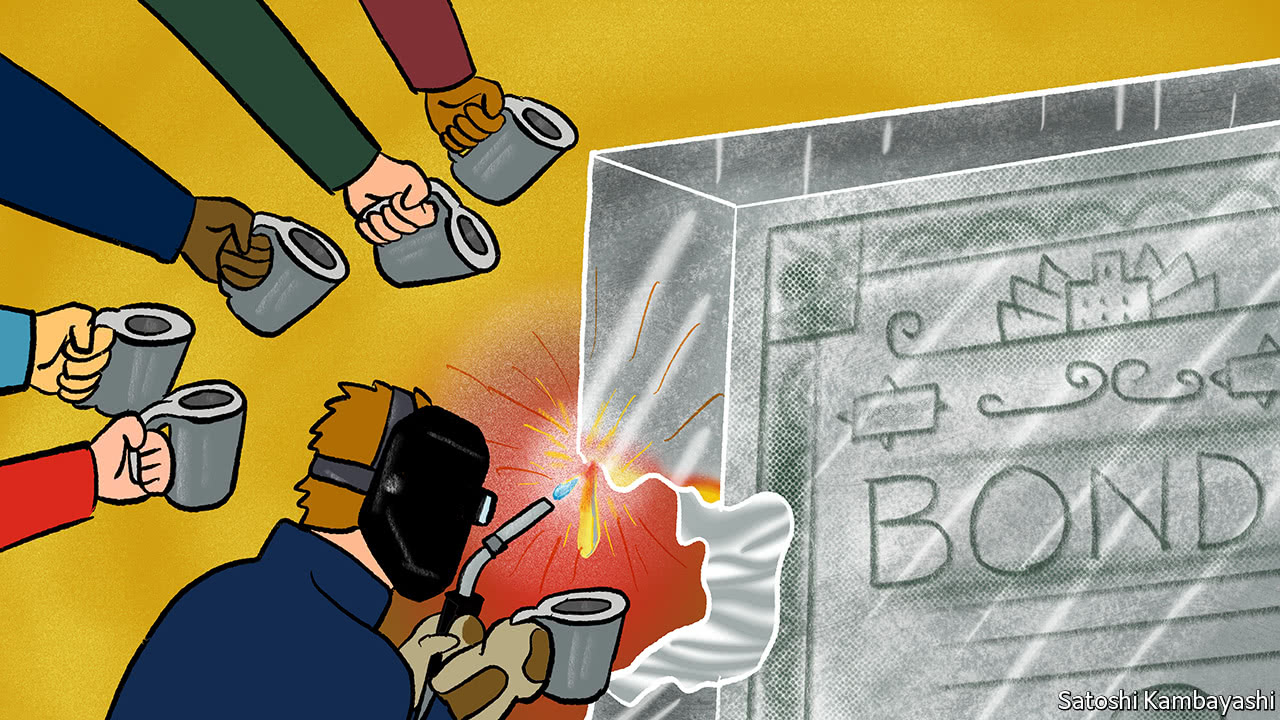
GOOD generals know that the next war will be fought with different weapons and tactics from the last. Similarly, financial regulators are right to worry that the next crisis may not resemble the credit crunch of 2007-08.
The last crisis arose from the interaction between the market for mortgage-backed securities and the banking system. As investors became unsure of the banks’ exposure to bad debts, they cut back on their lending to the sector, causing a liquidity squeeze. Since then, central banks have insisted that commercial banks improve their capital ratios to ensure they are less vulnerable.
Might the next crisis originate not in the banking system, but in the bond market? That is the subject of a new paper* from the Bank of England. The worry centres on the “liquidity mismatch” between mutual funds, which offer instant redemption to their clients, and the corporate-bond market, where many securities may be hard to trade in a crisis. The danger is that forced…Continue reading