
Tag: Business
India's Patanjali takes on Western consumer-goods firms

EXECUTIVES at firms selling consumer staples like to think of themselves as “marketing gurus”. But how many could actually contort themselves into the lotus position, let alone attempt a headstand? Such feats are nothing for the top brass at Patanjali, an Indian purveyor of toothpaste, cooking oil, herbal concoctions and much else. Fronted by a bona fide guru, the firm’s marketing strategy—play up the benefits of natural products, then paint foreign multinationals as latter-day imperialists—delivers over $1bn in annual sales, up tenfold in four years. Having dismissed the firm as a fad, the likes of Colgate-Palmolive and Unilever are emulating it.
Baba Ramdev (pictured), an ascetic yogi who is the public face of the brand, makes for an unconventional capitalist symbol. But with Acharya Balkrishna, a devotee of his who serves as the firm’s boss and majority-owner, he has built a consumer-goods powerhouse that is vying with the business-school graduates at the multinationals. Starting out two decades ago as an apothecary of traditional Ayurvedic potions, Patanjali has expanded into personal care, home products, packaged food and more. Mr Ramdev’s beard and saffron…Continue reading
A giant cement firm may have unwittingly funded Islamic State

KEEPING cool in the heat of war is not easy. That might help explain why LafargeHolcim, a French-Swiss cement-maker, blundered so badly while running operations in Syria as fighting raged. On April 24th the firm said that its chief executive, Eric Olsen, will go, a casualty of a growing scandal over its activities in the country.
The board of the world’s biggest cement producer stated only last month that Mr Olsen was not responsible for, nor aware of, wrongdoing by the firm in Syria. But public pressure has been increasing, notably after Jean-Luc Mélenchon, a left-wing candidate in France’s presidential election, attacked the firm and its “damned cement” in a television debate on April 4th. François Fillon, a pro-business rival, agreed the firm should be punished if allegations against it proved to be true.
At issue is the activity of Lafarge before the firm’s merger with its Swiss rival, Holcim, in 2015. In 2010 Lafarge had built a cement factory of 240 workers for $680m near Kobane, a north Syrian town. Operations there continued until 2014, long after the violence began in 2011. The firm evacuated foreigners in 2012; local workers fled in…Continue reading
French businesses relish the prospect of President Macron
THE likely election of Emmanuel Macron as France’s president, in a run-off vote on May 7th, has corporate leaders in a state of high anticipation. French politicians with business experience rarely prosper. It is nearly half a century since Georges Pompidou won office in 1969 on the back of a private-sector career partly at Rothschild, an investment bank. The sitting president, François Hollande, roused voters in 2012 by declaring that his “true enemy” was the world of finance. Mr Macron’s own stint at Rothschild, advising on mergers from 2008 to 2012, included handling a $12bn acquisition of a unit of Pfizer, a pharma firm, by Nestlé, a consumer-goods giant.
Markets rose and bond yields fell after Mr Macron won the first round on April 23rd. His second-round opponent, Marine Le Pen of the far right, dismays business—one investor admits re-registering his firm as European rather than French, the better to shift headquarters were she to win. But Mr Macron is favourite.

A chief of a big firm headquartered in Paris speaks of new optimism for France’s economy if Mr Macron wins. Business indicators are improving; measures of corporate confidence in…Continue reading
Technology firms and the office of the future
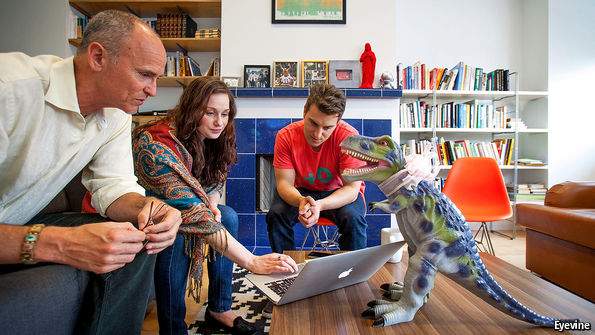
FROM the 62nd floor of Salesforce Tower, 920 feet above the ground, San Francisco’s monuments look piddling. The Bay Bridge, Coit Tower and Palace of Fine Arts are dwarfed by the steel-and-glass headquarters that will house the software company when it is completed later this year. Subtle it is not. Salesforce plans to put on a light show every night; its new building will be visible from up to 30 miles away.
It is not the only technology company erecting a shrine to itself. Apple’s employees have just begun moving into their new headquarters in Cupertino, some 70 kilometres away, which was conceived by the firm’s late founder, Steve Jobs. The four-storey, circular building looks like the dial of an iPod (or a doughnut) and is the same size as the Pentagon. At a price tag of around $5bn, it will be the most expensive corporate headquarters ever constructed. Apple applied all its product perfectionism to it: the guidelines for the wood used inside it reportedly ran to 30 pages.
Throughout San Francisco and Silicon Valley, cash-rich technology firms have built or are erecting bold, futuristic headquarters that convey their brands to employees and customers….Continue reading
A Form 10-K for America’s government

WHEN he was running Microsoft, Steve Ballmer was famous for his energy. In a legendary clip of a company meeting that has received almost a million hits on YouTube, he charges onto the stage and launches into his “monkey dance”, before roaring into a microphone: “I love this company!” Mr Ballmer stood down from the software giant in 2014 and has new outlets for his drive. One is the LA Clippers, a basketball team he bought for $2bn. The other could not be more different: a project to create a Form 10-K, a type of corporate report, for America’s dysfunctional government. That is more revolutionary than it sounds.
In most walks of life, 10-K denotes a long-distance run or a sum of money. In the investment world it refers to the report that American regulators force all listed companies to publish once a year. Investors have a near-religious reverence for 10-Ks. They are the global gold standard of corporate disclosure: 300 or so warts-and-all pages that contain a firm’s financial accounts and describe its objectives, conflicts of interests, governance, risks and flaws. Fund managers scour the documents to ensure that firms’ executives are not fibbing. Bosses study…Continue reading
Steven Mnuchin gets started on tax reform but there is more to do

OF THE things that investors and bosses have come to like about Donald Trump, the most important is his promise to redraw America’s knackered corporate-tax system. On April 26th Steven Mnuchin, the treasury secretary, laid out a guide for reform. After weeks of anticipation, Wall Street will be relieved. The thrust of the plan is just what business folk want—a simpler system, with lower bills. But whether it helps the wider economy and ordinary citizens remains to be seen. And Mr Trump will have to push the reforms through a bitterly divided Congress.
The actual tax rate America’s businesses pay in aggregate, of 20-25%, is much lower than the high, headline federal tax rate, of 35%. But in the home of free enterprise the taxman’s treatment of business is a muddle. There are three distortions. First, the treatment of overseas profits. Unlike most countries America taxes them when they are remitted back home, at high rates. The result is that American firms refuse to repatriate all their earnings, and collectively stash some $1trn of cash abroad.
The second distortion is that loopholes encourage firms to change their legal status from ordinary…Continue reading
Small flying “cars” come a bit closer to reality

“YOU may smile, but it will come,” said Henry Ford in 1940, predicting the arrival of a machine that was part-automobile and part-aeroplane. For decades flying cars have obsessed technologists but eluded their mastery. Finally there is reason to believe. Several firms have offered hope that flying people in small pods for short trips might become a reality in the next decade. These are not cars, as most are not fit to drive on land, but rather small vehicles, which can rise and land vertically, like quiet helicopters.
A prototype of a small electric plane capable of flying up to 300 kilometres per hour, made by Lilium, a German startup, completed a successful test over Bavaria on April 20th. Lilium is starting work on a five-seat vehicle and hopes to offer a ride-hailing service. Another German firm, e-volo, has been testing a flying vehicle for several years. It recently showed off the second version of its electric Volocopter (pictured), which could be certified for flight as soon as next year.
There are at least a dozen firms experimenting with making small flying vehicles in different guises, including Airbus, an aerospace giant, in partnership with…Continue reading
Another debate about net neutrality in America

THE details around network neutrality, the principle that internet-service providers (ISPs) must treat all sorts of web traffic equally, can be mind-numbingly abstruse. But they fuel passion, nonetheless. After Tom Wheeler, a former chairman of America’s Federal Communications Commission (FCC), proposed unpopular net-neutrality rules in late 2014, for instance, protesters blocked his driveway, forcing him to walk to work. Their action was meant to illustrate the threat of big ISPs erecting toll-booths and other choke-points that would relegate less well-off consumers to digital slow lanes.
Now it is the turn of Ajit Pai (pictured), Mr Wheeler’s successor, to stir the hornets’ nest. In the coming days Mr Pai is expected to unveil a proposal for new rules on net neutrality. His plan is anticipated to be a testament both to his deregulatory agenda and to the big ISPs’ lobbying power. It would essentially take the FCC out of the equation when it comes to policing the smooth running of the internet.
Because of the protests in 2014 and because of a court decision that year suggesting that the FCC needed the jurisdiction to be able to mandate net-neutrality…Continue reading
Japanese fast-food chains feel a squeeze
 Three-star service
SHIMMERING spreads of raw fish sashimi, succulent beef from massaged cows, and, for a decade, the capital with the most Michelin-starred restaurants: few nations rival Japan for fine dining. Its fast-food scene has also thrived for centuries. From the 1700s bowls of cold soba noodles, made from buckwheat, were cycled to wealthy clients on towering trays. Sushi began to glide past customers in 1958, when the first conveyor belt was installed. In 1970 its first homegrown hamburger chain opened, a year before McDonald’s entered the market.
Fast-food chains continued to be a rare bright spot for Japan during its two-decade-long economic slump. Since 2008 the size of the market has increased from $35bn to $45bn (those figures include convenience stores, or konbini); that of restaurants has declined every year in that period. But fast food is now being squeezed: by a combination of higher wages and still-tepid consumption, and by foreign rivals winning over more Japanese stomachs.
Tomoaki Ikeda, president of Yudetaro, a soba chain in the greater Tokyo…Continue reading
AkzoNobel, under siege, makes unrealistic promises about growth

THE future for AkzoNobel is dazzling—if you believe Ton Büchner, its chief executive. The boss of the Dutch paint-and-coatings firm reported a solid set of quarterly earnings on April 19th, then promised a new era of rapid growth and investments. Shareholders are to get lavish dividends this year. The firm will break up its ungainly conglomerate structure. A speciality-chemicals part of the business will be sold or listed separately next year.
Mr Büchner has no choice but to talk things up, if he is to justify rebuffing two recent takeover offers from a similar-sized American rival, PPG. Its latest bid, of €22.5bn ($24bn) in cash and shares, represented a 40% premium over Akzo’s market value before the first bid. An activist fund, Elliott Management, which has a 3% stake in Akzo, is pushing other shareholders to demand discussion of the bid.
Akzo’s promises were welcome. But like a newly opened tin of paint, they made some heads spin. After years of eking out smallish gains mostly through cost-cutting, the firm is suddenly to boom. Akzo had previously forecast that returns on sales would be 11% by 2018, already well over its average of less than 9%…Continue reading