
Tag: Business
Sinclair Broadcast buys Tribune Media
AT A time when ever fewer people are watching television, it may seem improbable that the owners of local TV stations in America want to expand their empires. It turns out that they can hardly wait. On May 8th, just 18 days after a change in federal rules made the deal possible, Sinclair Broadcast Group announced that it would buy Tribune Media in a transaction worth $6.6bn, beating out interest from others including 21st Century Fox, which is owned by Rupert Murdoch. Sinclair will become America’s dominant owner of local TV stations.
The deal signals a broader interest in expanding what has been a surprisingly decent business in recent years. In America local TV stations tend to affiliate themselves with a national broadcast network, transmitting its content, including live sports. In exchange the stations make substantial payments. Despite falling viewership of network TV, the economics of local-station ownership have remained robust for two reasons.
First is the resilience of local TV advertising, especially in election years, says Mark Fratrik of BIA/Kelsey, a media consultancy. The ability of small TV stations to reach specific areas for local political races has proved difficult to match.
Second, TV stations have tapped a new vein of cash: retransmission fees, the payments they command from cable- and satellite-TV providers for their consent…Continue reading
The super-connector airlines face a world of troubles

WHEN a video of a passenger being dragged off a United Airlines flight went viral last month, the American carrier’s Middle Eastern rivals were quick to mock its customer service. Qatar Airways updated its smartphone app to say it “doesn’t support drag and drop”. The ribbing was justified. Over a decade of expansion, Qatar Airways, along with Emirates of Dubai, the world’s largest airline by international passenger miles travelled, and Etihad Airways of Abu Dhabi, wowed customers with superior service and better-value fares.
Passengers joined them in droves, abandoning hub airports in America and Europe as well as the airlines that use them. Over the past decade the big three Gulf carriers and Turkish Airlines trebled their passenger numbers, to 155m in 2015 (see chart). They went a long way to dominating long-haul routes between Europe and Asia. Most international airlines rely on travellers going from or to their home countries, but customers of the four “super-connectors”,…Continue reading
Management lessons from an American general

STANLEY MCCHRYSTAL’S voice is hoarse as he addresses a packed arena in Helsinki. His audience, mostly businessmen in dark suits, is rapt. The American former general tells thrilling battlefield stories of leading the Joint Special Operations Command in Iraq, which captured Saddam Hussein and killed Abu Musab al-Zarqawi, al-Qaeda’s local chief. He explains how his outfit adapted against an unexpectedly difficult enemy. A change in management style let his group go from conducting a handful of raids each month to hundreds, achieving better results against insurgents.
Neither America’s occupation of Iraq nor Mr McChrystal’s military career ended well. He went on to lead Western forces in Afghanistan, but stood down in 2010 after falling out with his political bosses. He reinvented himself as a management consultant. His McChrystal Group employs 65 people. It draws on its founder’s experience hunting insurgents to advise businesses,…Continue reading
A boss’s guide to fending off an activist attack

MODERN bosses are a resilient bunch who can handle everything from Twitter storms to takeovers. But one thing drives many of them berserk: activist hedge funds, which buy stakes in companies and lobby for change. Last month Klaus Kleinfeld, the boss of Arconic, an industrial firm, succumbed to a bout of “activist apoplexy”. He sent a confidential letter to Paul Singer, head of Elliott Management, a fund that was trying to oust him. Its mysterious references to parties during the 2006 football World Cup in Germany and to a feather headdress seemed to be a threat to expose details about Mr Singer’s personal life. Mr Kleinfeld, who had spent over a decade running big listed firms including Siemens and Alcoa, resigned when his board found out.
Bosses feel that they are being stalked by activists. Elliott is now in a confrontation with Akzo Nobel, a Dutch chemicals firm that is using a poison pill to resist a takeover by PPG, an American rival. Since 2010, on average, 8% of…Continue reading
Donald Trump’s family and a controversial visa scheme

THE events seemed inconspicuous enough: presentations in smart hotels in Beijing and Shanghai seeking investors for luxury American apartments. The details might have gone unnoticed had not a journalist from the Washington Post heard about the event’s star attraction. But these days the surname “Kushner” is like a magnet. It quickly emerged that Nicole Meyer, sister of Jared Kushner, Donald Trump’s son-in-law and senior adviser, spoke in her pitch on May 6th to prospective investors about her powerful brother. One slide (pictured) that was shown to the audience included a photo of Mr Trump himself.
The affair underlined potential conflicts of interest surrounding Mr Trump’s family members and their businesses. Mr Kushner is not directly involved in the family firm. But Kushner Companies later apologised if Ms Meyer’s name-dropping “was in any way interpreted as an attempt to lure…Continue reading
How America’s two tech hubs are converging
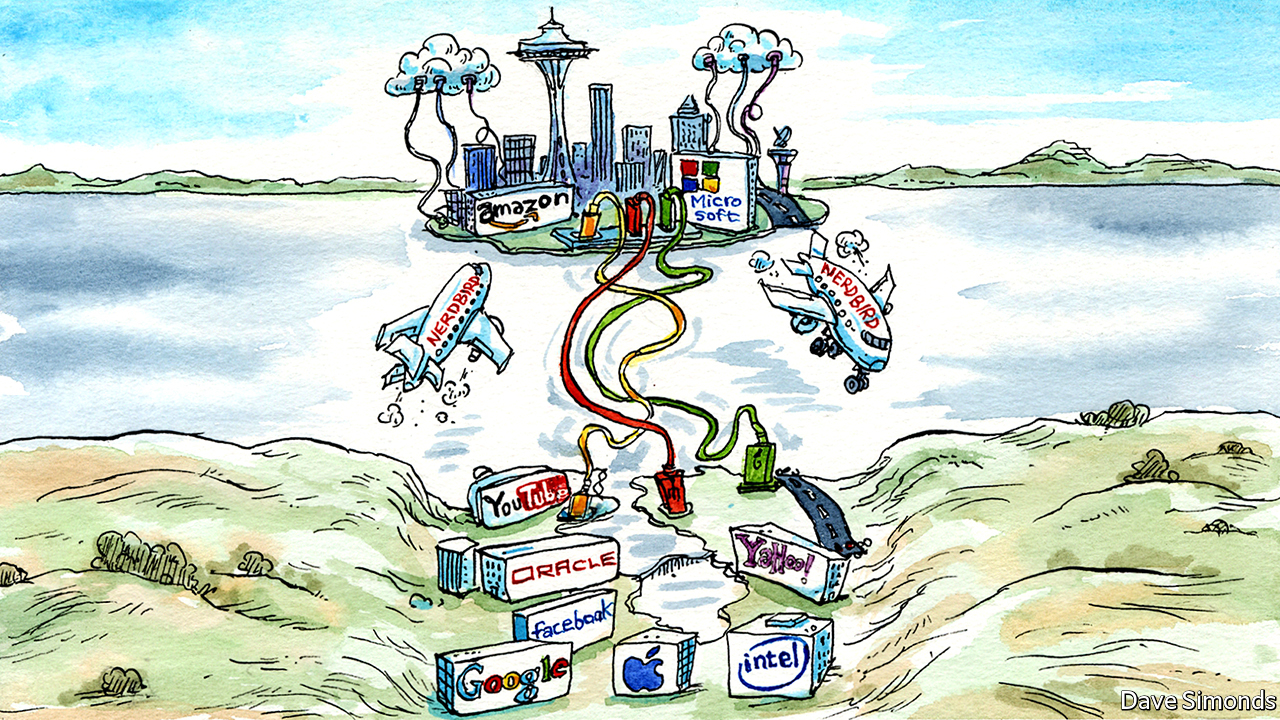
WOULD your region care to be the next Silicon Valley? In most of the world’s technology hubs, local leaders scramble to say “yes”. But ask the question in and around Seattle, the other big tech cluster on America’s west coast, and more often than not the answer is “no”—followed by explanations of why the city and its surrounds are different from the San Francisco Bay Area. The truth may be more complex: in recent years the Seattle area has become a complement to the valley. Some even argue that the two regions, though 800 miles (1,300km) apart, are becoming one.
They have similar roots, notes Margaret O’Mara, a historian at the University of Washington (UW). Each grew rapidly during a gold rush in the 19th century. Later both benefited from military spending. Silicon Valley ultimately focused on producing small things, including microprocessors, and Seattle on bigger ones, such as aeroplanes (Boeing was for decades the city’s economic anchor). This difference in dimension…Continue reading
America’s food-truck revolution stalls in some cities
 The burghers rise up
IT WAS in 2008 that an out-of-work chef named Roy Choi began selling $2 Korean barbecue tacos from a roaming kitchen on wheels, tweeting to customers as he drove the streets of Los Angeles. Mr Choi’s gourmet food truck has since inspired a reality-TV programme and a hit Hollywood film, and helped jumpstart a $1.2bn industry.
Within the food industry, the food-truck business, built on unique dishes, low prices and clever use of social media, is the fastest-growing segment. Restaurants fret about an army of trucks stealing customers but such concerns are unwarranted. According to the Bureau of Labour Statistics, counties that have experienced higher growth in mobile-food services have also had quicker growth in their restaurant and catering businesses.
Although many cities have treated food trucks as a fad, a nuisance, or a threat to existing businesses, others have actively promoted them. Portland, Oregon, known for its vibrant culinary scene, has had small food carts on its streets for decades. After a study in 2008 by researchers at Portland State University concluded that the carts benefited residents, the city…Continue reading
Axel Springer’s digital transformation
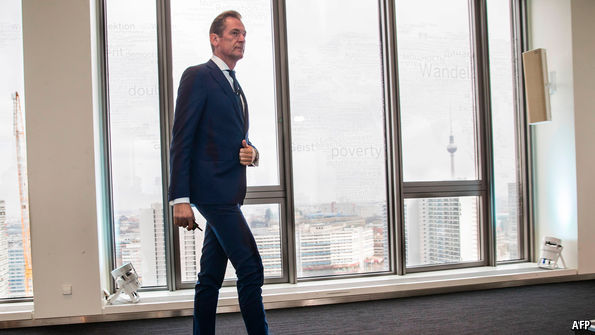
VISITING the top floor of Axel Springer’s tower in Berlin is like travelling back to a lost age. The German publisher’s Journalisten Club is a suite of wood-panelled rooms filled with antique books, leather armchairs and classical paintings. “It is a symbol,” says Mattias Döpfner, the publisher’s chief executive.
Whether it still makes sense as a symbol is unclear, for Axel Springer’s business has shifted rapidly away from print media (though it still owns Bild and Die Welt, two leading German dailies) towards an array of digital businesses. In 2000 it had almost no digital revenue; by the end of last year over 72% of its operating profit came from digital activities. Profits have increased by 37% over the past decade, from €434m ($473m) in 2006 to €596m last year.
Four years ago Axel Springer sold off several newspapers and magazines, including the Hamburger Abendblatt and the Berliner Morgenpost, for $1.2bn. In 2015 it nearly bought the Financial Times, a British paper with a strong online presence but…Continue reading
Harvard Business School risks going from great to good

YOU will all be aware that a book has just been published about our institution, Harvard Business School (HBS). Entitled “The Golden Passport”, by Duff McDonald, it makes a number of unflattering claims about the school’s ethics and its purpose. While often unbalanced, it is likely to galvanise hostility to HBS both inside Harvard University, of which we are a part, and among the public. This memorandum, circulated only to the most senior faculty members, assesses HBS’s strategic position.
Our school has been among the country’s most influential institutions since its foundation in 1908. Our forebears helped build America’s economy in the early 20th century and helped win the second world war. HBS educates less than 1% of American MBA students but case studies written by our faculty are used at business schools around the world. Our alumni fill the corridors of elite firms such as McKinsey. Many bosses of big American companies studied here. Even in Silicon Valley, where we are relatively weak, about a tenth of “unicorns”—private startups worth over $1bn—have one of our tribe as a founder.
We have a business model that monetises the Harvard brand…Continue reading
Cancer drugs are getting better and dearer

THE debate in rich countries about the high price of drugs is a furious and frustrating one. The controversy is already having an impact on spending on drugs, suggest new figures from the QuintilesIMS Institute, a research firm. The rate of growth in spending on prescription medicines in America fell to 4.8% in 2016, less than half the average rate of the previous two years (after adjusting for discounts and rebates). Michael Levesque of Moody’s, a rating agency, reckons that pressure over pricing is contributing to a deceleration in earnings growth at pharma firms. Public scrutiny constrains their flexibility over what they can charge and allows payers to get tougher.
In one area, however, earnings are expected to keep rising: cancer. Oncology is the industry’s bright spot, says Mr Levesque. The grim fact is that two-fifths of people can now expect to get cancer in their lifetime because of rising longevity. This is one of the reasons why the number of new cancer drugs has expanded by more than 60% over the past decade. The late-phase pipeline of new medicines contains more than 600 cancer treatments. New cancer drugs are being approved more quickly.
More are…Continue reading