
Tag: Business
France’s PSA Group may plan to buy Opel, GM’s European operation
AFTER sweeping past a significant milestone, drivers rarely slam their vehicles into reverse. Yet General Motors (GM), which last year joined Toyota and Volkswagen in an elite group that sells over 10m vehicles a year, may be on the brink of such a manoeuvre. On February 14th the American firm and PSA Group, which makes Peugeots and Citroëns, sprang a surprise by confirming that they were in talks that could lead to the French carmaker buying GM’s European operation. GM’s decision to downsize has many merits, but the advantages of getting bigger are much less clear-cut for its European counterpart.
The two carmakers say a deal for Opel (which carries the Vauxhall brand in Britain) is only a possibility. But GM’s global might is not reflected at Opel, and it is probably keen to offload a carmaker that it has owned for nearly 90 years. Opel has done little other than disappoint in the recent past. Its 6% share of the European market puts it behind seven other brands and the business has lost money for years.
GM has considered offloading Opel before. In 2009, as it struggled in bankruptcy protection in the wake of the financial…Continue reading
Planet’s satellites offer customers a new world view every day
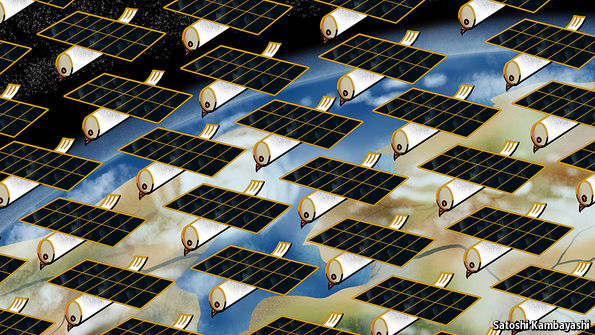
BUILT by the Indian Space Research Organisation, the Polar Satellite Launch Vehicle threw itself into the sky at 3.58am GMT on February 15th. It took with it a record-breaking 104 satellites—88 of which belonged to a single company, Planet, a remote sensing business based in San Francisco. Planet now has 149 satellites in orbit—enough for it to provide its customers with new moderately detailed images of all the Earth’s land surface every single day.
The satellites Planet makes—it calls them “doves”—measure 10cm by 10cm by 30cm. The first doves, launched five years ago, could send back pictures of just 3,000 square kilometres a day. But the satellites have followed a trajectory of improvement much closer to that seen in cell-phones—from which they get some of their components—than the established satellite industry. The latest doves can cover 2.5m square kilometres a day.
The expanded fleet of satellites will send over 3 terabytes of data a day to more than 30 receiver stations spread around the Earth. After processing to remove distortions and to locate each image, the data will be in the cloud and ready for the company’s…Continue reading
Traditional media firms are enjoying a Trump bump
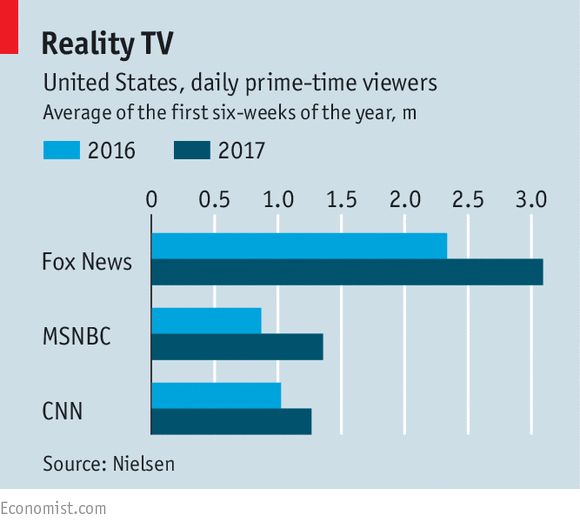
DONALD TRUMP calls it the “failing” New York Times in his tweets, but his presidency has breathed new life into the newspaper and other mainstream media outlets. The New York Times, the Washington Post and the Wall Street Journal have all received boosts in subscriptions and page views; cable news networks, such as CNN and the Fox News Channel, are getting huge increases in viewers at a time when most other channels are losing them; and even the long-suffering stocks of newspaper companies are rallying. Since the election shares in the New York Times Co have risen by 42%, outperforming even the mighty Goldman Sachs.
Why the boost? The unprecedented nature of political events has kept American eyeballs glued to pages and screens. The pace of change, especially since the election, compels Mr Trump’s fans and foes alike to stay abreast of developments. Many do so using Twitter (see article). But…Continue reading
Electric cars are set to arrive far more speedily than anticipated

THE high-pitched whirr of an electric car may not stir the soul like the bellow and growl of an internal combustion engine (ICE). But to compensate, electric motors give even the humblest cars explosive acceleration. Electric cars are similarly set for rapid forward thrust. Improving technology and tightening regulations on emissions from ICEs is about to propel electric vehicles (EVs) from a niche to the mainstream. After more than a century of reliance on fossil fuels, however, the route from petrol power to volts will be a tough one for carmakers to navigate.
The change of gear is recent. One car in a hundred sold today is powered by electricity. The proportion of EVs on the world’s roads is still well below 1%. Most forecasters had reckoned that by 2025 that would rise to around 4%. Those estimates are undergoing a big overhaul as carmakers announce huge expansions in their production of EVs. Morgan Stanley, a bank, now says that by 2025 EV sales will hit 7m a year and make up 7% of vehicles on the road. Exane BNP Paribas, another bank, reckons that it could be more like 11% (see chart). But as carmakers plan for ever more battery power, even…Continue reading
Sales of green vehicles are booming in Norway
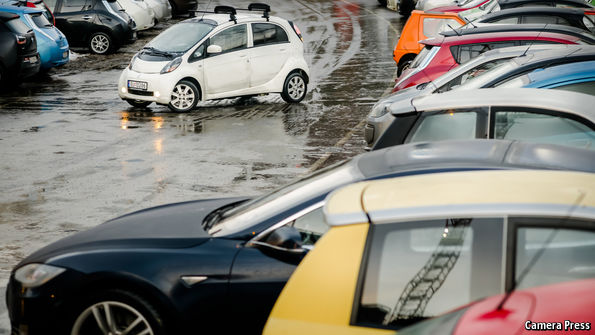
TO JUDGE by the gleaming rows of Teslas, Nissan Leafs and other electric cars parked in the snow in central Oslo, Norwegians might already have given up on the internal combustion engine. Before long they probably will. Battery-powered cars and plug-in hybrids together accounted for 29% of all new car sales last year. The 100,000th battery-powered unit sold in December.
Norway first introduced tax perks to boost the electric-car market in the 1990s. But sales only sparked in the past five years or so after slicker vehicles with better batteries appeared. Now the country’s 5m citizens constitute the most developed national market for electric cars anywhere. Christina Bu, who heads the country’s association for electric cars, expects 400,000 electric-only vehicles on the roads by 2020, and predicts 70% of new sales will be of zero-emission cars. As range increases and price falls, demand will rise faster.
Though less than 5% of the total fleet of cars in Norway are electric, the country’s transport minister calls it “realistic” to expect an end to sales of new cars powered by fossil fuels by 2025. Fiscal incentives, not an…Continue reading
Investors flock to buy a piece of Mexico’s leading tequila-maker

OVER the course of more than 200 years in the tequila business, Jose Cuervo will have been responsible for a fair few moments of giddy pleasure. Last week, it got one of its own thanks to a successful initial public offering (IPO). It was eight times oversubscribed and raised 18.6bn pesos ($920m) in exchange for 15% of the company.
Jose Cuervo, which is based in the western state of Jalisco, is one of the country’s best-known brands, and has been run by the same family for 11 generations. It dominates the Mexican tequila industry; sales in 2015 came to 18.5bn pesos. It also holds an assured place in the history of mixology: the original margarita cocktails were purportedly made with Jose Cuervo tequila.
Long considered a candidate for flotation, it eventually published a prospectus in September 2016. The IPO was delayed, though, seemingly to allow the company to take stock of the impact of Donald Trump’s election victory in November. Since then the peso has dropped over 10% against the dollar, and Mr Trump’s desire to rework, even to rip up, the North Atlantic Free-Trade Agreement, and perhaps impose a border tax on Mexican exports to America has sent tremors…Continue reading
Tata’s governance is still faulty
 Chandra in, Cyrus out
PROFIT is to good corporate governance what tides are to swimming trunks: when the former is high, absence of the latter tends to go unnoticed. The ebbing of profits at Tata, India’s largest conglomerate, in recent years has prompted a power struggle that in turn has exposed the often dysfunctional relationship between several dozen businesses, holding companies, people and charities that use the Tata name. The struggle is now over: on February 6th, Cyrus Mistry, Tata’s boss until last October (pictured on next page, on the right) was finally booted out of the company. Natarajan Chandrasekaran (on the left), the boss of one of the group’s key operating firms, Tata Consultancy Services, takes over as chairman on February 21st.
Executives at the 149-year-old group hope that will close a grim chapter in its history. Mr Mistry, whose family owns an 18% stake in Tata Sons, the main holding company, which is unlisted, reacted badly to being evicted as its chairman last year. The move to oust him was set in motion by Ratan Tata, the group’s 79-year old patriarch (and Mr Mistry’s interim successor)….Continue reading
Ralph Lauren and Macy’s tell a similar tale of woe

NEW YORK’s fashion week, which will start on February 9th, promises the usual show of glamour, but a more fascinating industry display came a week earlier. On February 2nd Ralph Lauren, a well-known brand, said that the executive it had hired in 2015 to overhaul its business would leave. On February 3rd the Wall Street Journal reported that Macy’s, America’s biggest department store, might be bought by Hudson’s Bay, a smaller Canadian rival. Each is an institution of American retailing. Each is a reminder of how hard it is to keep pace.
Consumer habits have changed especially rapidly in their world. Frocks, bags and shoes are now disproportionately bought online compared with other goods. Last year clothes and accessories accounted for a fifth of e-commerce, estimates Cowen, a financial-services firm; far higher than their 8% share of total retail spending. Cowen expects Amazon to surpass Macy’s as America’s top clothing seller this year.
For manufacturers, such as Ralph Lauren, the picture is more mixed. For some clothing firms, particularly small ones, Amazon offers a new way to reach…Continue reading
Internet firms’ legal immunity is under threat

GOOGLE, Facebook and other online giants like to see their rapid rise as the product of their founders’ brilliance. Others argue that their success is more a result of lucky timing and network effects—the economic forces that tend to make bigger firms even bigger. Often forgotten is a third reason for their triumph: in America and, to some extent, in Europe, online platforms have been inhabiting a parallel legal universe. Broadly speaking, they are not legally responsible, either for what their users do or for the harm that their services can cause in the real world.
It is becoming ever clearer, however, that this era of digital exceptionalism cannot last for ever. Governments and courts are chipping away at the sovereignty of internet firms, and public opinion is pushing them to police themselves better. Given their growing heft, this shift is likely not just to continue but to accelerate.
When the internet went mainstream in the mid-1990s, online firms feared being held liable if their services were used in illegal ways—for instance, when subscribers posted copyrighted content or defamatory information. The danger was underlined in…Continue reading
Snow-making companies in a warming world
 Better than mud
THE creamy glide of fresh powder sends skiing enthusiasts into ecstasies. Scraping over brown patches and dodging lumpen rocks inspires far less enthusiasm. Thousands of families will hit Europe’s slopes this month, hoping that snow conditions will be more favourable than at the start of the season in December. A warming world is changing precisely how, when and where snow falls. For the winter-sports industry, such shifts could hit profits harder than a springtime avalanche.
The snowfall season has become shorter in places such as the Alps, says David Robinson of Rutgers University in New Jersey, as snow arrives later and melts earlier than it once did. Resorts at lower altitudes are among the most vulnerable. Since the 1970s the duration of the snow season, averaged over the northern hemisphere, has declined by five days a decade, according to the European Environment Agency. Huge regional variation exists, however, both in Europe and elsewhere. Californian slopes that were unable to open in recent years because of snow shortages had to close at the start of 2017 because too much of the stuff had…Continue reading