
Tag: Business
Grab battles Uber in South-East Asia
 Overtaking manoeuvres
SCOOTER-DRIVERS in bright green helmets enliven the dusk of rush hour in Ho Chi Minh City, Vietnam’s commercial centre. This conspicuous fleet is carrying round clients of Grab, a South-East Asian ride-hailing firm. Its operations, connecting travellers with taxis, private cars and motorbike taxis in six countries, straddle a region that is twice as populous as America and swiftly urbanising. Its future seems assured, if it can compete with Uber, a deep-pocketed American competitor.
Grab started life at Harvard Business School, where its 34-year-old boss, Anthony Tan, met his co-founder, Hooi Ling Tan (the pair are unrelated). Its headquarters are in Singapore. Anthony’s father runs Tan Chong Motors, a car assembler and distributor which is among Malaysia’s largest companies, but he does not have funding from the family outfit.
Mr Tan denies that he is building South-East Asia’s answer to Uber, and says he is more inspired by Chinese technology firms such as Tencent, an online-gaming and social-media firm that owns WeChat, a fantastically popular mobile-messaging service, and Alibaba…Continue reading
Shareholder democracy is ailing

DEMOCRACY is in decline around the world, according to Freedom House, a think-tank. Only 45% of countries are considered free today, and their number is slipping. Liberty is in retreat in the world of business, too. The idea that firms should be controlled by diverse shareholders who exercise one vote per share is increasingly viewed as redundant or even dangerous.
Consider the initial public offering (IPO) of Silicon Valley’s latest social-media star, Snap. It plans to raise $3-4bn and secure a valuation of $20bn-25bn. The securities being sold have no voting rights, so all the power will stay with Evan Spiegel and Bobby Murphy, its co-founders. Snap’s IPO has echoes of that of Alibaba, a Chinese internet giant. It listed itself in New York in 2014, in the world’s largest-ever IPO, raising $25bn. It is worth $252bn today and is controlled by an opaque partnership using legal vehicles in the Cayman Islands. Its ordinary shareholders are supine.
Optimists may dismiss the two IPOs as isolated events, but there is a deeper trend towards autocracy. Eight of the world’s 20 most valuable firms are not controlled by outside shareholders. They…Continue reading
Beating Apple, Xiaomi and the gang in China

DONGGUAN, a southerly Chinese city near Hong Kong, is better known for cranking out cheap trinkets than for producing high-end equipment of any kind. And yet, amid the grit and grime is a gleaming low-rise factory producing some 50m smartphones a year for OPPO, a firm started by China’s BBK Electronics but which is now run independently.
Inside, as well as the usual assembly lines and serried workers, the factory has dozens of staff in quality engineering and testing, conducting 130 different tests on OPPO’s phones before they are released to the market. Such zealous pursuit of quality would be expected of factories that produce phones for Apple—the world-class facilities run by Taiwan’s Foxconn in nearby Shenzhen house similar teams. But it is unusual at a firm that makes relatively inexpensive handsets for the local market.
OPPO, and its sister firm, Vivo, also a child of BBK, started out in 2004 and 2009 respectively, making cheap and cheerful phones like plenty of other obscure Chinese manufacturers. They probably didn’t even register on Apple’s radar. Xiaomi was the Chinese handset-maker to watch; urban sophisticates, enticed by…Continue reading
America’s booming pet health-care business

AT THE 42,000-square-foot clinic in Hollywood that is owned by VCA, an animal-hospital chain, you may find a Pomeranian on a course of stem-cell therapy or a Shih Tzu having a hip replacement. There is even an underwater treadmill for cats. As pets are treated more and more like members of the family, so they are getting more health care. That also means they are racking up bigger vet bills for their owners.
That is the backdrop to the purchase in January of VCA by Mars, a firm best known for selling chocolate and sweets, for $9.1bn. Analysts whistled at the 31% premium Mars offered on VCA’s share price at the time, but they also agreed that the deal reflects the industry’s vitality. Spending on animal clinic visits in America has increased from a total of $13.7bn in 2012 to almost $16bn last year.
The deal is not as out of character for Mars as it may appear. Sales of chocolate are declining. The company is second only to Nestlé in the market for pet food in America, but competition from sellers on Amazon has sent the firm towards animal health. It was in 2007 that Mars bought Banfield Pet Hospital, then VCA’s largest rival. Since then…Continue reading
The market for alternative-protein products

MOST people like to eat meat. As they grow richer they eat more of it. For individuals, that is good. Meat is nutritious. In particular, it packs much more protein per kilogram than plants do. But animals have to eat plants to put on weight—so much so that feeding livestock accounts for about a third of harvested grain. Farm animals consume 8% of the world’s water supply, too. And they produce around 15% of unnatural greenhouse-gas emissions. More farm animals, then, could mean more environmental trouble.
Some consumers, particularly in the rich West, get this. And that has created a business opportunity. Though unwilling to go the whole hog, as it were, and adopt a vegetarian approach to diet, they are keen on food that looks and tastes as if it has come from farm animals, but hasn’t.
The simplest way to satisfy this demand is to concentrate on substitutes for familiar products. “Meat” made directly from plants, rather than indirectly, via an animal’s metabolism, is already on sale for the table and barbecue. Impossible Foods, a Californian firm, has deconstructed hamburgers, to work out what gives them their texture and…Continue reading
TVs: the next testing scandal?
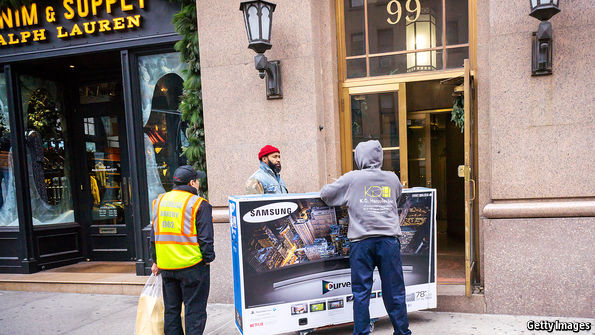 Plug and pay
VOLKSWAGEN, a German carmaker, has been disgraced for designing clever software that allowed it to cheat on emissions tests for diesel cars. A different scandal, with shades of the VW affair, has been building up in America’s television market. South Korea’s Samsung and LG, along with Vizio, a Californian firm, stand accused of misrepresenting the energy efficiency of large-screen sets. Together, they sell over half of all TVs in America.
In September 2016 the Natural Resources Defence Council (NRDC), an environmental group, published research on the energy consumption of TVs, showing that those made by Samsung, LG and Vizio performed far better during short government tests than they did the rest of the time. Some TVs consumed double the amount of energy suggested by manufacturers’ marketing bumpf. America’s Department of Energy (DoE) has also conducted tests of its own that have turned up big inconsistencies.
Not all TV-makers are at fault: the NRDC found no difference in energy-consumption levels for TVs made by Sony and Philips. But class-action lawsuits have already been filed against the…Continue reading
Logistics companies fear the return of hard borders

DURING the day, Leipzig’s airport is quiet. It is at night that the airfield comes to life. Next to the runway a yellow warehouse serves as the global sorting hub for DHL, a delivery firm owned by Deutsche Post of Germany. A huge extension, which opened in October, means it can sort 150,000 parcels each hour, says Ken Allen, DHL’s CEO. It was built as business soared. But the express-delivery industry faces a new challenge: the return of trade barriers due to the protectionist bent of Donald Trump and because of Brexit.
The slower-moving shipping and air-cargo business has long been in the doldrums as a result of slow overall growth in trade in recent years. Yet the rise of cross-border e-commerce has still meant booming business for express-delivery firms. On January 31st UPS revealed record revenues for the fourth quarter of 2016; FedEx and DHL are expected to report similarly buoyant results next month. Since 2008 half of the increase in express-delivery volumes has come from shoppers buying items online from another country.
Falling trade barriers have greatly helped them. When DHL and FedEx were getting going, in the 1970s,…Continue reading
The challenges for ExxonMobil’s new boss

WITH an institutional culture that lies somewhere between the marines and the boy scouts, ExxonMobil tends to avoid personality cults. Even so, it is surprising how little is known about Darren Woods, the chief executive who last month succeeded Rex Tillerson, America’s new secretary of state. Mr Woods’s Wikipedia biography is a few lines long. Rather than reveal the year of his birth, ExxonMobil just says he is 52. Never mind: the most significant fact about him is that he comes from the refining and chemicals side of the business, which hums along so efficiently that ExxonMobil is widely considered the world’s best “integrated” oil company. Yet it is upstream—the exploration and production part—where his hardest tasks lie.
On January 31st the company reported another year of plunging profits, which have buffeted its share price since 2014 (see chart). It earned less in a year than it used to earn in a quarter, and also less than Exxon made before its $80bn merger with Mobil in 1999. Profits among its “Big Oil” peers have likewise been clobbered by falling oil prices over the past two and a half years. It is also not…Continue reading
Snap’s IPO will be the largest in years

WHEN Snapchat first became popular in 2013, many thought the messaging app would disappear almost as quickly as its vanishing messages. Instead, it has become one of the most intriguing internet firms to emerge in years. When Snap, Snapchat’s parent company, goes public at an expected valuation of $20bn-25bn—the IPO is expected in March—its market debut will be the most closely watched since Alibaba, a Chinese e-commerce giant, floated in 2014. Snap’s offering documents may be filed publicly as soon as this week.
Snapchat has captivated youngsters in the West with its quickly disappearing content and playful features. It appears to have connected with youth more successfully than older rivals such as Facebook (or its messaging service, WhatsApp). Users share digitally enhanced photos and videos of themselves vomiting rainbows and morphing their faces into animal masks. Around 41% of Americans aged 18 to 34 use the ephemeral messaging service every month, and 150m people globally spend time on it every day.
Older grown-ups should pay attention too. Snapchat is experimenting with new technologies, such as augmented reality (AR) and…Continue reading
Silicon Valley’s criticism of Donald Trump

EARLY in 2016 Schumpeter went to a dinner with one of Silicon Valley’s luminaries, a man of towering intelligence and negligible humility. Asked about the upcoming election, he scoffed: it didn’t matter who America’s president was. Politics had become irrelevant, he said. Technology firms, and their leaders, would carry on fashioning brilliant products and generally carrying out God’s work on Earth, regardless of who occupied the White House. Cue smirks and more Hawaiian Kampachi all round.
Now Silicon Valley has thrust itself into a presidential stink. Technology groups were the first among big firms to slam Donald Trump’s executive order of January 27th, which temporarily bans people from seven mainly-Muslim countries in the Middle East from entering America. Tim Cook, Apple’s boss, criticised it to employees. Mark Zuckerberg at Facebook said he was “concerned”. Sundar Pichai, CEO of Google, told staff he was “upset” on the day of the order, and a day later the firm’s co-founder, Sergey Brin, was spotted among hundreds of protesters at San Francisco airport.
Just a month earlier all these technology firms and more…Continue reading