
Tag: Business
Formula One’s new American owner gives Bernie Ecclestone the heave-ho

FOR nearly 40 years, he showed skill and stamina at the wheel of Formula One (F1). But this week Bernie Ecclestone ran out of track. The sport’s new owner, Liberty Media, was at pains to portray its replacement of him as chief executive (by Chase Carey, a former president of Rupert Murdoch’s 21st Century Fox) as smooth. But the straight-talking octogenarian has never been one to stick to the script: he complained he had been “forced out”.
Liberty, which is controlled by John Malone, a billionaire, agreed to buy the sport last year, in a deal worth $8bn; the deal was completed on January 23rd. That provided an exit for CVC, a private-equity group which had purchased control in 2006. Mr Ecclestone gets the title of “chairman emeritus” as a sop—he said he doesn’t know what the title means—and will, said Liberty, “be available” to advise the board.
His exit was not a total surprise, though the timing had been unclear; he had talked about remaining involved in running F1 for another two to three years. Liberty may wish to draw a line under the Ecclestone era as a precautionary measure. F1 was often mired in litigation during…Continue reading
Bridge International Academies gets high marks for ambition but its business model is still unproven

AT THE Gatina branch of Bridge International Academies, on the outskirts of Nairobi, Nicholas Oluoch Ochieng has one eye on his class of five-year-olds and the other on his tablet. On the device is a lesson script. Every line is written 7,000 miles away, in Cambridge, Massachusetts. There an American team analyses 250,000 test scores every ten days from Bridge’s 405 Kenyan schools, and then uses the data to tweak those parts of a lesson where pupils find themselves stumped. Teachers, if they are instructing the same grade level, give identical lessons, and timetables are standardised, too. So when Mr Ochieng’s pupils read from their books, the same words should be reverberating off the walls of each Bridge nursery.
That chorus should soon grow louder. Founded in 2008, Bridge has grown into one of the world’s largest groups of for-profit schools—and the largest targeting poor pupils. It has 100,000 pupils spread across Kenya, Liberia, Nigeria, Uganda and India. Bridge says it aims to teach 10m children—the size of Britain’s pupil population—within the next decade.
Bridge’s ambitious target sets it apart from the low-cost…Continue reading
Qualcomm is again under attack for living large off its patent portfolio
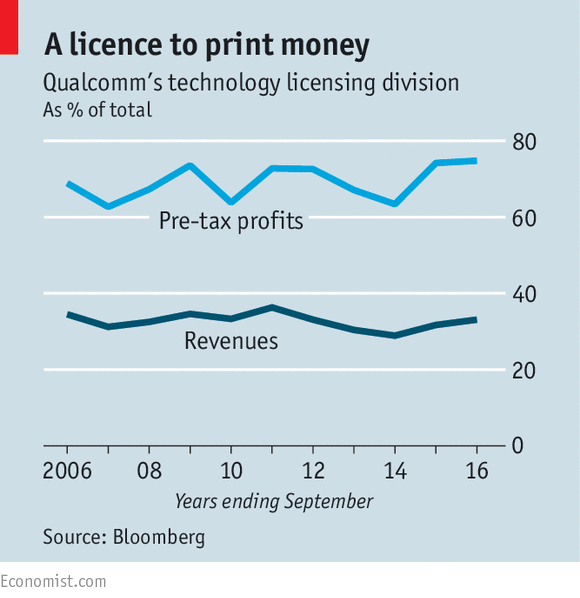
“SHOULD five per cent appear too small, be thankful I don’t take it all.” The Beatles wrote “Taxman” in 1966 to protest at Harold Wilson’s exorbitant “supertax” rates. Critics of Qualcomm, the world’s biggest chip-design firm, would say the lyric is a clue to the company’s business practices. Its methods have attracted a barrage of legal complaints. The latest came on January 25th, when Apple, a smartphone maker, sued it in China for abusing its clout in mobile processors and demanded 1bn yuan ($145m) in damages. Just days earlier Apple had filed a similar lawsuit in California asking for $1bn.
America’s Federal Trade Commission (FTC) issued a separate complaint against the firm this month. In late December, the equivalent body in South Korea fined it a whopping $853m, which hurt its quarterly results, announced this week. These cases follow two similar ones in 2015: Chinese regulators imposed an even higher fine, of $975m; and the European Commission found Qualcomm guilty of having sold chips below cost to hurt rivals.
Qualcomm is no household name, but most people with mobile phones use its technology….Continue reading
Political dating sites are hot
 Looking for a bit of Trumpy pumpy
AFTER Donald Trump was elected president, Maple Match, an online dating app which connects Canadians and Americans, was inundated with people signing up. The app promised to make it easy for Americans to find a Canadian partner to save them from the “unfathomable horror” of a Trump presidency. Joe Goldman, the app’s Texas-based founder, says it has taken on the perceived ethos of Canada: welcoming, open and tolerant. “We’re building bridges when people are talking about building walls and our users like that.”
TrumpSingles.com is forging connections, too. Its founder, David Goss, wants to make it easier for Trump supporters to find each other. The site’s earliest users were in Los Angeles, New York and Philadelphia, which are Democratic strongholds. Now its users are in every state. They are also signing up from abroad, including in Britain and in Russia. Mr Goss and his team personally approve each of the site’s 26,000 users to weed out trolls. The site was able to increase its monthly fee from $4.95 to $19.95 in December following Mr Trump’s election victory. It enjoyed a…Continue reading
How to build a nuclear-power plant
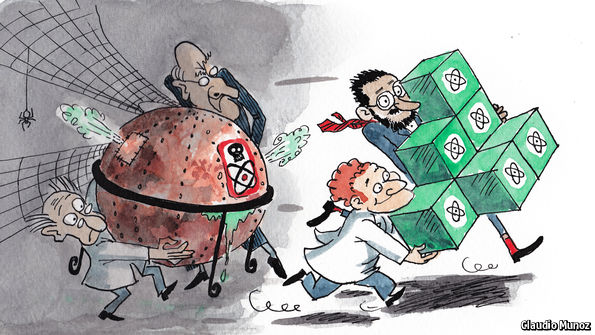
THE Barakah nuclear-power plant under construction in Abu Dhabi will never attract the attention that the Burj Khalifa skyscraper in neighbouring Dubai does, but it is an engineering feat nonetheless. It is using three times as much concrete as the world’s tallest building, and six times the amount of steel. Remarkably, its first reactor may start producing energy in the first half of this year—on schedule and (its South Korean developers insist) on budget. That would be a towering achievement.
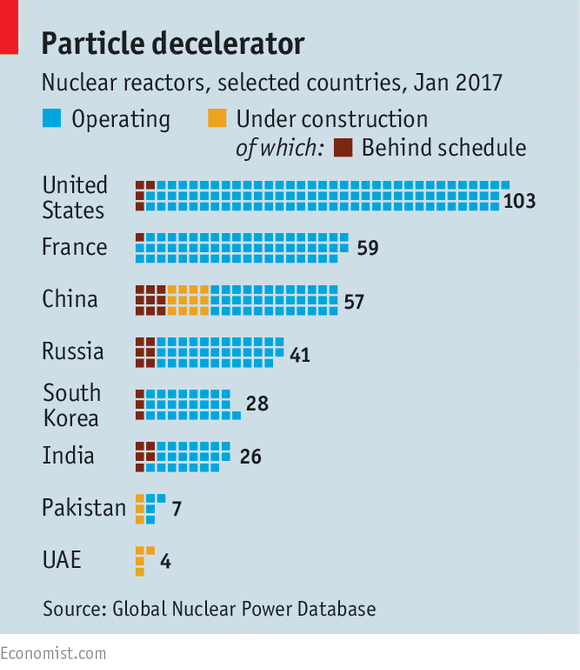
In much of the world, building a nuclear-power plant looks like a terrible business prospect. Two recent additions to the world’s nuclear fleet, in Argentina and America, took 33 and 44 years to erect. Of 55 plants under construction, the Global Nuclear Power database reckons almost two-thirds are behind schedule (see chart). The delays lift costs, and make nuclear less competitive with other sources of electricity, such as gas, coal and renewables.
 Continue reading
Why American bosses have become giddy, last-minute fans of Donald Trump

IN AN effort to understand their new reality, many American bosses have been studying “The Art of the Deal”. Donald Trump’s autobiography, published in 1987, begins by describing his working week, which mainly consists of frequent calls with his stockbroker, sitting in his office as other businesspeople pay him lavish tribute, and drinking tomato juice for lunch.
If Mr Trump’s routine is anything like the same today, he must be delighted. The broker has good news: the S&P 500 index has returned 6% since his election and on January 25th the Dow Jones Industrial Average closed above 20,000 for the first time. There have been chief executives-a-plenty lavishing praise on him both in public and in private. Their devotion seems extraordinary. Before the vote, many of the same C-suiters lambasted him as a menace to capitalism and much else.
One theory is that executives are simply terrified of Mr Trump. But many are supportive of him in private, too. They offer two explanations: that they can’t help but respond to his personal charm offensive to big business, and that they are persuaded that there is some substance there. Consider the…Continue reading
McDonald’s is going for healthier fare and greater digitisation

IN A newly released film, “The Founder”, the character of Ray Kroc promises that the startup he had taken over from the McDonald brothers “can be the new American church”. Portrayed by Michael Keaton as a turbo-charged egomaniac whose scruples diminish as his success increases, Kroc understood the power of branding, the advantages of franchising and the attraction of speed in food retailing. McDonald’s is now one of the country’s biggest food chains, with more than 14,200 outlets.
The domestic market is still its most important one, despite the firm’s massive global presence. When it reported this week that global sales had dropped by only 5% in the fourth quarter, the number beat expectations. News of a drop in sales in America of just 1.3% was received more gloomily. Hopes had risen because of the previous six consecutive quarters of domestic growth. At the end of 2015 and in early 2016 the chain had reaped the rewards of introducing the popular all-day breakfast in America. A year or so later, Egg McMuffins and sausage biscuits have shed some of their allure.
Still, Steve Easterbrook, the firm’s British boss, who took over…Continue reading
Lee Jae-yong dodges arrest on charges of bribery

THE deal which did most to secure Lee Jae-yong’s control over South Korea’s biggest conglomerate threatened this week to ruin him. On January 16th special prosecutors accused Mr Lee, the only son of Samsung’s chairman, Lee Kun-hee, of bribery, embezzlement and perjury. But three days later a court rejected a request to arrest him, as a suspect in an investigation into a vast influence-peddling case that led last month to the South Korean president’s impeachment. It saw “no reasonable grounds” to detain him while prosecutors pursue their probe.
For now, the result is a victory for Samsung. Prosecutors had accused Mr Lee of paying 43bn won ($36m) into sports and cultural organisations controlled by Choi Soon-sil, a former confidante of Park Geun-hye, the president: the biggest-ever sum in a South Korean bribery charge. In return for that grant, they allege, Samsung secured government support for a controversial $8bn merger of two affiliates—Cheil Industries, the group’s de facto holding company, and Samsung C&T, its construction arm—in July 2015. That support, they say, came from a vote cast by the state-run National Pension Service…Continue reading
A big fine for Rolls-Royce is not its only worry

FOR those who still associate Rolls-Royce with its past as a posh carmaker, its home on a scruffy industrial estate comes as a shock. Yet it is there the engine-maker assembles the Trent XWB, the second-biggest commercial jet engine in the world. Some components are made to a tolerance of 50 microns—the width of a human hair. The job of running the firm is a bit messier.
On January 16th, in a deal with American, British and Brazilian regulators, Rolls agreed to cough up £671m ($809m) to settle allegations that it had in the past secured sales with bribery. The fine is the largest-ever imposed by Britain on a firm for criminal conduct. But given the wrongdoing the deferred prosecution agreement outlines, the firm got off lightly (the co-operation of the company’s more recent management helped). It admitted a dozen counts of corruption and bribery in seven countries, spanning decades. This included giving officials money, hotel stays and even a luxury Rolls-Royce car to secure engine sales. Rolls has since cut its use of the freewheeling third-party consultants who got the company in trouble, and promises better oversight of all staff. If it errs…Continue reading
A merger is the latest sign of Big Tobacco’s resilience

BRITISH AMERICAN TOBACCO (BAT) announced on January 17th a final deal to buy Reynolds American for $49bn. BAT already owns 42% of Reynolds; buying the rest of it will create the world’s largest listed tobacco company by sales and profits. It will peddle brands such as Dunhill, Camel and Newport. The casual observer might imagine the deal to be a frantic bid to revive an ailing industry. On the contrary. Cigarettes may kill you, but the big companies that make them are rather healthy.
That is despite a decline in smoking rates. In 2015 just over a fifth of adults smoked, estimates the World Health Organisation, down from almost a quarter ten years earlier. This drop hardly helps companies, but it isn’t ruinous either.

Smoking is still popular in certain spots. More than three-quarters of men light up in Indonesia, for example. The habit is becoming more common among men in Africa and the eastern…Continue reading