
Economía
El ‘roaming’ será gratis en la UE pero tu compañía te puede cobrar si cree que abusas
Bruselas permite a las empresas de telefonía aplicar recargos si consideran que un usuario no justifica un uso elevado desde el extranjero
McDonald’s cambia su sede fiscal a Reino Unido para evitar el control de la Comisión Europea
La multinacional justifica el cambio por la nueva estructura de su negocio global
El billete de 10 dólares de Canadá honrará a una defensora de los derechos civiles
Viola Desmond, empresaria negra, se negó a abandonar una zona reservada para blancos en un cine del país en 1946
Bruselas abre expediente a España y a otros seis países por el ‘caso Volkswagen’
La Comisión Europea reprocha a Madrid no haber aplicado sanciones cuando se descubrió el escándalo
Finlandia, laboratorio mundial de la renta básica universal
El país nórdico, preocupado por la pérdida de empleos derivada de la automatización de muchos puestos de trabajo, será el primer país del mundo en experimentar en 2017 esta nueva forma de retribución económica
Winners and losers from the Trump stockmarket rally
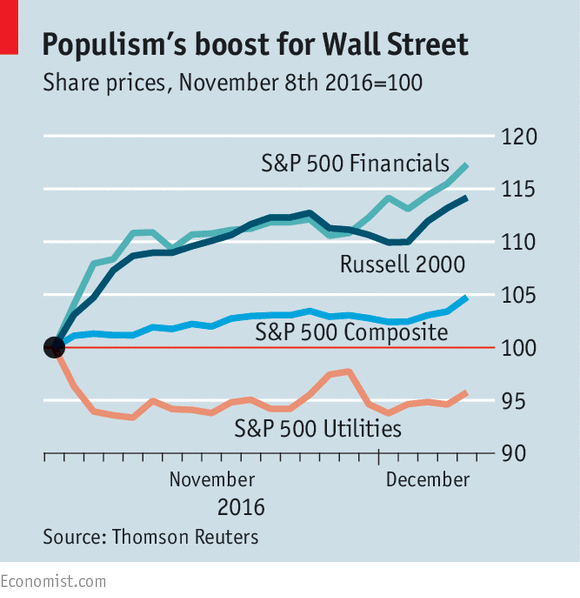
SELL on the rumour, buy on the news runs one version of a hoary stockmarket adage. And it certainly applied to last month’s presidential election. Before the poll, many investors were concerned about the risk that Donald Trump might become the 45th president. But as soon as the result was confirmed, they piled into shares. American equity mutual funds enjoyed four consecutive weeks of inflows, the longest streak since 2014, according to EPFR Global, a data provider.
One driver of the rally was Mr Trump’s planned fiscal stimulus. Investors believe this will lead to bigger deficits; hence the rise in bond yields since the election. But they also hope it will boost the American economy. That may explain why the Russell 2000 index of smaller companies, which tend to have a domestic focus, has outperformed the S&P 500 since the election (see chart). If this goes on, such stocks may become known as the Trumpettes.
Another factor was the planned cut in corporate-tax rates. The official American corporate income-tax rate is 35% (rising to 39% when state taxes are added). Standard & Poor’s, a ratings agency, reckons that the effective rate paid…Continue reading
Italian banks after the referendum

THE first casualty was Matteo Renzi’s hold on office. As he had promised, Italy’s prime minister resigned on December 7th, three days after voters rejected his proposals to overhaul the constitution. The second is likely to be a planned private-sector recapitalisation of Banca Monte dei Paschi di Siena, the country’s third-biggest bank and the world’s oldest. As The Economist went to press, the scheme’s chances looked slim. A government rescue was reportedly being prepared.
Monte dei Paschi has been in trouble for years. It has already had two state bail-outs and frittered away €8bn ($10bn) raised in share sales in 2014 and 2015. Its stockmarket value has dwindled to €600m, having fallen by 85% this year (see chart). Its non-performing loans (NPLs), even after provisions, are 21.5% of its total; the gross figure is 35.5%. In July it fell ignominiously short in European stress tests, ranking 51st of 51 lenders. The European Central Bank, its supervisor, asked it to raise more capital by the end of the year. This week the bank asked for more time.
Pre-empting the test results, Monte dei…Continue reading
A Dallas public pension fund suffers a run
 The mayor and Dallas’s finest
BANK runs, with depositors queuing round the block to get their cash, are a familiar occurrence in history. A run on a pension fund is virtually unprecedented. But that is what is happening in Dallas, where policemen and firefighters are pulling money out of their city’s chronically underfunded plan, and Mike Rawlings, the mayor, is suing to stop them.
At the start of the year the fire and police pension fund had $2.8bn in assets. Since then nearly $600m has been withdrawn from the plan, of which almost $500m has been taken out since August 13th. That is an alarming acceleration; in 2015 total withdrawals were just $81m.
Even at the start of 2016, the plan was just 45% funded, and was expected to become insolvent within 15 years. When some workers take out their money, they get the full value of their benefits; leaving a smaller pot to be shared among the remaining members. (The city estimates that the funded ratio has fallen to 36% after the withdrawals.) As in a bank run, it seems rational to withdraw your money if you worry that all the benefits won’t be paid.
The crisis…Continue reading
An epic legal battle with big implications for litigation funding

FOUNDED by former African American slaves, the west African country of Liberia has produced an insurance case that has bounced between the courts of several countries for a quarter of a century, condemning the claimants and their opponent to a generation of legal bondage. At long last, the saga might just be drawing towards a conclusion. It may also leave a legacy: to shift the calculus when third-party litigation funders assess the risks they face.
In the early 1990s, Liberia’s biggest importer, Lebanese-owned AJA, sued Cigna, an American insurer, in the federal court in Philadelphia for refusing to pay out over property damage incurred during Liberia’s civil war. AJA won, but a district-court judge overturned the verdict with a “judgment notwithstanding the verdict”—a rare device that can be employed when a jury is deemed to have deviated far from the law (in this case by failing to acknowledge a war-risk exclusion). The judge’s move was upheld by a higher appeal court.
Livid, AJA applied to Liberian courts and in 1998 won a judgment for $66.5m (now worth double that with interest). Cigna counter-sued, and in 2001 won an…Continue reading