
Finanzas
Un exempleado de BBVA, condenado a pagar 7 millones en costas por una demanda “temeraria”
Un juzgado de A Coruña declara que el exasesor jurídico “litigó con temeridad” al pedir 140 millones por usar su firma una vez jubilado
Una juez abre la vía para reclamar fondos por la manipulación del euríbor
El colectivo OpEuríbor gana una causa contra Caixabank que puede generar un aluvión de demandas
Sanción a JPMorgan por ‘enchufar’ a hijos de la élite china
El mayor banco por activos de Estados Unidos contrató a cerca de 200 personas por recomendación para apuntalar su negocio en Asia
Airlines are finally explaining what “last class” means. It isn’t pretty
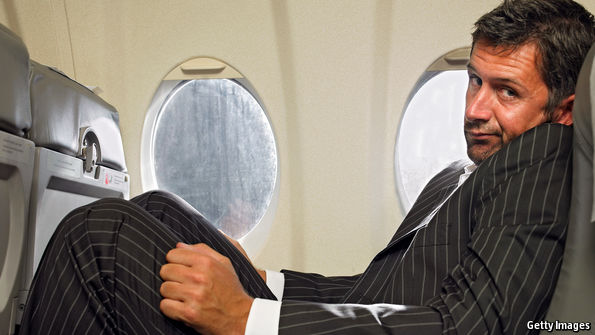
OVER the past couple of years America’s three biggest carriers, Delta, United and American, have each unveiled a fare class below economy. The new designation, known as “basic economy” to the airlines and derided as “last class” by their customers, is an attempt to compete with the low fares on profitable no-frills carriers such as Spirit and Frontier.
From the airlines’ initial announcements, it seemed that the sacrifices passengers would have to make in order to secure last-class fares would be modest. The most notable was the inability to select seats when booking a flight. For families travelling together that might be unpalatable, since they would run the risk of being split up. For solo travellers it would mean more chance of a middle seat—not ideal, but worth the lower cost for many flyers.
That changed this week when United, on a call with investors, dropped a bombshell: flyers in basic economy would be barred from using the overhead bins. Instead, they will be allowed only a small carry-on bag that can fit under the seat in…Continue reading
Amp my ride

“THE car is the ultimate mobile device,” said Jeff Williams, an executive at Apple, last year. It was taken as another sign that the maker of iGadgets would be deepening its interest in the automotive sector (among other projects, it is developing an in-house smart car that is codenamed Project Titan). Now Samsung Electronics, its big rival in the smartphone world, is following. On November 14th the South Korean company said it would pay $8bn for Harman, a firm based in Stamford, Connecticut, that makes internet-connected audio, information and security systems for cars. The deal is Samsung’s largest ever, and the first big transaction for its vice-chairman and heir apparent, Lee Jae-yong, grandson of the firm’s founder.
Though it is best known for its sound systems, Harman is one of the world’s largest supplier of smart parts for “connected cars” that help owners to drive by linking to the internet and to chip-enabled devices. It made $7bn in revenue in the year to September, two-thirds or so of it from the car sector, and has over three times that in new orders. Its products are the first step towards autonomous vehicles. Over 30m…Continue reading
Clash of the Tatas

COMPANY bosses who get the sack react in different ways: some quietly leave, others graciously wish their successor luck, most try to nurse hurt pride as best they can. Not Cyrus Mistry, who on October 24th was ousted as chairman of the Tata Group, India’s biggest conglomerate. Bemused and angered at having his predecessor, Ratan Tata, suddenly seize back control, he has refused to go. The schism at the heart of Tata has drawn attention to what made it possible in the first place: an overly complex structure trying to oversee too many businesses, deficient corporate governance and a penchant for opacity. Whether these problems are addressed, and how, will shape the group and its reputation for decades to come.
Tata’s reasons for sacking Mr Mistry are unclear. He is from a family that has had a nearly 20% shareholding in the group for decades (most of the other shares are controlled by charities that are chaired by Mr Tata). Allies say that after four years in the job, Mr Mistry had got to grips with the inner workings of the company. He was ready to start changing it.
His critics, on the other hand, never believed that any executive…Continue reading
Vein hope

DONALD TRUMP’S grandfather, Fred, got his start in the hotel industry at the turn of the 20th century supplying rooms, food, booze and female company to prospectors flocking to north-western Canada in the so-called Klondike gold rush. It may be part of this legacy that gave America’s president-elect his taste for golden fixtures and fittings. But it may also make miners a bit wary of Mr Trump. After all, their pockets have been “mined” by a Trump once before.
So the world’s biggest mining companies are downbeat about the rally in commodities prices that accompanied Mr Trump’s election victory, which briefly pushed up prices of copper at their fastest rate in five years and sent iron-ore prices to two-year highs close to $80 a tonne. On November 15th Rio Tinto, one of the world’s biggest mining companies, told 440 workers at an iron-ore mine in Western Australia to take two weeks off at Christmas, not as a celebration, but as a precautionary measure to reduce supply. It expects conditions to get much tougher in 2017. Its main rival, BHP Billiton, is also nonplussed. It predicts economic uncertainty, political instability and a…Continue reading
Polluting the outlook
 So they hope
IT WAS on November 16th that the International Energy Agency (IEA), an organisation that represents oil- and gas-consuming countries, announced its prediction that over the next quarter of a century renewable energy, such as wind and solar, and natural gas will hugely eclipse the traditional role that coal and oil have played in satisfying the world’s growing demand for energy (see chart). That is the base case for what it says is a powerful shift in the global energy landscape towards cleaner fuels.

The trouble is that after the projections were calculated, Donald Trump, who is both a climate sceptic and a fossil-fuel fan, was elected as America’s next president. As Fatih Birol, the IEA’s executive director, pointed out this week, no one knows what his energy policies will be. Yet he will run the world’s biggest producer and consumer of oil and natural gas.
Many…Continue reading
Iceland does not face another bust, but its economy looks lopsided
 No eruptions on the horizon
GOOD times are rolling again in Iceland. In June it beat England in a football match. On The Economist’s “glass-ceiling index”, it is the world’s best country for working women. And the economy is purring. After a thumping crash in 2008-09, GDP is expected to grow by 5% this year, faster than any other rich economy. The ruling (conservative) Independence Party has been rewarded: it won 30% of the vote in the election in October, more than any other party. But some fret that Iceland’s economic stability is, again, built on molten lava.
The biggest worry is over its treatment of foreign creditors. When the crisis hit, the country slapped on capital controls, protecting the krona by preventing investors from pulling capital from the country. Recently the government has been loosening restrictions. Icelanders may soon no longer have to present airline tickets in order to buy foreign currency for their holidays.
One group of foreign investors, however, accuses Iceland of, in effect, defaulting on its debts. They own offshore, krona-denominated, assets worth…Continue reading
Pot of gold
 Flat white joint to go
IN THE 1990s Snoop Dogg, a rapper, called cannabis “chronic”. The drug was illicit and cool. In 2016 Mr Dogg is a cannabis investor, and the drug is poised to earn another title: consumer staple. On November 8th four states, including California, voted to approve recreational cannabis use. Four other states eased rules for medical marijuana. About three-fifths of America’s population lives in states that now allow cannabis use in some form.
So pot entrepreneurs face the thrilling prospect of normality. This week industry leaders were meeting in Las Vegas to discuss how the sector might expand. They have in prospect a vast, partially established market. More than 32m Americans already use cannabis. As the business becomes more normalised, it is sure to attract new customers. “It’s not often that you see an industry and you know the inevitability of it,” says Brendan Kennedy of Privateer Holdings, a private-equity firm that specialises in cannabis. Last year legal sales reached $6bn, according to the Arcview Group, an investment and market-research firm. By 2020 Arcview expects legal sales to be…Continue reading