
Finanzas
Cinco Días premia la innovación y destaca su importancia en el éxito empresarial
NH Hoteles, Blendhub y Emite Ingeniería reciben los galardones del diario económico
La Audiencia investiga a Borrell y a todo el consejo de Abengoa y Deloitte
Admite una querella que les acusa de «administración desleal y falseamiento de documentación»
Seize the day
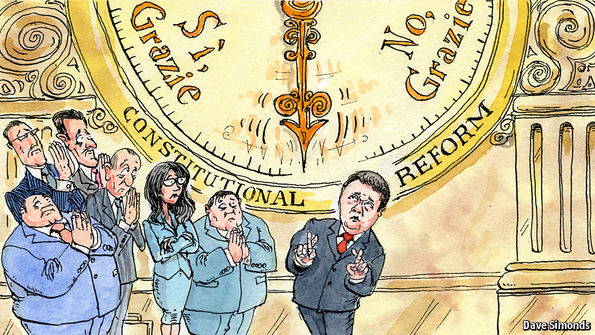
“THE biggest risk in Europe is the Italian referendum,” said Gianfelice Rocca, head of Assolombarda, Milan’s chamber of commerce, this summer. For corporate Italy, much is at stake in the vote on constitutional reform, which will be held on December 4th. Victory for Matteo Renzi, the business-friendly prime minister, could mean a big fillip for firms of all sizes, whereas a loss would be “a shock in the system”, said Mr Rocca.
The national employers’ federation, Confindustria, agrees with him. If those campaigning for a “yes” vote are to be believed, firmer government, easier conditions for investors and generally brighter economic prospects would follow. The two main issues to be decided are reform of the Senate’s powers—whether to let the lower chamber pass future laws, even when opposed by the Senate—and whether decision-making powers should be brought back from regional governments to the centre.
Francesco Starace, the chief executive of Enel, a giant European electricity company that is one of Italy’s more successful firms, sets out a strong case that the proposed changes would bring important benefits to…Continue reading
Indra y OHL se desploman más de un 12% en Bolsa
La tecnológica genera caja negativa y la constructora acusa la caída de beneficios
Brexit means…a lot of complex trade decisions

POLITICIANS campaign in soundbites but reality deals in awkward paragraphs. For all the sloganeering (Brexit means Brexit) and the prevarication, the British government must finally decide what kind of trade-offs it is willing to accept when it leaves the EU. The UK trade policy observatory at the University of Sussex has an excellent new paper out on the choices facing the country, which was the subject of a lunchtime seminar today.
The British government seems to have four red lines. It wants to stop free movement of labour; to be allowed to pursue an independent trade policy; not to contribute to the EU Budget; and to break away from legal oversight by the European Court of Justice. (All of these can be summed up by the slogan «taking back control»). The EU’s sole red line seems to be that Britain cannot benefit from «cherry picking» – for example, benefiting from membership of the single market in terms of goods trade, but not allowing free labour movement.
To understand the trade-offs, we must first understand the terms. The single market is an…Continue reading
Los intereses de la deuda se disparan y el BCE avisa del riesgo de Trump
El vicepresidente Constancio reclama «políticas más expansionistas» en Europa
Amazon y Fnac calientan el ‘Black Friday’ con un avance de las ofertas
El gigante de ventas online lanzará más de 10.000 productos rebajados. Otras cadenas como Oysho también anuncian descuentos
Exconsejeros de Caja Madrid: Las ‘black’ “eran un sueldo para gastarlo de forma adecuada”
Exconsejeros de la entidad no aclaran por qué había un control sobre sus gastos con las tarjetas si eran su retribución
How worrying is the global market reaction to the American election?

IT HAS not yet been a week since Americans elected Donald Trump their next president, and already there is a lot to digest. While Mr Trump’s initial personnel decisions deserve plenty of scrutiny, the global market reaction to the election also demands attention.
This morning, the decline in bond prices that began last week continued. In America, the 10-year government bond yield rose above 2.26%, the highest level since the end of 2015, while the 30-year bond yield reached 3%. Treasuries are faring worse than many other bonds, however. Yields are going up nearly everywhere, but emerging markets and the euro-area periphery are experiencing especially large moves. (It is, as my colleague Buttonwood quipped on Twitter, a «Trump tantrum».) What is happening here, and why?
The conventional wisdom is that markets are pricing in an expected move toward expansionary policy in America. Mr Trump is expected to cut taxes dramatically, increasing the American budget deficit, while also spending more on infrastructure and defence. That boost is coming at a time when America’s economy, while still…Continue reading
ACS redujo su deuda casi en una tercera parte en el último año
La ventas del grupo cayeron un 7% pero se mantuvo el beneficio neto en los nueve primeros meses