
Finanzas
Por qué nos gusta tanto el ‘marketing de la nostalgia’
Las marcas reviven iconos del pasado para enganchar al consumidor
Why did the Obama administration change its mind on the American Airlines-US Airways merger?
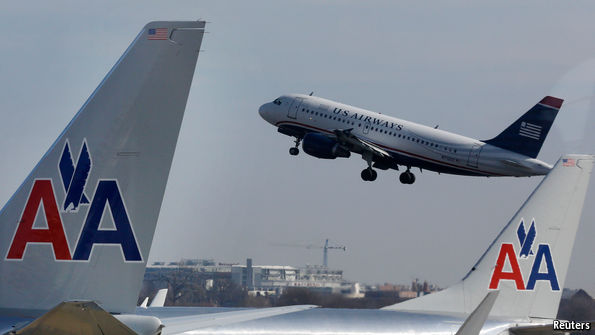
FLYERS in the United States are often frustrated by the dearth of options on certain routes, and the high price of tickets that are the result of limited competition. After several high-profile mergers in recent years, more than 80% of the domestic air market is controlled by four companies. That has led some travellers to ask how the government could possibly have allowed this to happen.
The answer is the same one that explains so many beguiling aspects of American governance: the combination of money, lobbying, influence, and the political revolving door that often makes it so easy for powerful companies to get their way.
A new investigation by ProPublica delves deeply into the complex web of meetings, donations, and hirings that surrounded the tie-up between American Airlines and US Airways. Three years ago, the administration of Barack Obama filed a lawsuit against the merger, alleging that it would raise prices and fees, cut service, and worsen amenities. Three months later, it reversed course, settling with the airlines and allowing the merger to move…Continue reading
Tres años de cárcel para un hombre que se amputó la mano para cobrar el seguro
El agricultor simuló que había perdido la mano derecha en un accidente de tráfico y deberá devolver los 335.000 euros de la indemnización
El Gobierno apoya el reflotamiento de Abengoa con nuevos avales por 153 millones
La aseguradora pública Cesce se compromete por carta con empresa y acreedores para apoyar su actividad internacional a días de acabar el plazo para cerrar el rescate
“Los políticos de Bankia no quieren perder sus poltronas y su financiación”
El jefe de la inspección de Bankia, José Casaus, advirtió de que había que vender el grupo, pero los gestores no querían perder privilegios
La inspección del Banco de España predijo el desastre de Bankia cuatro meses antes de la salida a Bolsa
Los correos del jefe de inspección, José Casaus, advertían insistentemente en abril de 2011 «las acciones del banco valdrán cada día menos» por la deuda
Will the Fed greet the next president with a recession?

IT WAS just a few months into the presidency of Barack Obama that America crept out of the Great Recession and into the current expansion. With just three months to go in his second term, Mr Obama seems likely to pass that expansion on to his successor. But what are they odds that she will make it through a four-year term without a brush with economic contraction? The Wall Street Journal polled 59 economists to get their view. They reckon there is a 60% chance of recession striking within the next four years. Is that a reasonable estimate? Let’s consider a few facts about expansions and recessions.
1) This expansion is getting up there in years, by American standards… The recovery began in June of 2009, which means that we are currently in its 88 month. According to NBER, which maintains a list of historical recessions going back to the mid-19th century, the current expansion is the fourth longest on record. The third longest, at 92 months, was the…Continue reading
Bankia afirma que Hacienda nunca descubrió las tarjetas ‘black’ de Caja Madrid
Un exdirectivo dice que el uso de la visa opaca era habitual y parte del contrato
Overdoing it

LATE of an evening, Japan’s black-suited salarymen let their hair down in the streets of Shimbashi, a district of Tokyo. Shirts untucked, ties off, liquor flowing, they stagger around before heading home, or directly back to the office via a konbini (convenience store) to buy a clean shirt.
This is the harmless outlet for their stress: karoshi, or death by overwork, is the darker, and until recently, more overlooked one. This month the first ever government report into the scale of karoshi found that employees put in over 80 hours of overtime a month at almost a quarter of companies surveyed. At 12% of those firms the figure rose to a whopping 100 hours. These numbers may underestimate the problem; under a fifth of 10,000 companies contacted responded, which is a normal response rate, but firms with still worse overtime figures may have kept out of the study.
Little wonder that 93 people committed or attempted to commit suicide in the year to the end of March 2015 because of overwork. These are the cases where the government has officially recognised that families are owed compensation;…Continue reading
Worth it?

While many MBA programmes are feeling the pinch, life is rosy for the very best business schools. Chicago retains its place at the top of our ranking of full-time MBAs. It is the sixth time in seven years that it has taken first place. Like most of Chicago’s peers, nearly all of its MBA class can expect to find a job immediately after graduation, with a basic salary well in excess of $100,000. Such degrees do not come cheap. The average cost of tuition at the top 15 schools is $112,000. America, the spiritual home of the MBA, dominates our list, accounting for 11 of the top 15 schools. The ranking is based on a mix of hard data and subjective marks given by students. It weights data according to what students tell us is important. The four categories covered are: opening new career opportunities (35% weighting), personal development and educational experience (35%), increasing salary (20%) and the potential to network (10%).