
Tag: Business and finance
Sinclair Broadcast buys Tribune Media
AT A time when ever fewer people are watching television, it may seem improbable that the owners of local TV stations in America want to expand their empires. It turns out that they can hardly wait. On May 8th, just 18 days after a change in federal rules made the deal possible, Sinclair Broadcast Group announced that it would buy Tribune Media in a transaction worth $6.6bn, beating out interest from others including 21st Century Fox, which is owned by Rupert Murdoch. Sinclair will become America’s dominant owner of local TV stations.
The deal signals a broader interest in expanding what has been a surprisingly decent business in recent years. In America local TV stations tend to affiliate themselves with a national broadcast network, transmitting its content, including live sports. In exchange the stations make substantial payments. Despite falling viewership of network TV, the economics of local-station ownership have remained robust for two reasons.
First is the resilience of local TV advertising, especially in election years, says Mark Fratrik of BIA/Kelsey, a media consultancy. The ability of small TV stations to reach specific areas for local political races has proved difficult to match.
Second, TV stations have tapped a new vein of cash: retransmission fees, the payments they command from cable- and satellite-TV providers for their consent…Continue reading
The super-connector airlines face a world of troubles

WHEN a video of a passenger being dragged off a United Airlines flight went viral last month, the American carrier’s Middle Eastern rivals were quick to mock its customer service. Qatar Airways updated its smartphone app to say it “doesn’t support drag and drop”. The ribbing was justified. Over a decade of expansion, Qatar Airways, along with Emirates of Dubai, the world’s largest airline by international passenger miles travelled, and Etihad Airways of Abu Dhabi, wowed customers with superior service and better-value fares.
Passengers joined them in droves, abandoning hub airports in America and Europe as well as the airlines that use them. Over the past decade the big three Gulf carriers and Turkish Airlines trebled their passenger numbers, to 155m in 2015 (see chart). They went a long way to dominating long-haul routes between Europe and Asia. Most international airlines rely on travellers going from or to their home countries, but customers of the four “super-connectors”,…Continue reading
Management lessons from an American general

STANLEY MCCHRYSTAL’S voice is hoarse as he addresses a packed arena in Helsinki. His audience, mostly businessmen in dark suits, is rapt. The American former general tells thrilling battlefield stories of leading the Joint Special Operations Command in Iraq, which captured Saddam Hussein and killed Abu Musab al-Zarqawi, al-Qaeda’s local chief. He explains how his outfit adapted against an unexpectedly difficult enemy. A change in management style let his group go from conducting a handful of raids each month to hundreds, achieving better results against insurgents.
Neither America’s occupation of Iraq nor Mr McChrystal’s military career ended well. He went on to lead Western forces in Afghanistan, but stood down in 2010 after falling out with his political bosses. He reinvented himself as a management consultant. His McChrystal Group employs 65 people. It draws on its founder’s experience hunting insurgents to advise businesses,…Continue reading
A boss’s guide to fending off an activist attack

MODERN bosses are a resilient bunch who can handle everything from Twitter storms to takeovers. But one thing drives many of them berserk: activist hedge funds, which buy stakes in companies and lobby for change. Last month Klaus Kleinfeld, the boss of Arconic, an industrial firm, succumbed to a bout of “activist apoplexy”. He sent a confidential letter to Paul Singer, head of Elliott Management, a fund that was trying to oust him. Its mysterious references to parties during the 2006 football World Cup in Germany and to a feather headdress seemed to be a threat to expose details about Mr Singer’s personal life. Mr Kleinfeld, who had spent over a decade running big listed firms including Siemens and Alcoa, resigned when his board found out.
Bosses feel that they are being stalked by activists. Elliott is now in a confrontation with Akzo Nobel, a Dutch chemicals firm that is using a poison pill to resist a takeover by PPG, an American rival. Since 2010, on average, 8% of…Continue reading
Donald Trump’s family and a controversial visa scheme

THE events seemed inconspicuous enough: presentations in smart hotels in Beijing and Shanghai seeking investors for luxury American apartments. The details might have gone unnoticed had not a journalist from the Washington Post heard about the event’s star attraction. But these days the surname “Kushner” is like a magnet. It quickly emerged that Nicole Meyer, sister of Jared Kushner, Donald Trump’s son-in-law and senior adviser, spoke in her pitch on May 6th to prospective investors about her powerful brother. One slide (pictured) that was shown to the audience included a photo of Mr Trump himself.
The affair underlined potential conflicts of interest surrounding Mr Trump’s family members and their businesses. Mr Kushner is not directly involved in the family firm. But Kushner Companies later apologised if Ms Meyer’s name-dropping “was in any way interpreted as an attempt to lure…Continue reading
How America’s two tech hubs are converging
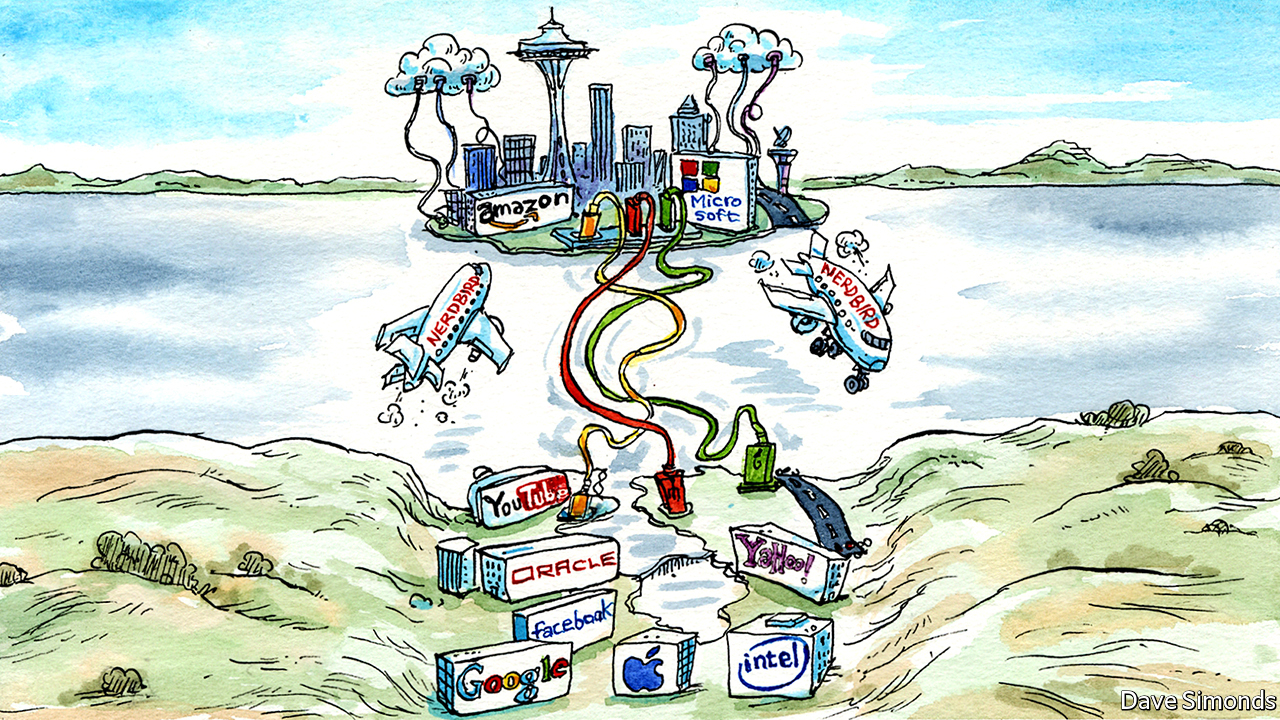
WOULD your region care to be the next Silicon Valley? In most of the world’s technology hubs, local leaders scramble to say “yes”. But ask the question in and around Seattle, the other big tech cluster on America’s west coast, and more often than not the answer is “no”—followed by explanations of why the city and its surrounds are different from the San Francisco Bay Area. The truth may be more complex: in recent years the Seattle area has become a complement to the valley. Some even argue that the two regions, though 800 miles (1,300km) apart, are becoming one.
They have similar roots, notes Margaret O’Mara, a historian at the University of Washington (UW). Each grew rapidly during a gold rush in the 19th century. Later both benefited from military spending. Silicon Valley ultimately focused on producing small things, including microprocessors, and Seattle on bigger ones, such as aeroplanes (Boeing was for decades the city’s economic anchor). This difference in dimension…Continue reading
The EU ponders moving euro clearing from London after Brexit
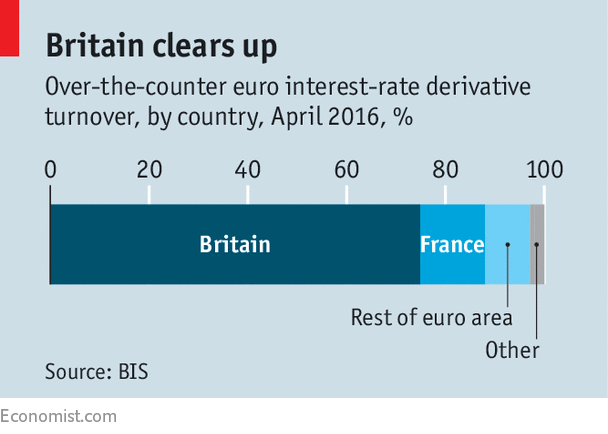
BREXIT has thrust a mundane, if crucial, bit of financial-market plumbing into the spotlight: the clearing of financial instruments. Clearing-houses sit in the middle of a securities or derivatives transaction, and ensure that deals are honoured even if one counterparty goes bust. In November a study commissioned by the London Stock Exchange (LSE) warned that if euro clearing was forced out of the City, 83,000 British jobs could be lost, and a further 232,000 affected. On May 4th the European Commission said it was looking into new rules for euro-denominated clearing. One option is relocation from London, an idea greeted in the City with a mixture of incredulity, disdain and fear.
In the wake of the financial crisis, the G20 group of big economies made it mandatory to settle most simple derivatives trades through clearing-houses. By 2016, 62% of the notional $544trn global over-the-counter derivatives market was settled in this way. Globally, London handles 37% of foreign-exchange derivatives…Continue reading
Africa’s informal economy is receding faster than Latin America’s
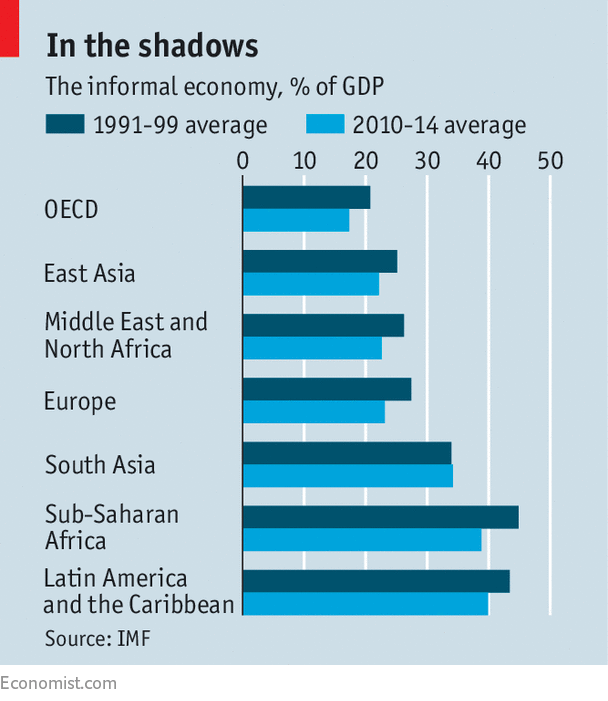
COMMON to all men, according to Adam Smith, is “the propensity to truck, barter and exchange”. Less common is a willingness to report all of this enterprise to the authorities (which have a propensity to register, regulate and tax). South Africa’s spaza shops (convenience stores often run from people’s homes), Kenya’s jua kali (a Swahili term referring to the “hot sun” under which craftsmen traditionally made and sold their wares) or Senegal’s tight-knit networks of Mouride street peddlers—all contribute to the informal economy. This shadow economy, which includes unregistered enterprises and off-the-books activity by registered firms, is difficult to measure, almost by definition. But this week the IMF released new estimates of its size.
The fund’s economists inferred the size of the informal economy indirectly, based on more visible indicators that either cause informality (heavy taxes, high unemployment and patchy rule of…Continue reading
A new sort of hedge fund relies on crowd-sourcing
“QUANT” hedge funds have long been seen as the nerdy vanguard of finance. Firms such as Renaissance Technologies, Two Sigma and Man AHL, each of which manages tens of billions of dollars, hire talented mathematicians and physicists to sit in their airy offices and develop trading algorithms. But what if such talent could be harnessed without the hassle of an expensive and time-consuming recruitment process? That is the proposition Quantopian, a hedge fund and online crowd-sourcing platform founded in 2011, is testing. Anyone can learn to build trading algorithms on its platform. The most successful are then picked to manage money. Last month the firm announced it had made its first allocations of funds to 15 algorithms it had selected.
Quantopian would appear to have one striking advantage over its competitors: sheer weight of numbers. The difficulty of hiring and a desire for secrecy limit even big quant funds to a full-time research staff in the low hundreds (Man AHL, for instance, has 120). Quantopian boasts 120,000 members on its platform.
These are amateurs, however, not full-time employees. John Fawcett, Quantopian’s CEO, says many sign up to…Continue reading
India needs to curb a borrowing spree by its state governments


WHICH Indian state sounds more likely to repay a loan: Bihar, the country’s poorest, with a budget deficit of nearly 6% of its state GDP last year and a hole in its finances after it banned alcohol sales; or Gujarat, a relatively prosperous coastal region with a deficit nearer to 2%? According to bond markets at least, both are equally good credits, and so pay the same interest rate. As welcome as such mispricing might be to the Bihari authorities, it is brewing trouble for the rest of the Indian economy.
The borrowing habits of Bihar, Gujarat, and India’s 27 other states used to be below the radar of all but the pointiest financial eggheads. The indebtedness of India, and its annual budget deficits—both high by emerging-market standards—could largely be blamed on the profligacy of the central government in Delhi. But an explosion in the net amounts borrowed by states over the past decade (see chart), from 154bn rupees in 2006 ($3.5bn then) to an estimated 3.9trn in the fiscal year…Continue reading