
Tag: Business and finance
The Trump administration starts to turn up the heat on trade

“WELL, I’m mostly there on most items,” said Donald Trump of his 100-day plan. As far as trade policy is concerned, his self-assessment would indeed be true—if tweets and executive orders ratcheting up tensions in a growing number of trade disputes constituted progress.
However, although Mr Trump has withdrawn America from the Trans-Pacific Partnership (TPP), a 12-country trade deal, he has neither labelled China a currency manipulator nor made progress in renegotiating the North American Free-Trade Agreement (NAFTA). On April 26th his administration denied reports that it was poised to trigger America’s withdrawal from the agreement. No new “America-first” trade deals have emerged, and his trade-related executive orders have requested reports or investigations. Mr Trump has created more work for pencil-pushers than for exporters.
The slow pace might reflect the obvious ideological infighting within his team, a desire for evidence before acting or the realisation that Congress, which sees trade policy as within its remit, must be kept on side. Congress officially delegates responsibility for trade to the United States Trade Representative. But it…Continue reading
The markets are uninspired by the Trump tax plan

REMEMBER why the «Trump bump» began, all the way back in November? The rationale for the surge in stockmarkets was that the new administration would cut taxes and allow American growth to accelerate. And so we waited for the details. When they came yesterday, it was only a one-page set of bullet points, containing around 200 words. If, as one expert pointed out, it had really taken 100 experts to come up with the plan, they averaged two words each.
The response from the markets was a yawn. Analysts at Clear Treasury said that
Much of yesterday was a non-event, markets were waiting to hear what came of Trump’s tax plans but there was certainly an air of disappointment when finally released.
The S&P 500 and Dow Jones Industrial Average were slightly lower on the day, and the European markets have fallen today. Of course that could be related to the other story floating around yesterday—that America might withdraw from Nafta. With the country also reviving its trade complaints about Canadian lumber and imported steel, Citigroup has taken to issuing a «US Protectionism Round-Up». But this is only a reminder that, in market terms, there has always been a «Trump…Continue reading
Alitalia is bankrupt again. This time perhaps it’s terminal

WHEN employees of Alitalia were offered the chance on April 25th to vote for pay cuts and redundancies to save the troubled airline, they spurned the opportunity. In some ways it is difficult to blame them. After all, in the past they have been able to rely on the Italian government to come to the rescue of the country’s flag carrier.
That may not happen this time. Alitalia has lost billions of euros over the past decade. (Indeed, over its 70-year history its accountants have barely had need for a black pen.) The firm had pinned its hopes on a €2bn ($2.2bn) capatilisation plan. But that had been dependent workers accepting cuts that were negotiated by the government and agreed with trade unions. With the workers’ no vote, that cash is now off the table.
Alitalia has been here many times before. In 2008 it was placed into bankruptcy after the government blocked plans for a sell-off. In 2014, with the airline on the verge of failing yet again, the government helped broker a deal with Etihad, a Middle Eastern superconnector, which took a 49% stake. A plan to make Alitalia
Small flying “cars” come a bit closer to reality

“YOU may smile, but it will come,” said Henry Ford in 1940, predicting the arrival of a machine that was part-automobile and part-aeroplane. For decades flying cars have obsessed technologists but eluded their mastery. Finally there is reason to believe. Several firms have offered hope that flying people in small pods for short trips might become a reality in the next decade. These are not cars, as most are not fit to drive on land, but rather small vehicles, which can rise and land vertically, like quiet helicopters.
A prototype of a small electric plane capable of flying up to 300 kilometres per hour, made by Lilium, a German startup, completed a successful test over Bavaria on April 20th. Lilium is starting work on a five-seat vehicle and hopes to offer a ride-hailing service. Another German firm, e-volo, has been testing a flying vehicle for several years. It recently showed off the second version of its electric Volocopter (pictured), which could be certified for flight as soon as next year.
There are at least a dozen firms experimenting with making small flying vehicles in different guises, including Airbus, an aerospace giant, in partnership with…Continue reading
Reducing rates for “pass-through” businesses will be tough to justify

THERE are two main reasons for a country to paw around in its tax code: to create more economic growth, or to repair a structural deficit. Any politician who wishes to quietly give money to friends or kill a troublesome programme will supply one of them. He will either say “businesses need tax certainty to grow” (meaning: “certainty that they will like the tax code”), or “we don’t have the money”. So as the Trump administration releases its tax plan on April 26th, there are only two questions to ask: whether it will speed up America’s current economic recovery, and whether it will begin to fill in the country’s long-term deficits. If the early leaks from the White House are any guide, it will do neither.
According to the Wall Street Journal, the White House wants to reduce the top tax rate on pass-through businesses to 15%. “Pass through” means the business itself has no…Continue reading
Podcast: How will France's election affect business?
As the presidential race narrows to two strongly contrasting candidates, we explore what a victory for each would mean for businesses. The digital revolution is making measuring GDP a bit trickier. Also, how a website that crowdsources algorithms for quantitative finance could disrupt the industry
Reports of populism’s death are premature

MONDAY was a day when, in the latest jargon, the markets went «risk on». Equities rose, the spread between the yields of French and German bonds narrowed and the euro rebounded. The reason was the first round of the French presidential election. As the results emerged on Sunday night, it was clear that a) the nightmare of a second round between Marine Le Pen and Jean-Luc Mélenchon had been avoided and b) Ms Le Pen’s vote was no better than her poll rating, indicating there was no reservoir of shy, far-right voters. The centrist Emmanuel Marcon (pictured) topped the poll and is predicted to get more than 60% of the vote in the second round, far outside the pollsters’ margin of error.
So France will not follow the US and Britain down the path that led to the election of Donald Trump and the Brexit referendum. But it is way too early to say, as some do, that populism is in retreat. First, France has a much greater tradition of support for the far left…Continue reading
An air marshal leaves her loaded gun in a plane toilet
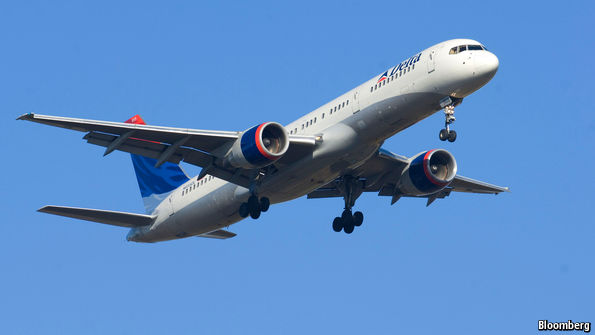
PEOPLE often enter a public toilet with a sense of trepidation; after all, who knows what horror might await behind the cubicle door. Even so, a passenger on a service between Manchester, Britain, and New York got a nasty surprise.
Earlier this month an American air marshal accidentally left her loaded gun in the loo of a Delta Air Lines plane bound for JFK. According to the New York Times, the weapon was found by a passenger, who handed it over the to the flight’s crew. The crew then returned it to the officer. The Times says that the air marshal did not report her oversight to authorities for several days, as is required, and had been assigned to other planes in the meantime. Using unimpeachable logic, one former air marshal explained to the paper: “You can’t have inept people leaving weapons in a lavatory. If someone with ill intent gets hold of that weapon on an aircraft, they are now armed.”
The idea of placing armed air marshals on commercial flights is a divisive one. We have discussed the issue on this blog…Continue reading
A market-related twist to the Dortmund bombing
WHEN three explosive devices hit a bus carrying the Borussia Dortmund football team on April 11th, it was immediately assumed that it was another Islamist attack. Notes were found at the scene of the crime alleging that Islam was the motivation, with the author claiming a link to the terrorist group Islamic State. But prosecutors in Germany allege a completely different rationale. They say that the suspect, a 28-year-old man, had borrowed money and taken out put options, which would benefit from a decline in Borussia Dortmund shares (which fell 3% on the day after the attack).
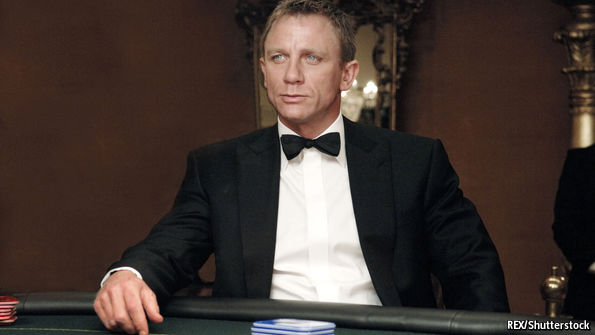
As yet, the suspect has not been convicted. But if true, the story would seem to come straight out of Hollywood. In the film “Casino Royale”, James Bond (as played by Daniel Craig) foils a plot to blow up an airliner owned by the fictional firm Skyfleet, after villain Hugo le Chiffre had sold the company’s shares short (ie, bet on their price to fall). In “The Fear index”, a Robert Harris novel, a hedge fund’s trading programme shorts an airline’s stock just before a fatal crash. It was rumoured, after the September 11…Continue reading
Is Tom Stuker the world’s most frequent flyer?

“AFTER entering a competition a lucky punter wins first prize: a week’s holiday in Skegness. Second prize is two weeks there.”
For some reason this most ancient of British jokes came to Gulliver’s mind when he read about Tom Stuker in the International Business Times. Mr Stuker, it is claimed, is the world’s most frequent flyer. He is about to clock up his 18-millionth mile on United Airlines. And as the Boarding Area blog points out, 18m miles with United means just that:
United calculates million miler status based on your “butt in seat” revenue miles flown on United. That’s right, we’re not talking about 10 million award miles, or even 10 million miles taking into account elite bonuses for flying first or business class.
Mr Stuker is president of a firm that trains sales staff at car dealerships around the world. He has flown to Australia over 300 times for business and pleasure; he travels to Hawaii “three…Continue reading