
Tag: Business and finance
Warren Buffett has many fans in China but few true followers

AS THE second-richest person in the world, and with a half-century record of investing success, Warren Buffett is a household name worldwide. But in China, he is something more: a celebrity. In March a special edition of Cherry Coke, featuring a cartoon image of the 86-year-old investor, hit Chinese shop shelves (Mr Buffett not only loves the sugary beverage; he is Coke’s largest shareholder). On May 6th thousands of Chinese investors will descend on Omaha for the annual meeting of Berkshire Hathaway, his holding company, and many more will tune into a live-stream of the event. Mandarin is the only foreign language into which the proceedings will be simultaneously translated. Those who miss the broadcast can pick up one of the hundreds of Chinese books about his approach to minting money.
Mr Buffett’s stature in China stems partly from good timing. China’s modern stockmarket was launched in 1990. Just as neophyte investors grappled with earnings reports and trend lines, the Oracle of Omaha’s reputation as the world’s best stock-picker was blossoming. Compared with the regular booms and busts of the Chinese stockmarket, the steady returns of Berkshire Hathaway…Continue reading
Investors are both bullish and skittish about share prices

TEN years ago this month investors were pretty confident. True, there were signs that problems in the American housing market would mean trouble for mortgage lenders. But most people agreed with Ben Bernanke, the Federal Reserve chairman, that “the impact on the broader economy…seems likely to be contained.” The IMF had just reported that “overall risks to the outlook seem less threatening than six months ago.”
That was reflected in market valuations. In May 2007 the cyclically-adjusted price-earnings ratio (CAPE), a measure that averages profits over ten years, was 27.6 for American equities (see chart). That ratio turned out to be the peak for the cycle. As the problems at Bear Stearns, Lehman Brothers and others emerged, and as the world was gripped by recession, share prices plunged. By March 2009 the CAPE had fallen by more than half.
Central banks then kicked into action, slashing interest rates and buying assets via quantitative easing (QE). The stockmarkets recovered rapidly and the S&P 500 is now more than 50% higher than it was ten years ago. And the American stockmarket’s CAPE, at 29.2, is also higher than it was…Continue reading
Puerto Rico declares bankruptcy at last

THE government of Puerto Rico said in 2015 that the island could not pay its debts. Yet it was only on May 3rd that it kicked off the biggest bankruptcy case in America’s history. Public-sector debts total almost $74bn (around 100% of GNP). The drawn-out fiscal crisis has both imperilled Puerto Rico’s economy and upended the island’s politics.
Something akin to bankruptcy is possible only because of a federal law passed in 2016. Until then, the island’s legal status as a territory afforded it no escape from its debts (were Puerto Rico a state, its public utilities could have declared bankruptcy). The law established a “financial oversight board”, appointed in Washington, with the task of reaching a deal with bondholders. But it also allowed for bankruptcy-like proceedings should negotiations fail.
A two-thirds majority of bondholders would have forced all of them to accept a reduction in the value of their debt. Yet agreement was always unlikely. Puerto Rica’s constitution says payments to holders of so-called “general obligation” bonds have priority over all other expenditure. But another group of creditors have first dibs on revenue from the sales…Continue reading
Price-bots can collude against consumers

MARTHA’S VINEYARD, an island off the coast of Massachusetts, is a favourite summer retreat for well-to-do Americans. A few years ago, visitors noticed that petrol prices were considerably higher than in nearby Cape Cod. Even those with deep pockets hate to be ripped off. A price-fixing suit was brought against four of the island’s petrol stations. The judges found no evidence of a conspiracy to raise prices, but they did note that the market was conducive to “tacit collusion” between retailers. In such circumstances, rival firms tend to come to an implicit understanding that boosts profits at the expense of consumers.
No one went to jail. Whereas explicit collusion over prices is illegal, tacit collusion is not—though trustbusters attempt to forestall it by, for instance, blocking mergers that leave markets at the mercy of a handful of suppliers. But what if the conditions that foster such tacit collusion were to become widespread? A recent book* by Ariel Ezrachi and Maurice Stucke, two experts on competition policy, argues this is all too likely. As more and more purchases are made online, sellers rely increasingly on sophisticated algorithms to set prices. And…Continue reading
Congress is right to be upset with America’s airlines

WHEN politicians feel they must summon industry bosses and implore them to treat customers better, it is a sure sign that the market is not working as it should. On May 2nd, a Congressional committee pleaded with airline bosses to improve service or, by implication, face legislation to force them to be nicer. Flyers, said Bill Shuster, the Republican chairmen of the House transport committee, are “tired of being treated inappropriately and without courtesy. Something is broken, and the obvious divide between passengers and airlines needs to be addressed.” Fix it, he added, or “we are going to come and you’re not going to like it”.
Among the executives hairshirting it to Washington, DC were representatives from American Airlines, Delta, Southwest and Alaska Airlines, as well as Oscar Munoz (pictured), the boss of United, which has become the emblem of just how disdainful carriers have become towards their customers. In the face of repeated criticism from Congressmen, the airlines did their best to sound contrite. Mr Munoz again repeated his mantra that the recent controversy, when a doctor was dragged semi-conscious from the seat he had paid for to make way for airline staff, “is not who…Continue reading
Euro-area GDP growth outpaces America’s
THE enduring appeal of GDP is that it offers, or seems to, a summary statistic that tells people how well an economy is doing. On that basis, the euro-area economy is in fine fettle, indeed it is improving at a faster rate than America’s. Figures released today show that GDP in the currency zone rose by 0.5% in the first quarter of 2017, an annualised rate of around 2%. That is quite a bit faster than the 0.7% rate reported in the same period for America’s GDP.
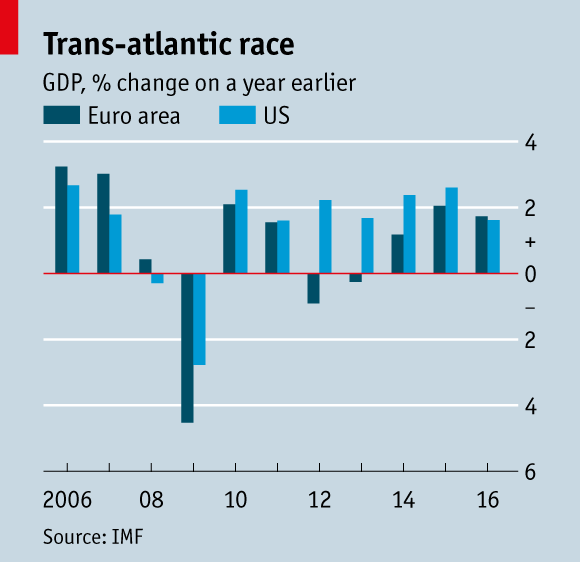
These figures probably overstate the gap between the two economies. In recent years, first-quarter estimates of GDP growth in…Continue reading
Home-sharing sites are targeting business travellers

BUSINESS travel accounts for about a third of total travel spending in America, according to the United States Travel Association, an industry group. But Airbnb, a private firm which is probably the world’s second most valuable hospitality provider after Marriott, gets less than 10% of its business from people travelling for work. As the San Francisco-based company continues to expand, it’s pretty clear whom it will be targeting.
This week Airbnb is rolling out a new tool specifically for business travellers to book home rentals. All listings deemed “Business Travel Ready” (BTR) feature free Wi-Fi, a desk, soap, shampoo, a hairdryer, an iron and check-in with a doorman (or a digital lock). In other words, all the basic amenities of a hotel. The tool also allows companies to track their spending, receive invoices directly, and manage employees’ itineraries.
Even if it is still principally for vacationers, Airbnb has seen a surge in…Continue reading
America’s economic growth slows to 0.7%
THE news that America’s GDP growth slowed to 0.7% on an annualised basis in the first quarter of 2017 is no real surprise, for two reasons. First, although consumer and small business confidence have soared since Donald Trump won the presidential election, most measures of actual economic activity have failed to display the same vim (see article). Second, it is often the case that growth sags in the first quarter of the year, despite recent efforts by statisticians to purge the economic data of seasonality. Since 2010, excluding today’s release, first-quarter GDP growth has averaged just 1.1%, compared with 2.5% at other times in the year. Judged against that benchmark, the latest data are only a little disappointing.
The more interesting story is a shift in the composition of growth….Continue reading
United Airlines changes its policy on bumping passengers

UNITED AIRLINES is making amends. After an unconscionable incident earlier this month, in which a passenger who refused to be bumped from a flight was forcibly dragged off the plane, on 27th April the airline announced 10 policy changes aimed at preventing such indignities in the future. Chief among them are increasing the maximum compensation offered to passengers who agree to be bumped to $10,000, and an end to the practice of forcing passengers on the plane to give up their seats against their will, unless they pose a safety risk.
Bravo, United? Not quite. The airline had little choice but to make big, public, rapid changes. In a survey following the incident at…Continue reading
India's Patanjali takes on Western consumer-goods firms

EXECUTIVES at firms selling consumer staples like to think of themselves as “marketing gurus”. But how many could actually contort themselves into the lotus position, let alone attempt a headstand? Such feats are nothing for the top brass at Patanjali, an Indian purveyor of toothpaste, cooking oil, herbal concoctions and much else. Fronted by a bona fide guru, the firm’s marketing strategy—play up the benefits of natural products, then paint foreign multinationals as latter-day imperialists—delivers over $1bn in annual sales, up tenfold in four years. Having dismissed the firm as a fad, the likes of Colgate-Palmolive and Unilever are emulating it.
Baba Ramdev (pictured), an ascetic yogi who is the public face of the brand, makes for an unconventional capitalist symbol. But with Acharya Balkrishna, a devotee of his who serves as the firm’s boss and majority-owner, he has built a consumer-goods powerhouse that is vying with the business-school graduates at the multinationals. Starting out two decades ago as an apothecary of traditional Ayurvedic potions, Patanjali has expanded into personal care, home products, packaged food and more. Mr Ramdev’s beard and saffron…Continue reading