
Tag: Business and finance
Stockmarkets give up some of their Trump bump
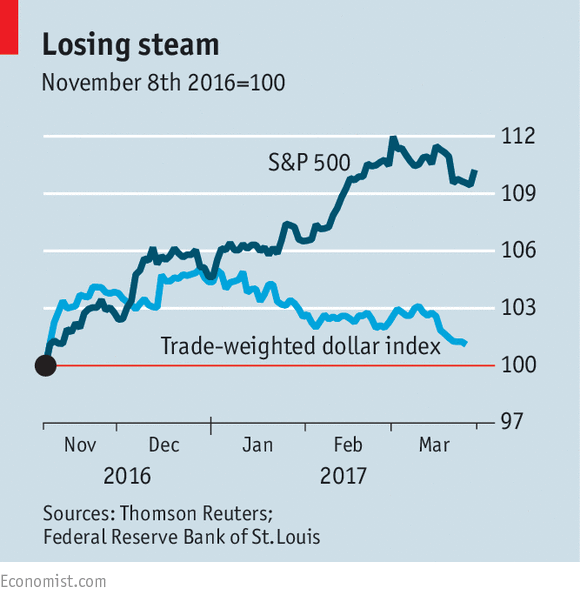
HONEYMOONS don’t last for ever. Having been a reluctant bride to President Donald Trump when courted in the run-up to November’s election, the American stockmarket quickly melted into a mood of romantic euphoria. Shares rose by 12% between election day and March 1st (see chart). But in recent days, sentiment has dimmed. There is talk of the “Trump-disappointment trade”.
For the markets to experience some kind of sell-off is hardly a surprise. The S&P 500 index had gone more than 100 days without a 1% decline, the longest such streak since 1995. And the setback should not be exaggerated. The S&P 500 remains well above its pre-election level, compared with the dollar, which has given up around half its gains. The ten-year Treasury-bond yield, which hit 2.62% on March 13th, has dropped back to 2.38%.
The immediate cause of the retreat seemed to be the failure of Mr Trump to repeal his predecessor’s health-care bill. That logic was hardly a great advertisement for capitalism, implying that the fewer Americans had access to health insurance, the happier investors would be. But the broader rationale seemed to be that, if the Republicans…Continue reading
What gets left behind in an Uber

IN THEORY, leaving an item in an Uber car should induce less panic than leaving something in a cab. After all, you can just pull out your phone and look up the name and number of your driver. Unless, of course, the item you left behind is your phone.
This week, the ride-hailing company unveiled the “Uber Lost & Found Index”, which documents the things most commonly left behind in its cars. Topping the list is, inevitably, phones.
Rings are the second most frequently abandoned possessions, followed by keys, wallets and glasses. The firm says that the day of the week has a significant effect on what is lost. (In truth, many of the conclusions can probably be explained by the Texas sharpshooter fallacy, but why spoil a fun story?) Saturdays bring the biggest haul of lost plane tickets. Passengers are likeliest to leave their swimsuits behind on Tuesdays. And wedding dresses are most often forgotten on Sundays—presumably because they are left behind by tired and emotional couples who had tied the knot the day…Continue reading
Will robots displace humans as motorised vehicles replaced horses?

IN THE early 20th century the future seemed bright for horse employment. Within 50 years cars and tractors made short work of equine livelihoods. Some futurists see a cautionary tale for humanity in the fate of the horse: it was economically indispensable until it wasn’t. The common retort to such concerns is that humans are far more cognitively adaptable than beasts of burden. Yet as robots grow more nimble, humans look increasingly vulnerable. A new working paper concludes that between 1990 and 2007, each industrial robot added per thousand workers reduced employment in America by nearly six workers. Humanity may not be sent out to pasture, but the parallel with horses is still uncomfortably close.
Robots are just one small part of the technological wave squeezing people. The International Federation of Robotics defines industrial robots as machines that are automatically controlled and re-programmable; single-purpose equipment does not count. The worldwide population of such creatures is below 2m; America has slightly less than two robots per 1,000 workers (Europe has a bit more than two). But their numbers are growing, as is the range of tasks they…Continue reading
Will robots displace humans as motorised vehicles ousted horses?

IN THE early 20th century the future seemed bright for horse employment. Within 50 years cars and tractors made short work of equine livelihoods. Some futurists see a cautionary tale for humanity in the fate of the horse: it was economically indispensable until it wasn’t. The common retort to such concerns is that humans are far more cognitively adaptable than beasts of burden. Yet as robots grow more nimble, humans look increasingly vulnerable. A new working paper concludes that, between 1990 and 2007, each industrial robot added per thousand workers reduced employment in America by nearly six workers. Humanity may not be sent out to pasture, but the parallel with horses is still uncomfortably close.
Robots are just one small part of the technological wave squeezing people. The International Federation of Robotics defines industrial robots as machines that are automatically controlled and re-programmable; single-purpose equipment does not count. The worldwide population of such creatures is below 2m; America has slightly fewer than two robots per 1,000 workers (Europe has a bit more than two). But their numbers are growing, as is the range of tasks they can tackle, so…Continue reading
Podcast: Luxury for the masses?
The Chinese middle class led a boom in demand for luxury goods. But a government crackdown made consumers wary about showing off their wealth. How has China’s new modesty affected the luxury business as a whole? Also: India’s power sector has until now been dependent on using dirty coal but things are changing. And sand has become a scarce resource, leading to a burgeoning trade in illegal mining. Simon Long hosts.
Smoking rooms in airports are being stubbed out

IT IS about 15 years since Gulliver gave up the evil weed. Over time, many of the hardships of being a smoker have become mere embers in his memory. But a recollection was kindled after reading a recent report by Airports Council International, an industry group. In it, ACI listed the three current amenities that are most likely to disappear from American airports in the near future. It is an unsurprising triumvirate: payphones, banks and smoking rooms.
There are good reasons to suppress memories of frantic searches for somewhere to have a final cough-and-a-drag before the forced abstinence of a long-haul flight. Even better cause to forget the disgusting rooms that awaited at the end of those searches. After reading the ACI report, a particular impression resurfaced of a tiny perspex pod in the departure lounge at Gatwick airport that used to pass as a smoking room. Standing in it, cheek to cheek with equally desperate souls, while fans thundered overhead, it felt as if your dignity was being sucked away alongside your smoke.
Those rooms have now gone….Continue reading
The Brexit arguments work for Scotland too

THERE is an old chess short story about the grand master who ends up in a remote village. Short of money, he agrees to pay two locals; his meal will be free if he wins both matches. But there is a catch; in one game, he must play as white, in the other as black. As soon as the matches start, he realises his mistake when the man playing white in the second game simply copies the grand master’s moves as white in the first. No matters what the master does, he cannot win both games; if he wins in the first, he must lose in the second.
The three-way negotiations between Britain, the EU and Scotland could yet work out the same way. Every argument used by Theresa May against the EU can be used her by Nicola Sturgeon.
Taking back control. The Leave campaign clearly resonated with voters when it talked about the need for Britain to take back control of its laws from a remote Brussels bureaucracy. But the argument applies just as well in Scotland where the Conservatives last won most seats in 1955; in the 2010 and 2015 elections, the Tories got one seat but the Scots still ended up with a Conservative prime minister. It will probably happen in 2020 as well. Do the Scots have…Continue reading
How airlines are responding to America’s laptop ban
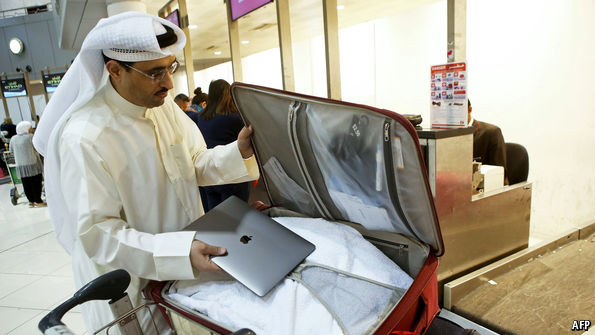
THE recently announced ban on laptops and other large electronic devices on direct flights from Middle Eastern airports to America is bad news for business travellers hoping to get work done on these long journeys. That, in turn, spells trouble for the airlines that fly these routes. Carriers like Emirates, Turkish, Qatar, and Etihad compete for long-haul flyers all over the world. They have just become a little bit less competitive. (Gulliver recently booked a flight from Manila to Washington, DC on Emirates, via Dubai; had he known what was coming, he might well have opted to fly via Tokyo or Beijing instead.)
Turkish Airlines stock tumbled more than 7% after the ban was announced in America. (Britain announced similar restrictions soon after, though crucially the superconnectors’ hubs in the United Arab Emirates, Qatar and Turkey were not included.) Rival airlines, meanwhile, are thrilled at the news. Emirates, Etihad and Qatar currently serve half the travellers flying between India and the United States, for example. Air India now
Companies are racing to add value to water

PRESENTED in an unusually-shaped heavy glass bottle with outsized black lettering, it could be a fine vodka. On sale for £80 ($99) in Harrods, an upmarket department store in London, it has a price tag to match. In fact, it is a bottle of water. Harvested directly from Norwegian icebergs that are up to 4,000 years old, Svalbardi is one of hundreds of water brands that are sourced from exotic places and marketed as luxury products.
From the basic to the expensive, the market for bottled water is an attractive place to be. According to Zenith Global, a consulting firm, the global market has grown by 9% annually in recent years and is worth $147bn. The main reason is changing lifestyles. People are spending more time, and eating more of their meals, away from home. They are also switching from soft drinks and alcohol to healthier fare. Data from Beverage Marketing Corporation (BMC), another consultancy, show that consumption of bottled water overtook that of sugary soft drinks in America in 2016 (see chart).
An earthquake in European banking

IN BRITAIN alone millions of people make formal complaints each year about their banks. For them, Sebastian Siemiatkowski, founder of Klarna, a Swedish payments startup, brings good news. New European rules, he says, will open the door to a host of innovative services that analyse transactions, so “an app could tell you there’s a cheaper mortgage available and start the switching process for you.” Apps could warn account-holders if they spend more than a predetermined amount or are about to become overdrawn, or even nudge them to save more. Customers need barely ever interact with their bank.
To date, despite dire warnings, European retail banking has been remarkably unscathed by technology-driven disruption. Customers stay loyal, and banks still do the most of the lending. Financial-technology (“fintech”) companies are beginning to mount a challenge, most conspicuously in the online-payments industry in northern Europe: Sofort, iDEAL and other fintech firms conduct over half of online transactions in Germany and the Netherlands, for example. But their reach is more limited elsewhere in Europe. Physical payments are still overwhelmingly made with cash or bank…Continue reading