
Tag: Business and finance
Flyers rarely complain even when they should

BUSINESS travellers are hardy souls. It goes with the territory. Theirs is a life of jet lag, cramped seating and reheated meals, all washed down with weak cups of coffee. Small wonder, then, that a recent study by Clarabridge, a technology firm, suggests that few travellers ever actually lodge complaints about their flights. It surveyed almost 2,500 passengers in Britain and America and found that about two-thirds of respondents have never aired a grievance, even when they had good reason to do so. This is despite the fact that complaints are on the rise overall, as Gulliver has previously reported.
Why are so many reluctant to complain? One reason is that passengers think airlines will ignore them. This explanation was given by about a third of those who have never complained, according to Clarabridge’s study.
This should worry…Continue reading
Can you afford to retire?

HOW much money do you need to retire? Depending on your age, it is a question you think about a lot (if retirement is imminent) or barely at all. For younger people, the subject is a combination of too far away, too complex and too boring, and too depressing. When you consider that you might live for 20, 25 or even 30 years after you stop working, it is a pretty important issue.
Say you want to retire on £20,000 a year (not a fortune) and you are 65. The best annuity rate at the moment in the UK is just under 5.2% which means you would need a pot of £385,000 to afford this. But hold on a minute. That is a flat £20,000 which does not account for inflation; if prices rise at 3% a year, the value of that pension will halve by your 90th birthday. To get an income of £20,000 that is guaranteed to rise in line with prices, you would need a pot of £619,000. (For American readers, the dollar amounts won’t be exactly the same, but they will be in the ballpark).
These are very big sums and explain why private sector…Continue reading
A Chinese carmaker agrees to buy a Danish investment bank
A COMPANY that moves up the value chain from refrigerator parts to cars is impressive but not that surprising. A car company that buys an investment bank is audacious. But Zhejiang Geely Holding Group, a conglomerate based in Hangzhou, China, did not become big by paring its ambitions. Having successfully made the fridge-parts-to-cars transition at home, it went global in 2010. It acquired Volvo, a Swedish carmaker, from Ford of America. Now Geely is back in Scandinavia for another acquisition. This time it is buying one of Denmark’s biggest banks.
Saxo Bank announced on October 2nd that Geely would acquire 51.5% of its shares. It will spend over $800m on the deal, which still requires regulatory approval. Sampo Group, a Finnish insurance company, will acquire 19.9% of Saxo shares for €265m ($311m), and Kim Fournais, Saxo’s co-founder and chief executive, will retain 25.7%. The sellers are Sinar Mas, an Indonesian conglomerate, and TPG, an American private-equity firm.
Saxo was an early adopter of online securities trading and still invests heavily in financial technology. It makes a substantial portion of its profits from selling trading platforms to other firms. Daniel Donghui Li, Geely’s chief financial officer, says Geely hopes to expand Saxo’s technologies into Asia. Besides facilitating this expansion, Geely does not intend to change how…Continue reading
A new study details the wealth hidden in tax havens
SWITZERLAND, which developed cross-border wealth-management in the 1920s, was once in a league of its own as a tax haven. Since the 1980s, however, tax-dodgers have been spoilt for choice: they can hide assets anywhere from the Bahamas to Hong Kong. The percentage of global wealth held offshore has increased dramatically. But it has been hard to say how much that is, and who owns it.
Few offshore centres used to disclose such data. But in 2016 many authorised the Bank for International Settlements (BIS) to make banking statistics publicly available. Using these data, a new study by Annette Alstadsaeter, Niels Johannesen and Gabriel Zucman, three economists, concludes that tax havens hoard wealth equivalent to about 10% of global GDP. This average masks big variations. Russian assets worth 50% of GDP are held offshore; countries such as Venezuela, Saudi Arabia and the United Arab Emirates climb into the 60-70% range. Britain and continental Europe come in at 15%, but Scandinavia at only a few per cent.
One conclusion is that high tax rates, like those in Denmark or Sweden, do not drive people offshore. Rather, higher offshore wealth is correlated with factors such as political and economic instability and an abundance of natural resources.
Proximity to Switzerland also remains a good indicator. But assets held there have declined since the financial…Continue reading
Tech giants are building their own undersea fibre-optic networks

WHEN Cyrus Field, an American businessman, laid the first trans-Atlantic cable in 1858, it was hailed as one of the great technological achievements of its time and celebrated with bonfires, fireworks and 100-gun salutes. Alas, the reason for the festivities soon went away. Within weeks the cable failed.
On September 21st the completion of another trans-Atlantic cable was welcomed with much less ado. But it is remarkable nevertheless: dubbed Marea, Spanish for “tide”, the 6,600km bundle of eight fibre-optic threads, roughly the size of a garden hose, is the highest-capacity connection across the ocean. Stretching from Virginia Beach, Virginia, to Bilbao, Spain, it is capable of transferring 160 terabits of data every second, the equivalent of more than 5,000 high-resolution movies. It is jointly owned by Facebook and Microsoft.
Such ultra-fast fibre networks are needed to keep up with the torrent of…Continue reading
How protectionism sank America’s entire merchant fleet

IN APRIL 1956 the world’s first container ship—the Ideal X—set sail from New Jersey. A year later in Seattle the world’s first commercially successful airliner, Boeing’s 707, made its maiden flight. Both developments slashed the cost of moving cargo and people. Boeing still makes half the world’s airliners. But America’s shipping fleet, 17% of the global total in 1960, accounts for just 0.4% today.
Blame a 1920 law known as the Jones Act, which decrees that trade between domestic ports be carried by American-flagged and -built ships, at least 75% owned and crewed by American citizens. After Hurricane Irma, a shortage of Jones-Act ships led President Donald Trump on September 28th to waive the rules for ten days to resupply Puerto Rico. This fuelled calls to repeal the law completely.
Like most forms of protectionism, the Jones Act hits consumers hard. A lack of foreign competition drives up the cost of coastal transport….Continue reading
Ford has a clear plan to fix its present failings
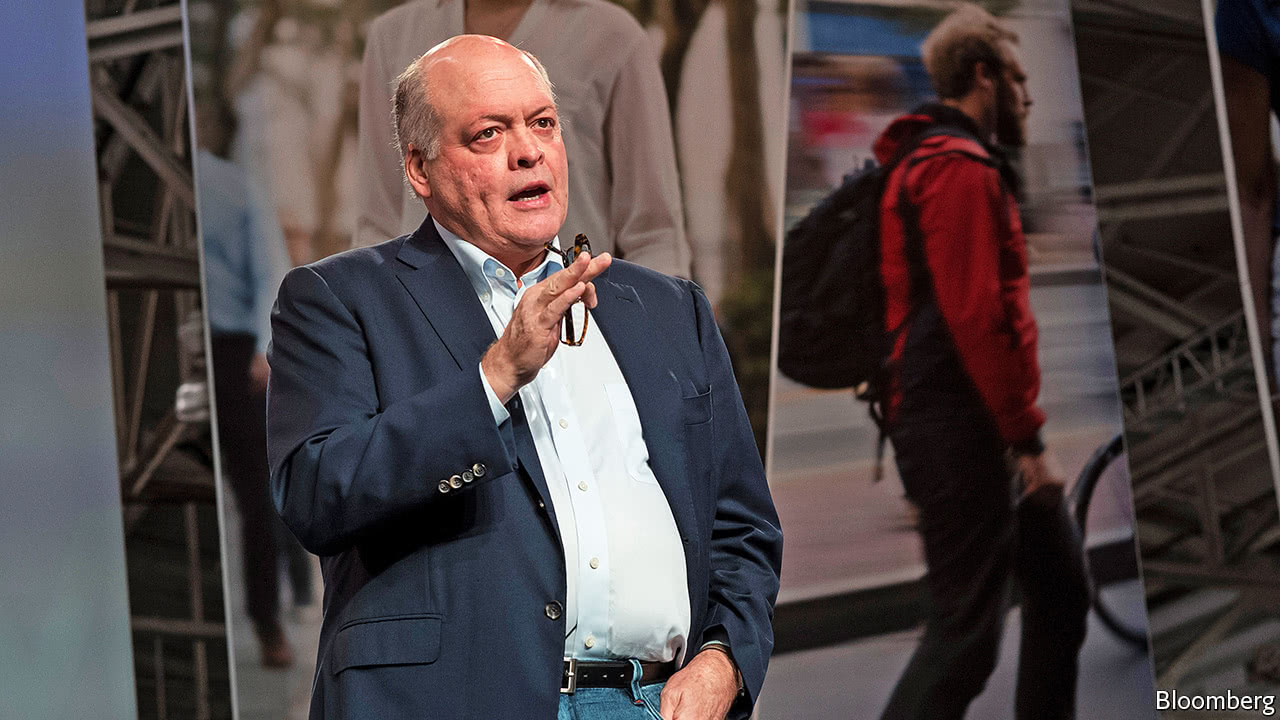
LIKE any mechanic with a misfiring car, Ford’s new boss has had his head under the bonnet working out what needs attention. Jim Hackett emerged on October 3rd with a checklist of repairs to present to investors, who have been awaiting his diagnosis since he took over in May. The list is short but the engineering is complicated: restore Ford’s competitiveness while preparing for a future of electric vehicles (EVs), self-driving cars and transport services. But those expecting a radical overhaul were probably disappointed.
Mr Hackett’s predecessor, Mark Fields, was shown the door by Bill Ford, the firm’s chairman, for failing to make a persuasive case that he was reinventing Ford as a mobility firm at the forefront of automotive technology. Despite acknowledging to investors that he and Mr Ford agreed that his new job was “about the future not the past”, Mr Hackett was clearest about how to make Ford fit for the…Continue reading
Taxing fat and subsidising healthy eating widens inequality

IN RICH countries, people’s diets are getting worse and they are getting fatter. Hence the increasing popularity of a “fat tax”, to make unhealthy food cost more. Since Hungary led the charge in 2011 with a “chip tax” on fatty and sugary foods, other countries have followed. Britain is to join a long list next year.
Since the poor both spend a higher proportion of their income on food and tend to eat less healthily, they are the main targets of such taxes. In France, for instance, adult obesity is seen in over 20% of households with monthly incomes under €1,500 ($1,765) compared with less than 10% of those who earn over €3,000.
Punishing consumers, however, is politically painful. So “thin subsidies” have been gaining ground. But data on the impact of such policies are scarce. A recent study on the distributional impacts of fat taxes and thin subsidies from researchers at the universities of Oklahoma and Grenoble suggests policymakers should be…Continue reading
The bosses of two famous French firms struggle to keep customers

ALEXANDRE RICARD wants to talk boxing. He runs Pernod Ricard, a firm that sells Chivas whisky and Absolut vodka, among other drinks. Formed by his grandfather in 1975, with roots in a Pernod distiller set up in 1805, it is the world’s second-largest seller of wine and spirits, with a market capitalisation of €32bn ($37bn). He brags that Floyd Mayweather, an American pugilist with 19m Instagram followers, recently endorsed one of the company’s tequila brands. Such a “key influencer” on a digital channel “gives us speed and scale”, says Mr Ricard.
Celebrity endorsements are an old ploy: French singers, actors and racing drivers used to push Pernod Ricard’s liquor. But with 90% of sales in markets outside of France, punchier efforts are needed. Two years ago the firm commissioned a global study of boozing habits, which totted up all “moments of consumption” for drinkers, identifying 20 important ones in…Continue reading
Unequal at work, men and women are even more so in retirement

“THE retirement-savings crisis is a women’s crisis,” says Sallie Krawcheck, co-founder of Ellevest, a financial-advice firm for women in America. When it comes to retirement income, women are far worse-off than men. The gender pension-gap may be less well-known than the gender pay-gap, but it is in fact far larger.
Among those retired in the EU, women on average receive 39% less in pension income—from state and workplace pensions—than men do (see chart). This puts women at greater risk of old-age poverty. The European Institute for Gender Equality, a think-tank, warned in a study in 2015 that it also makes them more likely to stay with abusive partners. Reforms to European pensions, tying benefits even closer to individual contributions and thus income, mean the gap may widen further.
