
Tag: Business and finance
Goldman Sachs announces a change in strategy

IT IS not easy to feel pity for Goldman Sachs. Its alumni lord it in pivotal government positions around the world; from every prestigious business school, applicants queue in hope of a job; its senior executives earn eye-watering amounts; and it has a presence, it seems, in every corner of the global economy. Yet these are troubling times for the bank. It is facing fundamental questions about its business model.
Its investors are particularly worried by a precipitous decline in the fortunes of its core fixed-income, currencies and commodities unit (FICC). That is the business from which Goldman’s current leadership graduated. The bank’s president, Harvey Schwartz, used a conference on September 12th to give an unusually detailed account of how it is changing. He outlined plans for igniting growth in an apparently stagnant business, and for preserving profitability despite that stagnation.
One factor in Goldman’s problems has been a change in its staff structure. In the hunt…Continue reading
Retail banks’ foreign ventures rarely pay off

NOT everybody—or every business—travels well. Retailers from Walmart to Tesco have faltered in forays into foreign lands. Banks, too, often fancy that success at home can be reproduced abroad. In meeting the needs of big companies, they are often right. Global corporations seem to want global banks. But in retail banking, serving households and small businesses, they are usually mistaken.
Or so concludes a report by Lorraine Quoirez and her colleagues at UBS, examining the performance of seven international banks (BBVA, Citigroup, HSBC, ING, Santander, Société Générale and Standard Chartered). For several measures, such as net interest margins and returns on equity, the Swiss bank’s analysts constructed benchmarks for each firm. The benchmarks are the averages for all banks in countries where the seven are active, weighted by the importance of each market in each bank’s loan book.
Most of the banks fall short on most measures. For example, UBS expects…Continue reading
The Fed prepares for its balance-sheet—and its board—to shrink
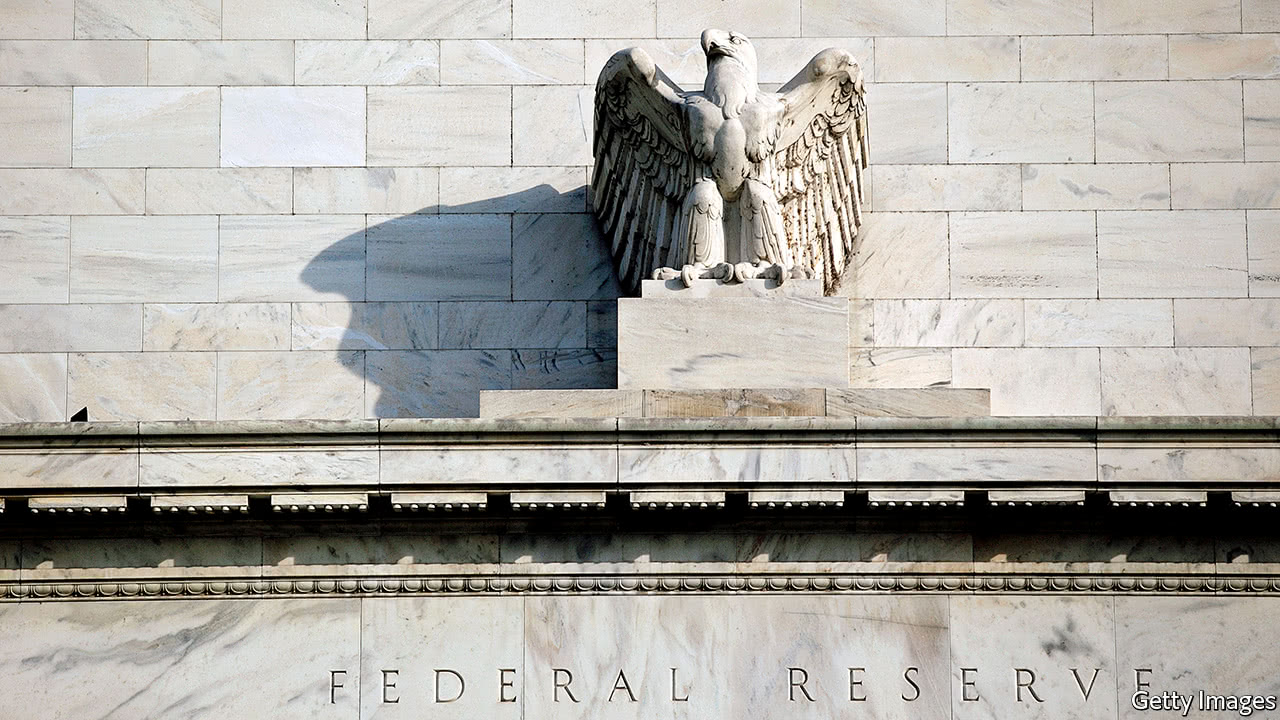
NINE years ago, in the autumn of 2008, the Federal Reserve was fighting a financial collapse. To stave off disaster, it lent aggressively—to banks, to money-market funds, even to other central banks. As a result, its balance-sheet ballooned. At the start of September 2008, the month when Lehman Brothers collapsed, the Fed’s assets totalled $905bn (at the time, about 6% of GDP). By December they had more than doubled in size, to $2.1trn. That was only the start. As its emergency lending unwound, the Fed began purchasing government debt and mortgage-backed securities (MBSs), in an attempt to support the real economy. Three volleys of so-called “quantitative easing” (QE) eventually swelled the balance-sheet to $4.5trn by 2015.
On September 20th the Fed will probably announce that it is putting QE into reverse. It does not intend to sell its assets. Rather, as its securities mature, it will stop reinvesting all of the proceeds. The permitted monthly “run-off” will gradually rise…Continue reading
Stanley Fischer and the twilight of technocracy
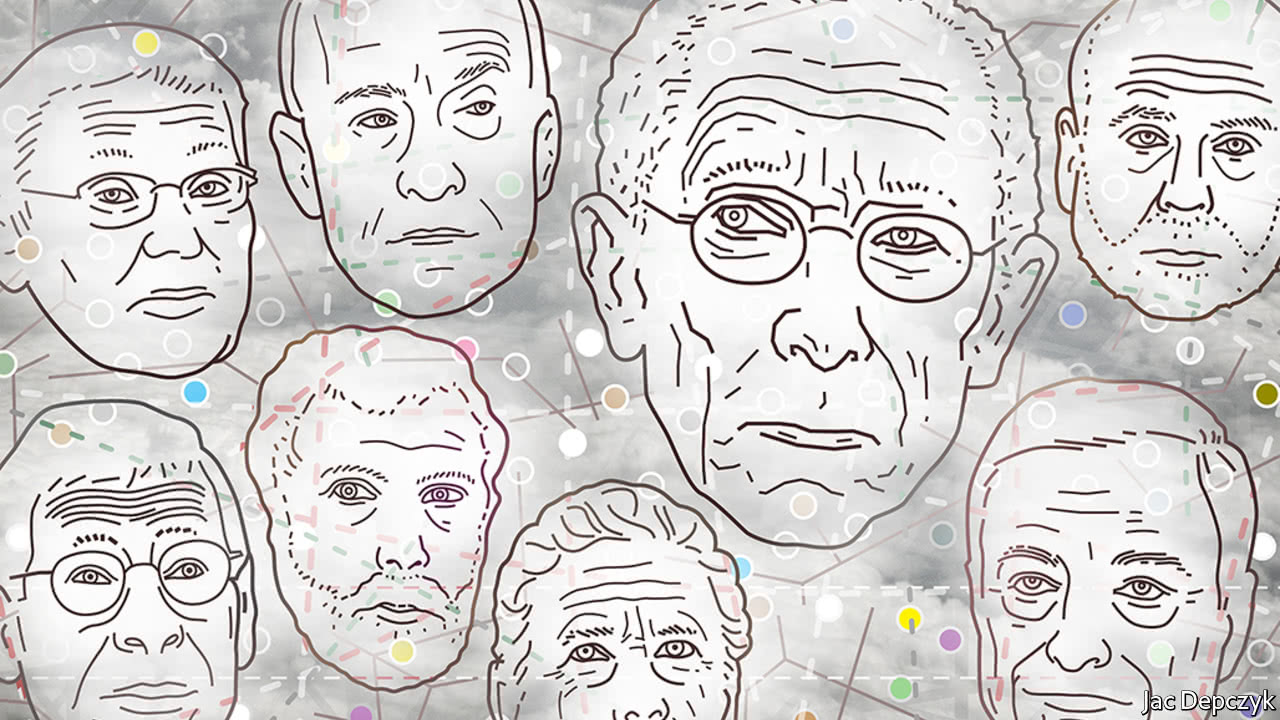
IN 2004 Stanley Fischer described the wonder he felt as an economics student in the 1960s. “You had a set of equations”, he said, “that meant you could control the economy.” Technocracy—the dream of scientific government by a caste of wise men—arose in the 20th century, as rapid change rendered the world unfathomably complex; in economics, it came of age in the Keynesian revolution of the 1930s. On September 6th, after a remarkably distinguished career in public service, Mr Fischer, an intellectual heir to Keynes, announced his imminent retirement as the vice-chairman of the Federal Reserve. It is tempting to see in his departure the end of the era and the ideal of technocracy.
A century ago, as physicists unlocked the secrets of the atom and biochemists probed the molecular basis of life, economists sought to systematise their own field. But the growing complexity of their work created a problem: laymen could not make head or tail of it. Government consultation with experts,…Continue reading
Initial Coin Offering means investor caution obligatory

HERE is the deal. You can buy an entry in a computer ledger issued by a startup company on the basis of an unregulated prospectus. It is called an “initial coin offering” or ICO. But though the ledger entry is called a coin, you cannot spend it in any shop. And whereas the use of the term ICO makes it sound like an IPO (initial public offering), the process whereby a firm lists on a stockmarket, coin ownership does not necessarily get you equity in the company concerned.
This sounds like the kind of bargain that would appeal only to people who reply to e-mails from Nigerian princes offering to transfer millions to their accounts. But ICOs may well be the most popular investment craze since the dotcom boom of 1999-2000; even Paris Hilton, a celebrity heiress, has jumped on the bandwagon. The list of active, upcoming and recent ICOs on the website “ICO alert” covers 31 pages of A4 paper and includes around 600 companies. More than $2bn has been raised in total.
There is…Continue reading
ICO stands for Investor Caution Obligatory

HERE is the deal. You can buy an entry in a computer ledger issued by a startup company on the basis of an unregulated prospectus. It is called an “initial coin offering” or ICO. But though the ledger entry is called a coin, you cannot spend it in any shop. And whereas the use of the term ICO makes it sound like an IPO (initial public offering), the process whereby a firm lists on a stockmarket, coin ownership does not necessarily get you equity in the company concerned.
This sounds like the kind of bargain that would appeal only to people who reply to e-mails from Nigerian princes offering to transfer millions to their accounts. But ICOs may well be the most popular investment craze since the dotcom boom of 1999-2000; even Paris Hilton, a celebrity heiress, has jumped on the bandwagon. The list of active, upcoming and recent ICOs on the website “ICO alert” covers 31 pages of A4 paper and includes around 600 companies. More than $2bn has been raised in…Continue reading
More business travellers are booking their own trips

A friend of Gulliver’s recently received some devastating news, in the form of a change to company policy. No longer would he and his co-workers be able to book their own flights and file for reimbursements. Instead, the firm would buy all employees’ plane tickets from the start.
On the face of it, this is a convenient change. It saves staff time by ensuring that they do not have to fill in tedious expense forms. But many business travellers may not see it that way. A study from Phocuswright, a travel-research firm, finds that more and more employees are booking their own travel and filing for reimbursements. Sometimes doing so allows for a better itinerary: travellers can avoid annoying layovers and airlines for which they reserve particular ire. Sometimes, if they are feeling generous towards their employer, it can save money too.
But the most-compelling reason is often the credit-card reward points. Say you are booking a flight from London to New York. On United Airlines, the round-trip will earn you close to…Continue reading
Will credit cause a slowdown?

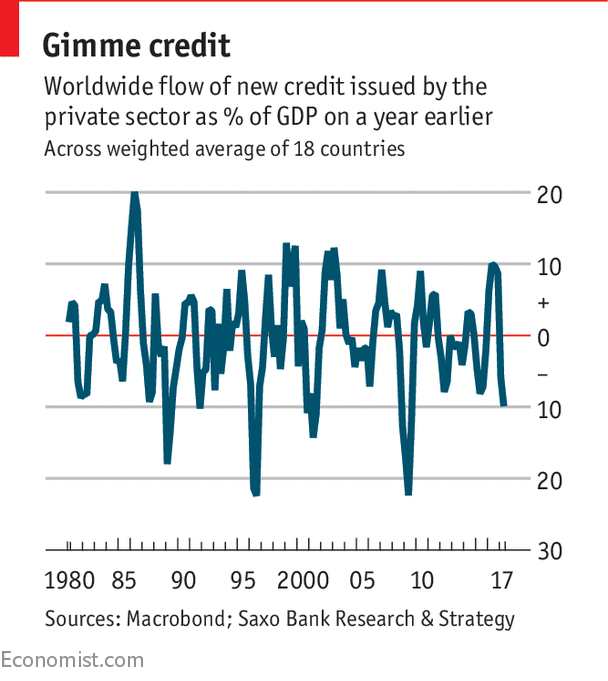
IF THERE is a consensus at the moment, it is that the global economy is finally managing a synchronised recovery. The purchasing managers’ index for global manufacturing is at its highest level for six years; copper, the metal often seen as the most sensitive to global conditions, is up by a quarter since May.
America’s utilities prepare for a nuclear threat to the grid

WHEN North Korea said on September 3rd that it had developed a hydrogen bomb, adding that it could be used for a “super-powerful” high-altitude electromagnetic pulse (HEMP) attack, America’s electricity industry was already on alert. Sceptics tend to dismiss as far-fetched the idea that the rogue regime would knock out the electricity grid by detonating a nuclear bomb high in the atmosphere. Regulators have not mandated safety measures. But the utilities are taking it seriously enough.
They are more than a year into a three-year programme, funded by about 60 electricity firms, to understand the potential impact of a HEMP attack on the generation and transmission of electricity, and to find ways to shield the network. Such concerns are not new. In 1962, when America exploded nuclear devices high above the Pacific, electrical damage was found in Hawaii. The industry has also studied analogous space-weather effects on power systems,…Continue reading
Mobile technology is revamping loyalty schemes
THOSE of a cynical bent might think Tom Stuker a glutton for punishment. Over the years, Mr Stuker has flown more than 18m miles (29m kilometres) on United Airlines, a carrier not always renowned for treating its passengers tenderly. Mr Stuker may possess the world’s most impressive frequent-flyer account. Over the past half-decade he has averaged over 1m miles a year with United.
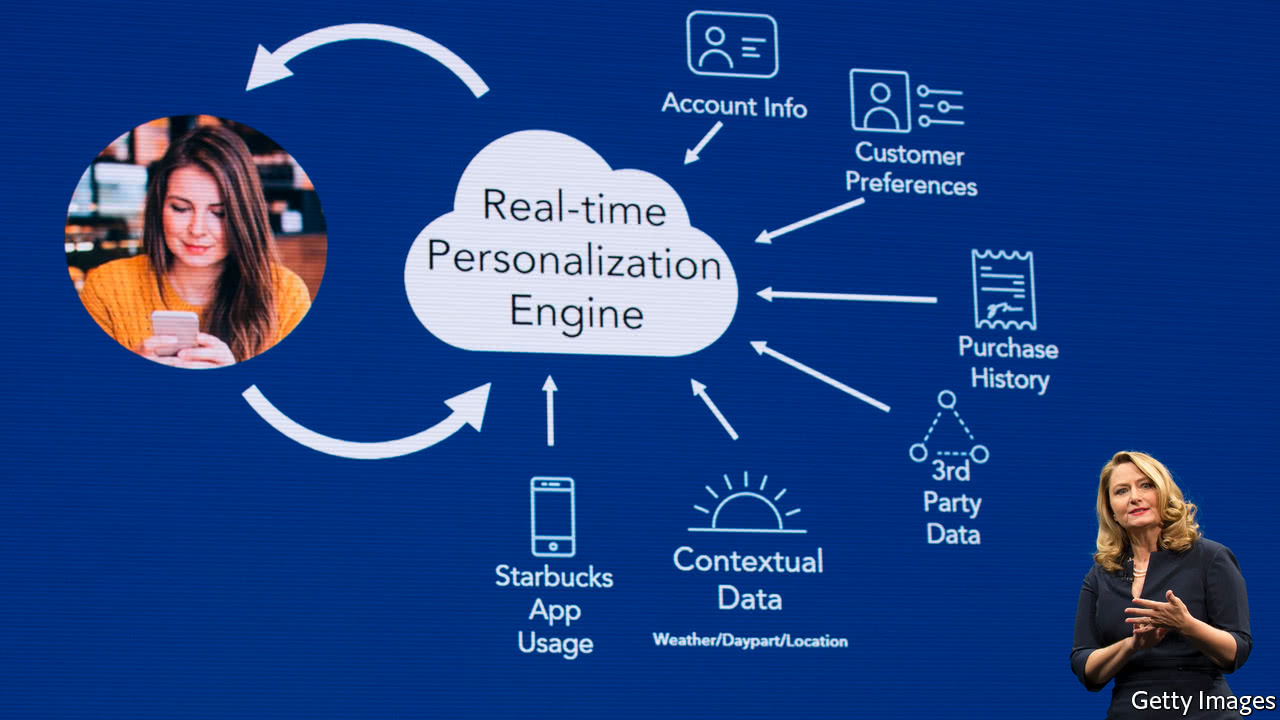
Mr Stuker is extreme in his devotion. But engendering customer loyalty is something that nearly all firms strive for. Most fail. The average American household belongs to 28 loyalty schemes. The country is home to 3.8bn scheme memberships in total, according to Colloquy, a research firm, up from 2.6bn in 2012. More than half of these accounts go unused.
Frequent-flyer programmes, introduced in the 1970s, were the first examples of modern loyalty schemes. They proved to be a clever bit of marketing. Flyers value plane seats highly, so a free one feels like a substantial reward. But…Continue reading