
Tag: Business and finance
Why are investors so relaxed about the tensions in Korea?
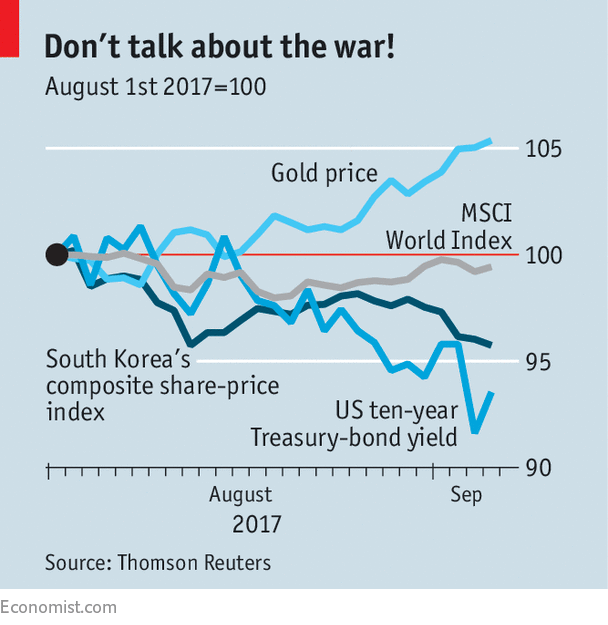
A ROGUE state has tested what may be a hydrogen bomb and has sent a missile over the territory of a neighbouring country. The American president has promised “fire and fury” if threats continue. The Security Council of the United Nations has been locked in debate. This sounds like the plot of a Hollywood thriller or a paperback potboiler in which the world is heading for conflagration.
But international investors are not thrilled, and seem barely disconcerted, by the crisis on the Korean peninsula. Gold has risen a bit, the yield on Treasury bonds has dropped and the MSCI World equity index has fallen since the start of August. However, the moves have not been huge. Even the South Korean stockmarket, surely the most sensitive gauge of war risk, is well above its level at the start of the year.
What explains this remarkable insouciance? One possibility is that the markets may simply not be very good at assessing political risk. After all, investors failed to foresee either the…Continue reading
Capacity cuts in China fuel a commodity rally and a debate

STEEL ran in Zhang Cheng’s family for three generations. His grandfather mined iron ore. His father got a job in the big state-owned steel mill just outside Jinan, capital of Shandong province. His mother worked in the on-site hospital. And Mr Zhang went to the mill-run school, graduating to a job in its foundry, where, in the heat of the blast furnace, he rolled metal into thin bars for construction. But after nearly two decades in Jinan Steel, he worked his last day there this summer. In the name of “capacity reduction”—a government policy to rein in excess production of steel—the plant stopped operating in July, and Mr Zhang went on the dole.
Since they worked for a state-owned company, the local government has helped him and the 20,000 others who lost jobs find new ones. But it has been a struggle for Mr Zhang, a soft-spoken man. Openings in Jinan are mainly in the service industry—as a waiter in restaurants or an attendant at a station on the new underground. He worries…Continue reading
Ever better and cheaper, face-recognition technology is spreading

TOURING the headquarters of Megvii in Beijing is like visiting Big Brother’s engine room. A video camera in the firm’s lobby recognises visitors in the blink of an eye. Other such devices are deployed around the office. Some of the images they capture are shown on a wall of video called “Skynet”, after the artificial-intelligence (AI) system in the “Terminator” films. One feed shows a group of employees waiting in front of an elevator with a white frame around every face and the name of each person next to it. Quizzed on the Orwellian overtones of the set-up, Yin Qi, the startup’s chief executive, simply remarks that “this helps catch bad guys.”
Even if Mr Yin wanted to ponder the implications of the technology, he would not have the time. Megvii is busy building what he describes as a “brain” for visual computing. The firm has come a long way since its founding in 2011 (its name stands for “mega vision”). More than 300,000 companies and individuals around the…Continue reading
What effect is Donald Trump really having on American tourism?
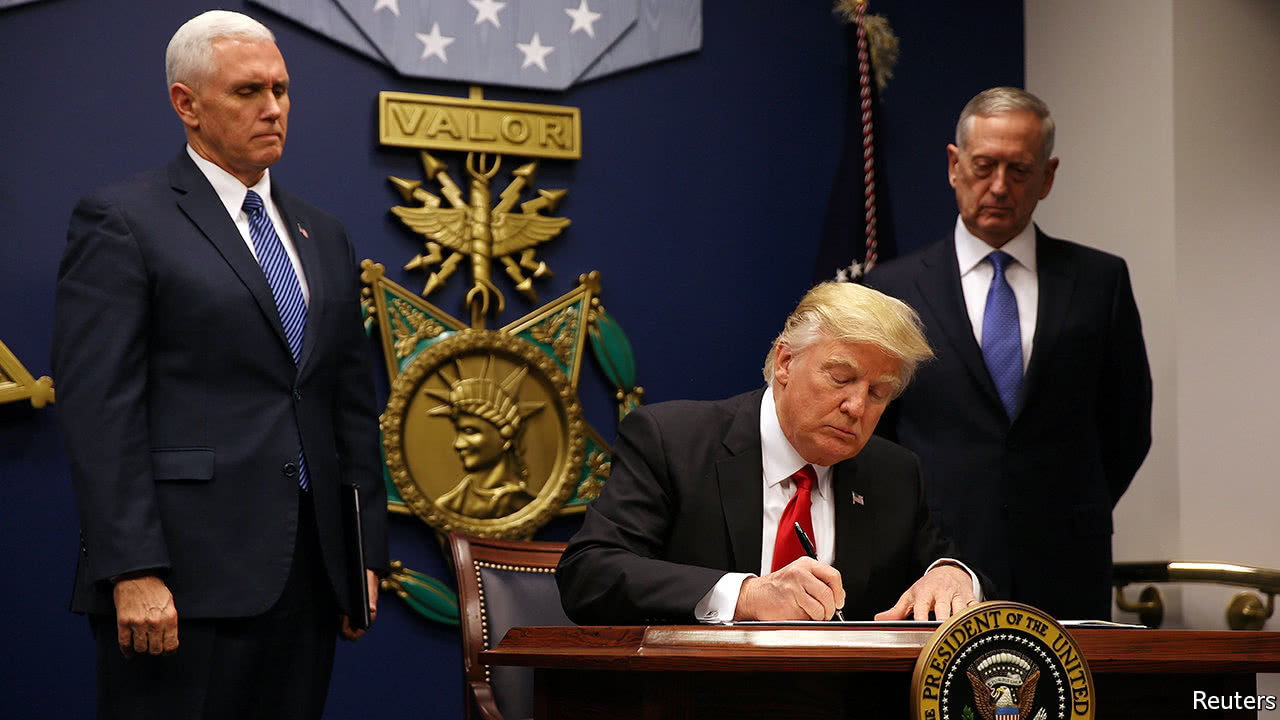
WHEN Donald Trump was inaugurated in January, he wasted no time in trying to bar people from certain Muslim-majority countries entering America. He swiftly, too, promised to make good on his pledge to build a wall along the Mexican border. The nation’s travel industry shuddered. It did not feel like the actions of a man keen to woo visitors from abroad.
The predicted “Trump slump” quickly appeared to materialise. Within months, several online travel firms, including Kayak and Hopper, reported that fewer people were searching for flights to America. That seemed plausible. The country was getting terrible press abroad and the firms that sell flights online seemed the best placed to monitor demand for travel in real time. Come July, however, the U.S. Travel Association revealed that everything was rosy. Instead of a Trump slump, the country was in fact enjoying a Trump bump. The organisation’s Travel Trends Index, which tracks flight and hotel bookings, plane boardings and other data, suggested that the number of…Continue reading
The lessons of fidget spinners

YOU can spin it on your nose, chin, finger or tongue. Some include LED lights, others resemble a ship’s wheel, or even a skull and crossbones. The fidget spinner has three paddle-shaped blades attached to a central, weighted disc containing ball bearings. Flick a blade and it spins, for anything up to 12 minutes in an advanced version from Japan. It was originally designed to help calm children with attention-deficit hyperactivity disorder or autism, but swept the world earlier this year as a toy that everyone can play with.
Retail sales have undoubtedly slowed recently, says Mark Austin of ToyWorld, a trade publication—good news for the schools that have banned it as too distracting for pupils. But the spinner has created a new “fidget” category of toys. And the global toy industry, which was surprised by its success, has learned lessons.
The fad started in America in February. By May, all 20 of the top-selling toys on Amazon, an online retailer,…Continue reading
A survey finds support for both globalisation and import tariffs

IN JANUARY 2000, George W. Bush, then a presidential candidate, said: “If the terriers and bariffs are torn down, this economy will grow.” His eloquence did little for the cause of free trade. Tariffs have consistently retained broad global support despite the spoonerism.
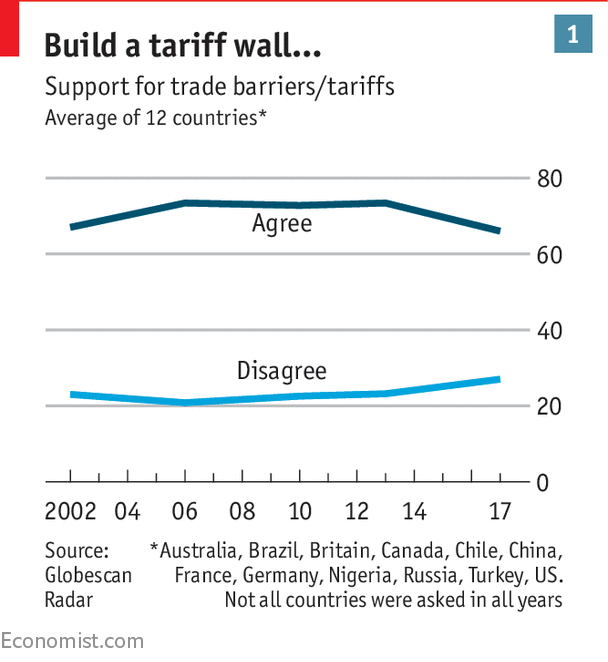
GlobeScan, a consultancy, has regularly conducted surveys in several developing and developed countries. They measure support for trade barriers, globalisation and free markets. Since 2002, average global support for trade barriers has remained relatively stable at around two-thirds of respondents (see chart 1). Support for globalisation and the free market has been…Continue reading
Is there a wage growth puzzle in America?

TODAY’S labour market report showed that the American economy created 156,000 net new jobs in August. That was a bit less than expected, but payrolls are still growing comfortably faster than the working-age population. Despite having created over 2m jobs in the last year, pushing unemployment below 4.5% for the last five months, wage growth remains muted, at around 2.5%, compared to more like 3.5% the last time unemployment was comparably low. In a recent article for the print edition, I anlysed one potential explanation for weak wage growth: retirements of high-earnings baby-boomers.
Scott Sumner has taken issue with the premise of my piece. He says there is no puzzle at all. Instead, slow wage growth is being caused by slow growth in nominal GDP (cash-terms spending in the economy) —…Continue reading
A scheme to let non-flyers through the security gates

In an era of strict security checks and other inconveniences for air travel, one American airport is making a sharp move in the opposite direction. On September 5th, Pittsburgh International will become the first American airport since the terrorist attacks on September 11th 2001 to allow people who are not booked on a flight to pass through security. Families will be able to see loved ones off as they board their flight. Children will be able to join a travelling parent to watch planes take off. Friends will be able to eat and shop at the stores that flyers normally frequent (in Pittsburgh, some retailers, such as Hugo Boss, Armani Jeans and Bar Symon, only have shops in the airport).
Pittsburgh International has been pushing for years for this change, which flies in the face of…Continue reading
Cargill, an intensely private firm, sheds light on the food chain

ANGLERS love a record catch. Fish farmers, too. So when a salmon bred and raised near this village at the head of a Norwegian fjord was pulled out of captivity earlier this year weighing a sumo-sized 17kg, it was cause for jubilation. “It was fantastic,” says Einar Wathne, head of aquaculture at Cargill, the world’s biggest food-trading firm. Not only was it produced in 15 months, one-fifth faster than usual, it also looked and tasted good. Mr Wathne’s Norwegian colleagues celebrated by eating it sashimi-style shortly after its slaughter.
Cargill is a company usually associated with big boots rather than waders. America’s largest private company has built a reputation after 152 years of existence as middleman to the world, connecting farmers with buyers of human and animal food everywhere. Through a trading network that spans 70 countries (and that includes scores of ports, terminals, grain and meat-processing plants and cargo ships), it supplies information and finance to…Continue reading
Of Indian banknotes cancelled last year, 99% are accounted for
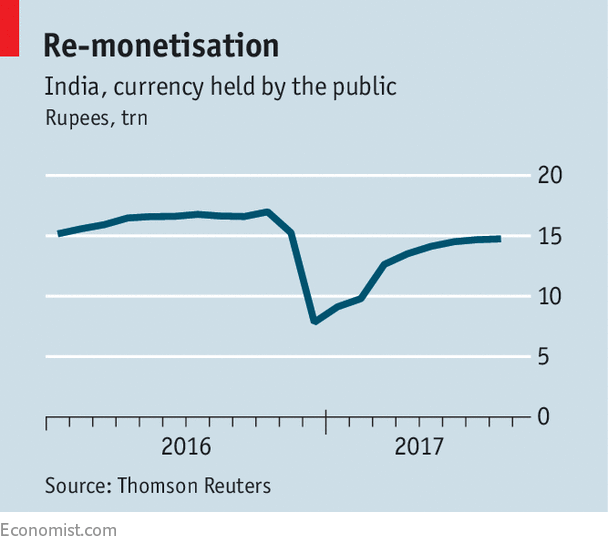
ON NOVEMBER 8th 2016, Narendra Modi, India’s prime minister, stunned its 1.3bn people by announcing that most banknotes would soon become worthless. Indians then queued for weeks on end to exchange or deposit their banned money at banks. The comfort for the poor was that the greedy, tax-dodging rich would suffer more, as they struggled to launder their suitcases full of cash by year-end.
Not so. A report from the central bank, the Reserve Bank of India (RBI), on August 30th suggests that of the 15.4trn rupees ($241bn) withdrawn—roughly 86% of all banknotes by value—15.3trn rupees, or 99% of them, have been accounted for. Either the “black money” never existed or, more likely, the hoarders found a way of making it legitimate.
Defenders of the scheme say it is merely one plank of a wider fight against informal economic activity and corruption. Banks have enjoyed an influx of cash. Digital payments are up (from a low base), as issuance of replacement notes has not caught…Continue reading