
Tag: Business and finance
The teaching of economics gets an overdue overhaul

ECONOMISTS can be a haughty bunch. But a decade of trauma has had a chastening effect. They are rethinking old ideas, asking new questions and occasionally welcoming heretics back into the fold. Change, however, has been slow to reach the university economics curriculum. Many institutions still pump students through introductory courses untainted by recent economic history or the market shortcomings it illuminates. A few plucky reformers are working to correct that: a grand and overdue idea. Overhauling the way economics is taught ought to produce students more able to understand the modern world. Even better, it should improve economics itself.
The dismal science it may be, but economics is popular on campus. It accounts for more than 10% of degrees awarded at elite universities each year, by one estimate, and many more students take an introductory class as part of their general-education requirements. Teachers of such courses aim to grab the attention of their glassy-eyed audience, to…Continue reading
America holds the World Trade Organisation hostage
EIGHT months into Donald Trump’s presidency, the rules-based system of global trade remains intact. Threats to impose broad tariffs have come to nothing. Some ominous investigations into whether imports into America are a national-security threat are on hold. Mr Trump looks less a hard man than a boy crying wolf. All the same, supporters of the World Trade Organisation (WTO), the guardian of that rules-based system, are worried. Other dangers are lurking. There is more than one way to undermine an institution.
The WTO is meant to be a forum for reaching deals and resolving disputes. But all 164 members must agree to new rules, and agreement has largely been elusive. So if members do not like today’s rules, as interpreted by judges, they have little prospect of negotiating better ones. That puts pressure on the WTO’s judicial function, the bit that has been working fairly well.
Trouble is brewing at the WTO’s court of appeals. It is meant to have seven serving judges, but has only five and by the end of the year will have just four. The Americans refuse to start the process of filling the spots, citing systemic concerns. What seemed an arcane procedural row has become what some call a “crisis”.
China sets its sights on dominating sunrise industries

IN RECENT days China set the record for the world’s fastest long-distance bullet train, which hurtled between Beijing and Shanghai at 350kph (217mph). This was a triumph of industrial policy as much as of engineering. China’s first high-speed trains started rolling only a decade ago; today the country has 20,000km of high-speed track, more than the rest of the world combined. China could not have built this without a strong government. The state provided funds for research, land for tracks, aid for loss-making railways, subsidies for equipment-makers and, most controversially, incentives for foreign companies to share commercial secrets.
High-speed rail is a prime example of the Chinese government’s prowess at identifying priority industries and deploying money and policy tools to nurture them. It inspires awe of what it can accomplish and fear that other countries stand little chance against such a formidable competitor. Yet there have also been big industrial-policy misses, notably…Continue reading
The case against shrinking the Fed’s balance-sheet
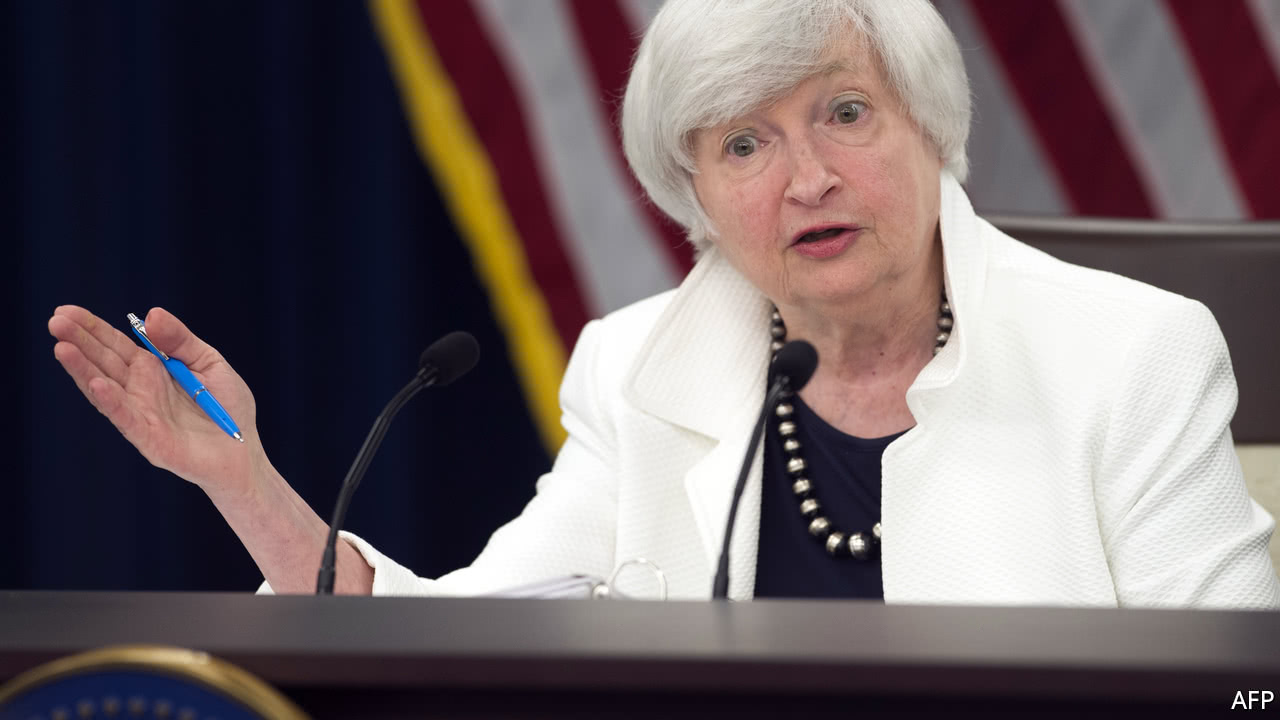
AS EXPECTED, the Federal Reserve announced on September 20th that it will soon begin reversing the asset purchases it made during and after the financial crisis. From October, America’s central bank will stop reinvesting all of the money it receives when its assets start to mature. As a result, its $4.5trn balance-sheet will gradually shrink. However, the Fed did not give any clues as to what the endpoint for the balance-sheet should be. This is an important question. There are strong arguments for keeping the balance-sheet large. In fact, it might be better were the Fed not shedding any assets at all.
Most commentators view a large balance-sheet, which is the result of quantitative easing (QE), as an extraordinary economic stimulus. Janet Yellen, the Fed’s chair, seems to agree: at a press conference after the Fed announcement, she said the balance-sheet should shrink because the stimulus it provides to the economy is no longer needed. But the claim that the balance-sheet is stimulating the economy is far from an…Continue reading
Toys “R” Us files for bankruptcy

ASK young American parents about Toys “R” Us and they are likely to be able to sing a jingle from their childhood: “I don’t wanna grow up, ’cause maybe if I did, I couldn’t be a Toys ‘R’ Us kid”. For children of the 1980s, Toys “R” Us was a mecca at the strip mall, an awe-inspiring array of dolls, trucks, board games, bikes, art supplies and much more. Many of them noticed when on September 18th, the chain filed for bankruptcy.
Dave Brandon, the company’s chief executive, emphasised that shops would carry on operating as usual and claimed that the best era of Toys “R” Us was still to come. “These are the right steps to ensure that the iconic Toys “R” Us and Babies “R” Us brands live on for many generations,” he declared. A Chapter 11 bankruptcy, many analysts agree, is a sensible way to deal with the chain’s $5bn of long-term debt. So Toys “R” Us is not dead. But its future is hardly certain.
The company’s tale in many…Continue reading
The Ryanair cancellations

SOME strategies are too successful. When Ryanair convinced many of its pilots to take less vacation during peak-travel season, it probably thought it was being clever. However, pilots who ferry tourists to holiday destinations need vacations too. Poor planning and a bit of bad luck have left Ryanair with a shortage of working pilots for the autumn. This shortfall has forced the low-cost airline to cancel around 2,100 flights beginning on September 16th and continuing through October. The abrupt cancellation of last weekend’s flights and the short notice provided to customers has left many angry.
Ryanair’s woes were caused in part by a change in the way the airline determines employee leave. Previously, Ryanair staff took their vacations over an operational year from April to March. In 2016, under pressure from the Irish Aviation Authority, Ryanair adopted the calendar year instead. As part of the transition, it needed to allow its employees to take the entirety of their vacation time between April and December of this year. That…Continue reading
Ryanair’s mass cancellations are a problem of its own making
WHEN Ryanair convinced many of its pilots to take fewer holidays during peak summer-travel season, it probably thought it was being clever. But poor planning and a bit of bad luck have left the airline with a shortage of working pilots, many of whom have now taken time off, for the autumn. The shortfall has forced Ryanair to cancel some 2,100 flights starting on September 16th and continuing through October.
Ryanair’s woes were caused in part by a change in the way the airline determines employee leave. Previously, Ryanair counted holidays in the year from April. In 2016, under pressure from the Irish Aviation Authority, Ryanair adopted the calendar year instead. As part of the transition, it needed to allow its employees to take the entirety of their leave between April and December of this year, leaving it with a staff shortage. As a result, the airline will probably have to scrap around 50 flights every day until the end of October.
This has left customers annoyed and Ryanair with a public-relations problem….Continue reading
The value of credit-card points

THE value of credit-card points has long been a topic of debate among business travellers. The subject is also picked over online on an impressive number of dedicated blogs and forums. Now it is getting an airing in a different sort of venue: the corruption trial of an American senator.
Robert Menendez, a Democratic senator from New Jersey, is facing charges for allegedly doing favours for Salomon Melgen, a Florida-based eye doctor and friend of the lawmaker. Prosecutors say that Mr Melgen was trying to avoid repaying the government $8.9m that he had allegedly overbilled Medicare, the public health-care programme for seniors. And he wanted Mr Menendez’s help in exchange for lavish kickbacks. These included flights in a private jet, stays in a fancy hotel and more than $750,000 in campaign contributions.
But at the centre of the third day of the trial last week was the issue of credit-card points. In 2010, Mr Salomon paid for Mr Menendez to stay for three nights at the Park Hyatt Vendome, a five-star hotel in…Continue reading
A positive sign from the bond market

THE stockmarket’s positive mood has managed to survive the tensions over North Korea’s nuclear programme. In part, this is because investors believe that global economic growth and corporate profits will continue to do well.
One reassuring signal is from the corporate bond market. The global default rate on speculative (junk) bonds has been dropping; fewer companies are going bust (see chart).
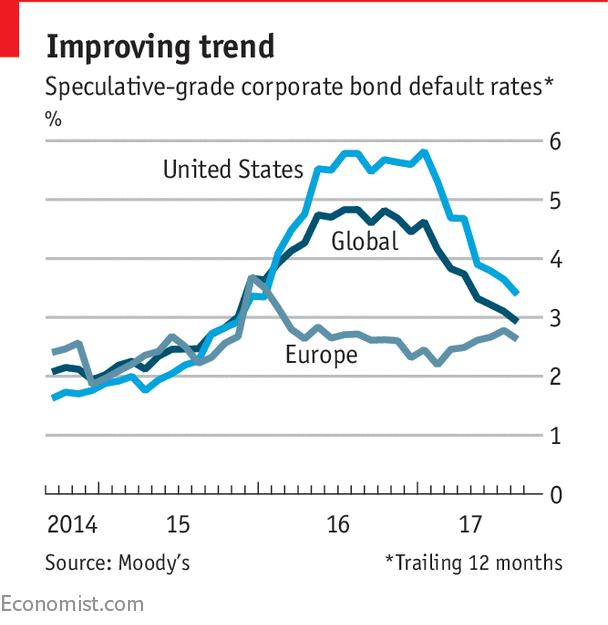
This is the first time the default rate has dropped…Continue reading
A legal vulnerability at the heart of China’s big internet firms
COMPANIES’ legal structures are usually mind-numbing fare. But occasionally it is worth pinching yourself and paying attention. Take “variable interest entities” (VIEs), a kind of corporate architecture used mainly by China’s tech firms, including two superstars, Alibaba and Tencent. They go largely unremarked, but VIEs have become incredibly important. Investors outside China have about $1trn invested in firms that use them.
Few legal experts think that VIEs are about to collapse, but few expect them to endure, either. One sizeable investor admits loving Chinese tech firms’ businesses while feeling queasy about their legal structures. Like scientists appalled by their monstrous creations, even the lawyers who designed VIEs worry. They are “China’s version of too-big-to-fail”, says one. As well as being spooky, VIEs are another instance of how China’s weak property rights hurt its citizens.
What are VIEs? Over 100 companies use them. Since the 1990s private firms have sought to break free of China’s isolated legal and financial systems. Many have done so by forming holding companies in tax havens and listing their shares in New York or Hong Kong. The problem is that they are then usually categorised as “foreign firms” under Chinese rules. That in turn prohibits them from owning assets in some politically sensitive sectors, most…Continue reading