
Tag: Business and finance
The next financial crisis may be triggered by central banks
AS WITH London buses, don’t worry if you miss a financial crisis; another will be along shortly. The latest study on long-term asset returns from Deutsche Bank shows that crises in developed markets have become much more common in recent decades. That does not bode well.
Deutsche defines a crisis as a period when a country suffers one of the following: a 15% annual decline in equities; a 10% fall in its currency or its government bonds; a default on its national debt; or a period of double-digit inflation. During the 19th century, only occasionally did more than half of countries for which there are data suffer such a shock in a single year. But since the 1980s, in numerous years more than half of them have been in a financial crisis of some kind.
The main reason for this, argues Deutsche, is the monetary system. Under the gold standard and its successor, the Bretton Woods system of fixed exchange rates, the amount of credit creation was limited. A country that expanded its money supply too quickly would suffer a trade deficit and pressure on its currency’s exchange rate; the government would react by slamming on the monetary brakes. The result was that it was harder for financial bubbles to inflate.
But since the early 1970s more countries have moved to a floating exchange-rate system. This gives governments the flexibility to deal with an…Continue reading
Europe’s capital markets face a big shake-up and are not ready

FINANCIERS usually regard new regulations as dull, annoying drudgery best left to lawyers or the compliance department. That is not an option with the second iteration of the Markets in Financial Instruments Directive (MiFID 2), a European Union law years in the making and entering into force on January 3rd 2018. The law introduces radical changes to trading in trillions of euros-worth of stocks, bonds and derivatives. But its sheer scope and complexity mean that an unprecedented number of issues and technicalities are still unresolved.
MiFID 1, in force since 2007, was aimed at shares, and spawned a proliferation of new trading venues ranging from electronic platforms to “dark pools” run by investment banks, breaking the oligopoly of dozy national stock exchanges. The new, more ambitious, law seeks to bring transparency to a far wider range of asset classes, notably bonds and derivatives.
The single reform that has probably received most attention is the requirement to…Continue reading
The cost of innovation has risen, and productivity has suffered
WERE there far fewer undiscovered ideas out there than in our more primitive past, how would people know? This is not an idle question; decoding the mysteries of nature, from atmospheric pressure to electricity to DNA, allowed people to bend the natural world to their will, and to grow richer in the process. A dwindling stock of discoverable insights would mean correspondingly less scope for progress in the future—a dismal prospect. And some signs suggest that the well of our imagination has run dry. Though ever more researchers are digging for insights, according to new research, the flow of new ideas is flagging. But that uncovering new ideas is a struggle does not mean that humanity is near the limits of its understanding.
The development of new ideas—meaning scientific truths or clever inventions—allows economies to grow richer year after year. Adding more workers or machinery to an economy boosts GDP, but only for a while. Applying ever more men with hoes to the cultivation of a field will generate diminishing returns in terms of crop yields, for instance; wringing more from the soil eventually requires the use of better seed-stock or fertiliser. Unless humanity finds new ways to do more with the same amount of labour and capital, growth in incomes peters out to nothing.
Dwindling growth in incomes is not a bad description of what has happened…Continue reading
Why a Labour government might mean a fall in sterling
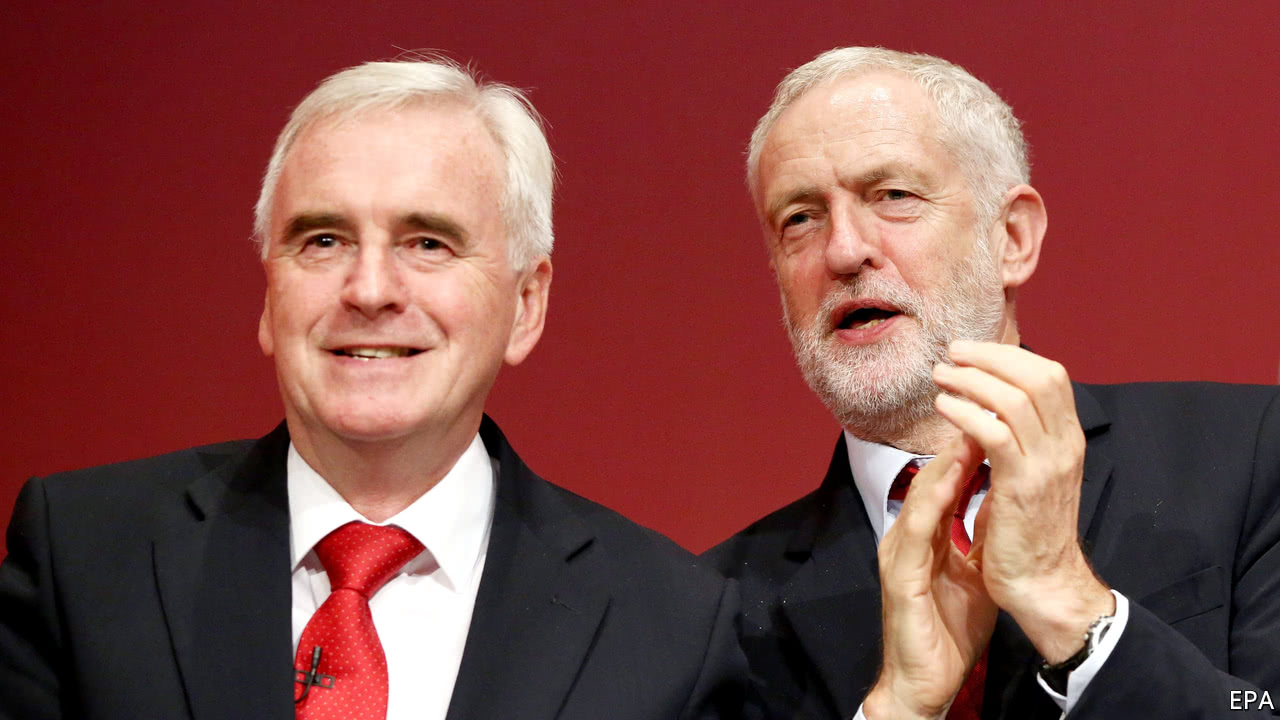
THE British Labour party is in buoyant mood at its annual conference, expecting to be in power very soon. And it has already started to think about the consequences, including a possible run on the pound if it takes office. But not everyone thinks this is likely; Simon Wren-Lewis, an economist, challenged people to think of “a serious economic reason why stering would fall on the election of a Labour government?” Well, this blogger can think of several.
1. Labour plans to increase the rate of tax on corporate profits from (what will be) 17% to 26%. That means the profits available to overseas investors will be reduced accordingly. They will demand a lower price to compensate for this lower return—this will either come in the form of a fall in the stockmarket or in the pound, or probably a bit of both.
2. Labour plans to nationalise various utilities (railways, water, the Royal Mail and some energy) and to cancel some private finance initiatives, by…Continue reading
Picking a fund manager? The odds aren't great

WHO wants mediocrity? That is what a lot of people say when the subject of index-tracking, or passive fund management, comes up. They would rather choose a fund manager (an active manager in the jargon) who tries to beat the market by picking the best stocks. It does sound like a good idea.
The tricky bit is finding the right manager. The temptation is to look at past performance but fund managers rarely beat the market for long.
The average fund manager is always going to struggle to beat the market (this is a separate argument from whether markets are «efficient»). That is because the index reflects the performance of the average investor before costs. In a world dominated by professional fund managers, there aren’t enough amateurs for the professionals to beat. Even the hedge funds, those supposed «masters of the universe», haven’t been able to do it; Warren Buffett looks set
Online auctions of Boeing 747s reflect shifts in the air-travel industry

FOR many aeroplane enthusiasts, buying a Boeing 747 is the stuff of dreams. The “Queen of the Skies” is an icon from the golden age of air travel, a period the 1960s and 1970s when the industry was at its most glamorous. And owning one would be like having a little piece of aviation history.
Last week that dream shifted slightly closer to reality, albeit only for well-heeled fans. Three Boeing 747s went up for auction on Taboo, China’s equivalent of eBay. The seller is a state court in Shenzhen, which seized the planes when Jade Cargo International, an airline, went bust in 2012. At first, state officials tried to flog the planes offline at private auctions. But after six failed attempts, they opened the sale up to public bids. Offers currently range from 122m yuan ($18.5m) to 135m yuan.
This is not the first time one of the planes has been auctioned online. Last year Concord Aerospace, a Florida-based firm which buys and sells plane parts,…Continue reading
Sleep pods are becoming increasingly common at airports

IN THEORY, overnight air travel should be wonderfully convenient. Instead of booking a hotel for the night and losing a day, travellers simply sleep while they fly. In reality, sleeping on a plane is hard, and at an airport tougher still. The chairs in terminals, nobody’s idea of comfort to begin with, tend to have armrests that make splaying out unfeasible. Even in business-class lounges, travellers contort themselves into impossible shapes to pretend that workspace desks are actually beds.
But soon there may be less need for such acrobatics. Sleep pods are coming to more and more airports. Last month, Washington Dulles International put out a call for proposals for a company to provide “a quiet and comfortable place within the airport to sleep, relax, or work while waiting to board a flight”. Mexico City’s airport has just added sleep pods with a space-age design for $30 a night. YotelAir, which offers pods in…Continue reading
Bitcoin is fiat money, too

FINANCIERS with PhDs like to remind each other to “read your Kindleberger». The rare academic who could speak fluently to bureaucrats and normal people, Charles Kindleberger designed the Marshall Plan and wrote vast economic histories worthy of Tolstoy. “Read your Kindleberger” is just a coded way of saying “don’t forget this has all happened before”. So to anyone invested in, mining or building applications for distributed ledger money such as bitcoin or ethereum: read your Kindleberger.
Start with A Financial History of Western Europe, in which Kindleberger documents how many times merchants in different centuries figured out clever ways of doing the exact same thing. They made transactions easier, and in the process created new deposits and bills that increased the supply of money. In most cases, the Bürgermeister or the king left these innovations in place, but decided to control the supply of money and credit themselves. It is good for the king to be in charge of his own creditors. But also, it has…Continue reading
Streaming has pushed Latin music into the mainstream

“MI GENTE” lures listeners with a mesmerising hook, a thumping beat and lyrics about breaking down barriers. A collaboration between J Balvin, a Colombian reggaeton star (pictured), and Willy William, a French producer, the latest product of this summer’s Latin craze is crooned almost entirely in Spanish. (The title means “My People”; reggaeton borrows from hip hop, reggae and rap.) The song topped the charts on Spotify, a streaming service, for weeks. “To be a crossover artist, you used to have to sing in English,” said John Reilly, Mr Balvin’s publicist. Now six of YouTube’s top ten music videos are predominantly in Spanish. In August the Billboard Hot 100, which tracks streams, sales and radio plays, sported seven Latin hits. Just five graced the chart in all of 2016.
Latin music is helping the music industry to arrest years of decline. Its growth is far outpacing that of other genres. Last year Latin America yielded just $598m out of total global recorded-music…Continue reading
Online matchmaking businesses in India have many ways to woo

“IT WAS 2012…I was number 37,” says Ashwini, referring to the badge that was pinned on her shirt pocket. Her task was to go onto the stage and introduce herself to around 70 eligible bachelors and their parents. Families then conferred and, provided caste and religious background proved no obstacle, would approach the event’s moderator asking to meet number 37. At midday girls would wait for prospects to swing by, again with parents on either side. A brief exchange might establish the potential bride’s cooking skills or her intention to work after marriage. If the two sides hit it off, they would exchange copies of their horoscopes. Nearly 50 men lined up to meet Ashwini that day, speed-dating style. No one made the cut. She later married a colleague.
Such gatherings form an important part of the wedding industry, worth around $50bn a year, in a country where arranged marriages continue to be the norm. India has 440m…Continue reading