Tag: Business and finance
El Al can no longer ask women to move seats on religious grounds

ONE of the more unsavoury airline practices has now been outlawed. In 2015 flight attendants on El Al, Israel’s national carrier, asked Renee Rabinowitz, an 81-year-old holocaust survivor, to move seats after she boarded her flight in New Jersey. An ultra-orthodox Jewish male passenger had objected to having to sit next to her. Haredim, it was explained, are forbidden from close contact with females who are not relatives.
Ms Rabinowitz is not alone. As this blog has reported on several occasions in recent years, haredi men flying El Al regularly refuse to take their seats next to female passengers. And El Al staff, if the men cannot be accommodated elsewhere on the plane, will sometimes ask the “offending” woman to vacate her seat.
At the time, Ms Rabinowitz
Etihad allows flyers to bid to keep adjacent seats empty

THERE are few things that airlines will not now put a price on. Even so, Etihad Airways has come up with an intriguing idea. The Abu Dhabi-based carrier is offering flyers the chance to bid to keep adjacent seats on a flight empty. Passengers can suggest the price they are willing to pay to block up to three berths, and the chance to stretch out a bit.
Anyone who regularly suffers the ignominy of economy-class flying knows that there is no finer feeling than discovering that a flight is half empty and that there is no need to sit cheek-by-jowl with fellow members of the hoi polloi. Most travellers can recount with glee a journey in which they found they had an entire row to themselves, could raise the armrests, and sleep soundly and horizontally for the duration of the flight. It is surely the only time that it is preferable to have a booked ticket in the middle column of seating. (A particularly pleasing
Qatar Airways wants a 10% stake in American Airlines

IT SEEMED, at first blush, to be a masterclass in how to bait a rival. For years, American Airlines, along with other big American carriers, has complained of “unfair” competition from Middle Eastern operators, which stand accused of taking state subsidies. On June 22nd one of those accused, Qatar Airways, said it planned to take an unsolicited 10% stake in the firm.
In a regulatory filing, it was revealed that Qatar, which reported a profit of $540m in 2016, wants to buy at least $808m of American’s shares. The move has not gone down well with some. Doug Parker, American’s boss, described it as “puzzling”. One airline union accused Qatar of “using enormous government subsidies to gain a greater foothold in US markets”. Adding “They’re coming after our routes, which means the jobs of our members are at stake.”
Politicking from America, in turn, has been making life tough for Qatar’s national carrier. This month Donald Trump backed the decision of several Gulf states to cut diplomatic ties with…Continue reading
Why the falling oil price isn’t hurting markets

INVESTORS could easily get confused about the impact of oil-price rises on the economy and markets. The story seemed to be clear: high prices bad, low prices good. The two great oil shocks in the 1970s were unambiguously bad for Western economies—ushering in stagflation and transferring spending power to the oil-producing countries. In turn, low oil prices in the late 1990s coincided with the dotcom boom.
But when oil fell in the second half of 2015, that was seen as a bearish sign for the global economy and markets. Now oil is falling again, with both Brent crude and West Texas intermediate dropping more than 20%. But the decline has barely made a dent in the upward march of the S&P 500 index.
The key to the differing market reaction is why the oil price is falling. Back in 2015, the fear was falling demand. Investors worried in particular that the Chinese economy was slowing. If that assumption had been right, demand for much more than oil would have suffered. The equity markets did not…Continue reading
Cisco adapts to the rise of cloud computing
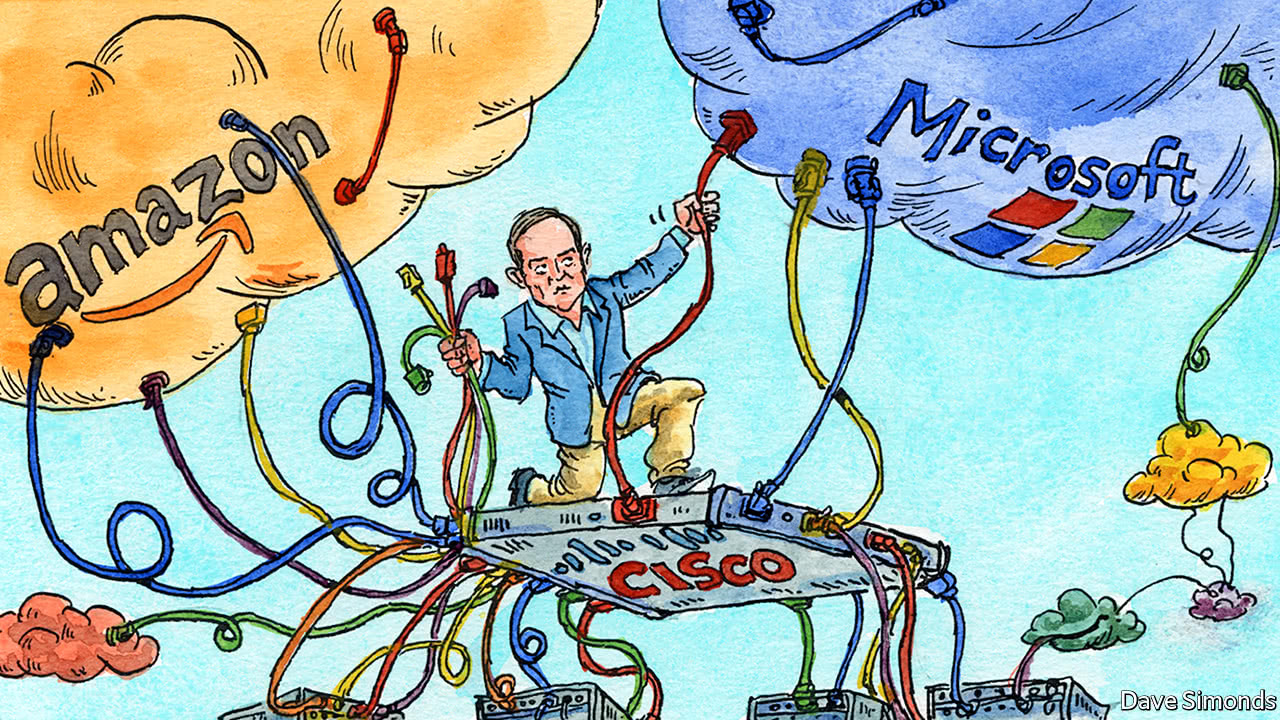
WHEN John Chambers ran Cisco, the world’s biggest maker of networking gear, his hyperactivity nearly matched that of the high-speed switches and routers that made the firm’s fortune. He pushed Cisco into dozens of new businesses, from set-top boxes to virtual health care. He travelled the world preaching the virtues of connectivity. In interviews it was hard to get a word in edgeways. Conversations invariably ended on a restless question: “What should we do differently?”
Chuck Robbins, who succeeded Mr Chambers in July 2015, has two decades of experience selling Cisco gear and seems more comfortable talking about its core business than about diversifications. He avoids the limelight and comes across as almost shy. But he, too, is aware of the need to keep moving. “Networking is getting complex. We need intuitive networks that are secure and can learn and adapt.”
Different times require different bosses. Mr Chambers led Cisco to the top during the dotcom boom; in…Continue reading
The prospects for the world’s biggest IPO

THE proposed sale of 5% of Saudi Aramco is not just likely to be the biggest initial public offering (IPO) of all time. “It’s like Gibraltar selling the rock,” as one expert on Saudi Arabia’s oil policy puts it. The world’s biggest oil company keeps the House of Saud in power, bankrolled 60% of the national budget last year, and is a paragon of efficiency in an economy otherwise mired in bureaucracy.
The elevation on June 21st of Muhammad bin Salman, the 31-year-old architect of the IPO, to crown prince is likely to add more momentum to a sale planned for the second half of 2018. The news will further sideline domestic critics of the IPO, some of whom wonder whether it would be better to borrow the money than sell the family silver. But the success of the IPO is not guaranteed. The tendency of MBS, as the prince is known, to micromanage the listing runs counter to the spirit of openness and liberalisation that he says he wants for Saudi Arabia. That could backfire on the IPO…Continue reading
Investors snap up Argentina’s 100-year bonds

ONE hundred years ago, Argentina was not the country it is today. Thanks to a belle époque of lavish foreign investment, rapid inward migration and bountiful agricultural exports, its GDP per person in 1917 was comparable to that of Germany and France. Although the first world war brutally interrupted international trade and investment, the country profited from filling the bellies of soldiers on the front with tinned corned beef.
No one knows how Argentina may change over the next 100 years. But many investors seem willing to bet on one forecast: that its government will in 2117 repay $2.75bn-worth of dollar-denominated, 100-year bonds, sold to enthusiastic investors on June 19th.
Since Argentina has defaulted six times in the past 100 years, that belief seems brave. But instead of looking backwards, investors are looking from side to side, at the miserable yields on offer elsewhere. Argentina’s “century” bonds yield almost 8%. That…Continue reading
General Motors is getting smaller but more profitable
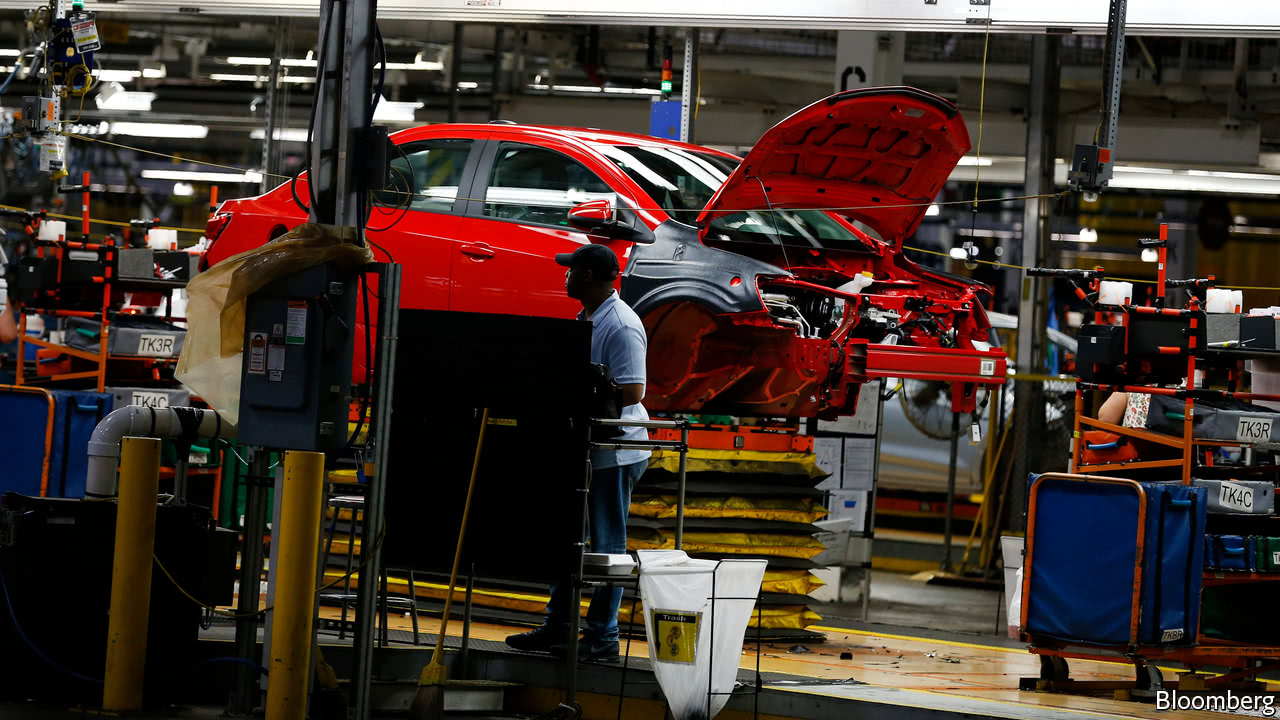
THE headquarters of General Motors (GM) tower over the other skyscrapers in Detroit’s city centre, a reminder that the carmaker still rules the American market. Yet GM’s domestic might increasingly contrasts with its position elsewhere in the world. Although most other carmakers see becoming ever bigger everywhere as the answer to the industry’s multiple challenges, GM is in retreat.
It, too, long vied with the world’s largest carmakers for the global crown. Along with Volkswagen, Toyota and Renault-Nissan, it made around 10m cars last year. Investors have been unimpressed. Although GM had record profits in 2015 and 2016 and has performed solidly this year, its share price has barely budged since its IPO of 2010, after the financial crisis had forced it into bankruptcy.
Such is the frustration that Greenlight Capital, a hedge fund with a 3.6% stake in GM, proposed splitting its shares into two classes—one keeping the current dividend and the other…Continue reading
The Federal Reserve risks truncating a recovery with room to run
WHEN it comes to inflation, the Federal Reserve sometimes resembles a child freshly emerged from an age-inappropriate horror film. To its members, runaway price increases seem to lurk in every oddly shaped shadow. On June 14th America’s central bank raised its benchmark interest rate for the third time in six months, even as inflation lingered below its 2% target, as it has for most of the past five years. Some critics reckon the Fed’s 2% inflation target is too constraining. Indeed, in recent comments on a letter from prominent economists calling for a higher target, Janet Yellen, the chairman, signalled openness to the idea. But the Fed’s problem is less its target than an unforgiving pessimism about American productivity. If its bleak view is wrong, the Fed itself is partly to blame for slow growth.
Economists generally treat productivity growth as a “real” factor, outside central-bank control. Thus, it is thought to depend on things such as technological progress, workers’ skill levels and the flexibility of the economy. But productivity growth is cyclical: it varies depending on whether an economy is booming or busting. Central banks might therefore have more influence over it than they are prepared to admit.
Economies have a growth speed limit, determined by changes in population and productivity. When unemployment is high, the economy…Continue reading
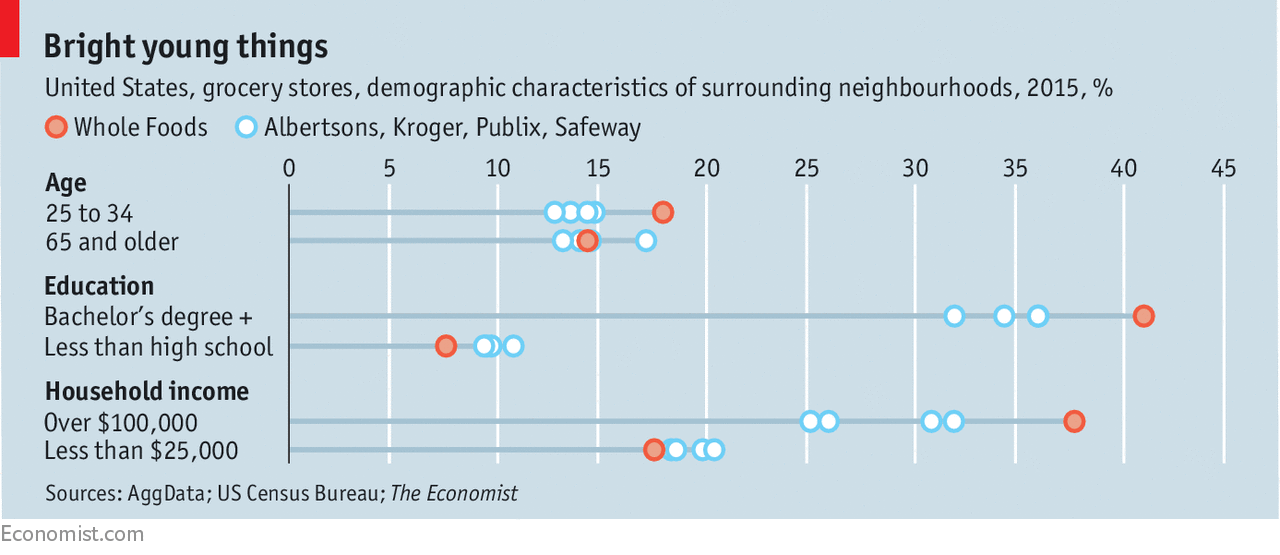
Amazon’s big, fresh deal with Whole Foods

JEFF BEZOS does not like sitting still. In his annual letter to Amazon’s shareholders this year, he warned of “stasis. Followed by irrelevance. Followed by excruciating, painful decline. Followed by death.” Competitors are toiling to avoid the same fate but it is hard to keep up. On June 16th Amazon said it would pay $13.7bn for Whole Foods, an upscale grocer known for its organic produce. Lest be accused of sloth, four days later Amazon announced a new service to let shoppers try clothes at home, for no fee, then return those they don’t like.
The news that Amazon would make clothes shopping even easier is a blow to America’s apparel chains, many of which are already in the middle of that excruciating decline. Yet it was the Whole Foods deal, more than ten times bigger than any acquisition Amazon has made so far, that caused the bigger stir.