
Tag: Business
Sweden tries to increase gender equality on Wikipedia

EVER since Julian Assange, founder of WikiLeaks, referred to Sweden as a “hornets’ nest of revolutionary feminism” and as a “Saudi Arabia of feminism”, Swedes have worn this as a badge of honour. Now its foreign ministry has an ambitious plan to increase gender equality on the internet.
Its precise target is Wikipedia, a user-generated online encyclopedia on which some 90% of the content is created by men. Of its biographies, 80% are about males. On International Women’s Day on March 8th (as The Economist went to press) the Swedes were hosting “WikiGap” edit-a-thons and seminars in 54 of its embassies, from Abuja to Vilnius, in partnership with Wikimedia, the foundation behind the platform. The hope was that participants would write more entries about notable women.
“Knowledge is power,” explains Margot Wallström, the foreign minister, and because these days knowledge and information come from the “clearly unbalanced” internet, this is a…Continue reading
Comcast announces a surprise offer for the British television firm

HAVING failed to get Rupert Murdoch’s attention before, Brian Roberts, chief executive of Comcast, certainly has it now. On February 27th the American pay-television giant said it would make a £22.1bn ($30.7bn) offer for Sky, the European satellite broadcaster, potentially disrupting Disney’s agreed $66bn purchase of much of 21st Century Fox.
The surprise announcement comes as Fox, which owns 39% of Sky, is trying to get regulatory approval in Britain for its own purchase of the remaining 61% of the satellite broadcaster, which it would then hand over to Disney after shareholders and regulators approve that deal (perhaps by the end of this year). By putting himself in the middle of that complex transaction, with an all-cash offer 16% richer than that of Fox, Mr Roberts is causing people to wonder what his goal is. He had tried to outbid Disney for Fox’s assets in the autumn, but gave up due to a lack of engagement from Mr Murdoch. He may now only be after Sky, or he may intend to make a still bigger hostile bid to top…Continue reading
Some airport terminals are learning from the luxury-hotel business

THE private-jet industry advertises itself as the height of luxury for the rich. But travelling through the ramshackle, ugly buildings it used to use as terminals was rather like going commercial. No longer. At one of Dubai’s newest facilities for private jets—built by Jetex, a fast-growing chain—passengers strum guitars on hammock-shaped sofas around a coffee table dressed up as a campfire, before being whisked away to their planes in limousines. Others amuse themselves playing table football or having elaborate spa treatments.
It is unsurprising that such a facility has emerged in Dubai. But the boom in luxurious terminals that look more like playpens for adults than somewhere to fly from is spreading. Jetex has opened 39 of them in more than 20 countries since 2005. Adel Mardini, the firm’s boss, is clear about how he wants to disrupt the industry. He says he wants airport facilities to feel “like a five-star hotel”.
Often…Continue reading
A new boss for McKinsey

THE Jesuits, the US Marines and the Freemasons: McKinsey has been compared to them all, at one time or other. The firm prides itself on being the most prestigious management consultancy, sending out its bright, young footsoldiers to advise executives and policymakers on tricky strategic issues. It is everywhere, counselling 90 of the top 100 firms (as ranked by Forbes magazine). Among its many government assignments it is helping Britain to leave the EU, Lebanon to fix its economy and the Saudis to wean themselves off oil.
Occasionally the company needs new leadership itself. On February 25th the result of a long election process was made public. Kevin Sneader, the Scottish chairman of McKinsey’s Asia unit, will replace Dominic Barton as managing partner—the top job. He inherits a thriving business. The firm remains by far the biggest of the premium consultancies (see table). Over the past decade, annual revenues have doubled to $10bn; so too has the size of the partnership, to more than 2,000.
Two oil majors face trial over a controversial deal in Nigeria

RESOURCE-RICH Nigeria has long ignited interest from oil firms, but it can be a dangerously combustible environment when it comes to the risk of corruption. Two firms caught up in scandals are Royal Dutch Shell and Eni, Italy’s state-backed energy group. In 2010 both entered into deferred-prosecution agreements with America’s Department of Justice after being implicated in separate Nigerian bribery schemes. But those pale beside a case involving the two companies that is set to go to trial in Milan on March 5th.
The case centres on the purchase of a big offshore oil field known as OPL 245, and touches the top ranks of both firms. In the dock will be, among others, Eni’s current CEO, Claudio Descalzi, and Shell’s former exploration chief, Malcolm Brinded. Also on trial are the firms themselves, charged with failing to prevent bribery. The individuals face jail if convicted; the companies face fines. All deny wrongdoing.
In 2011…Continue reading
Comcast announces a surprise offer for a British television firm
HAVING failed to get Rupert Murdoch’s attention before, Brian Roberts, chief executive of Comcast, certainly has it now. On February 27th the American pay-television giant said it would make a £22.1bn ($30.7bn) offer for Sky, the European satellite broadcaster, potentially disrupting Disney’s agreed $66bn purchase of much of 21st Century Fox.
The surprise announcement comes as Fox, which owns 39% of Sky, is trying to get regulatory approval in Britain for its own purchase of the remaining 61% of the satellite broadcaster, which it would then hand over to Disney after shareholders and regulators approve that deal (perhaps by the end of this year). By putting himself in the middle of that complex transaction, with an all-cash offer 16% richer than that of Fox, Mr Roberts is causing people to wonder what his goal is. He had tried to outbid Disney for Fox’s assets in the autumn, but gave up due to a lack of engagement from Mr Murdoch. He may now only be after Sky, or he may intend to make a still bigger hostile bid to top…Continue reading
American companies snub the National Rifle Association

FOR all the controversy that the National Rifle Association (NRA), America’s gun lobby, arouses, Americans of all political stripes have tended to regard it as nearly unassailable. The NRA and its 5m members have therefore been valued customers for companies, too. But after the latest school shooting, at Marjory Stoneman Douglas High School in Florida on February 14th, that has started to change. Not only has the political discussion shifted, but corporate America has reacted.
Snubs from big business began just a week after the shooting. On February 22nd First National Bank of Omaha, a bank, said “customer feedback” prompted it to stop issuing NRA-branded credit cards. Angry customers and riled-up activists, students from Marjory Stoneman Douglas foremost among them, have pushed a campaign to #BoycottNRA on Twitter, piling pressure on companies. In the span of just a few days, several firms ended their discounts for NRA members, including Delta and United, two airlines; MetLife, an insurer;…Continue reading
Are China’s state giants reformable?

AMONG investors it is fashionable to say that China’s state-owned enterprises (SOEs) do not matter much any more and that entrepreneurs now power the world’s second-largest economy. But China’s SOEs are still hard to avoid. They account for 40% of its stockmarket and a third of its investment, and they dominate heavy industry. On the global stage, SOEs’ appetites sway commodity prices and many are expanding abroad.
These empires of men and machines account for 45 cents of every dollar of debt in China, so their health determines whether the country’s financial system will escape a crisis or blow up. And SOEs have become a loaded gun on the negotiating table between China and America. Treasury officials argue that China has broken the promises it made upon joining the World Trade Organisation in 2001 about further liberalising its economy. According to one negotiator, it is “abusing the system” by subsidising SOEs which in turn rig markets, dump cheap exports abroad and deter foreign…Continue reading
German cars have the most to lose from changes facing the auto industry

GERMAN carmakers have much in common with the self-confident roadhogs who favour their vehicles. The cars they produce, with sleek design, doors that close with a satisfying thunk and roomy interiors swagged with leather and technology, are the dominant force at the upper end of the car market worldwide. At home, too, they are the purring engine of the economy; carmaking is by far Germany’s biggest industrial sector.
But cars are changing. Electric power and autonomous vehicles will alter radically the way they are used (see special report). The difficulty in adapting threatens not only future revenues and profits at the big three—Daimler, BMW and Volkswagen (VW)–but also Germany’s status as a mean economic machine.
For now they are ahead. Brands built on unmatched quality mean four-fifths of the world’s premium cars have…Continue reading
A pharmaceutical firm bets big on a cancer drug
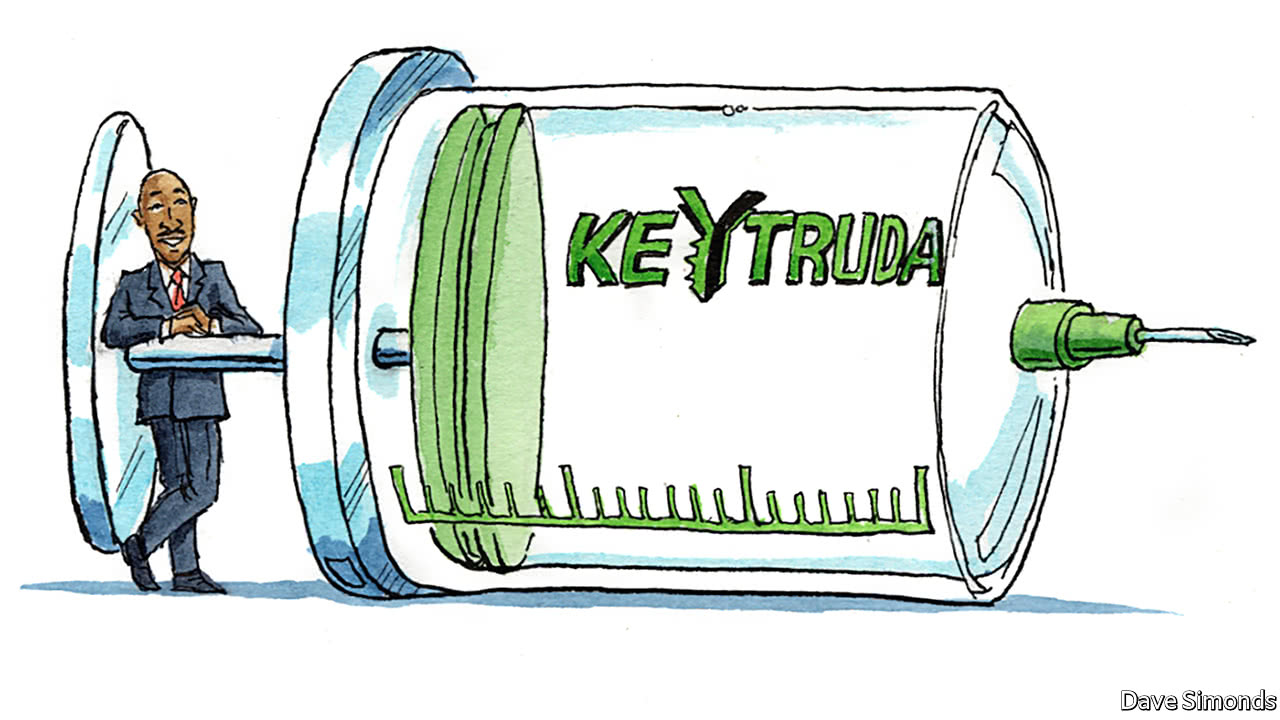
WHEN Ken Frazier, chief executive of Merck, an American pharmaceutical giant, started his job in 2011, he had a hard decision to make. The firm had promising new drugs—such as Januvia, for diabetes, and Gardasil, a vaccine against cervical cancer. But the pharma industry was struggling with dismal returns on R&D and investors were questioning if companies were overspending on science. Some surrendered and started buying in drugs instead. But Mr Frazier opted to carry on backing his labs and promised publicly to spend on R&D for the long term, not for the stockmarket’s immediate gratification.
An opportunity to implement the pledge soon arrived. Merck’s merger with another pharma firm, Schering-Plough, in 2009, had brought it an obscure new cancer drug. At first Merck’s scientists were unimpressed and relegated the drug to a list of assets to be licensed out. There was widespread scepticism at the time about whether drugs that attacked cancer using the immune system would…Continue reading