
Tag: Business
Chinese cities are competing to woo overseas entrepreneurs

WHEN Maria Veikhman, founder of SCORISTA, a Russian credit-scoring startup, was considering expansion abroad, China immediately came to mind. She believes the scope there is vast, for two-fifths of Chinese have no credit records. Ms Veikhman settled in Tianfu Software Park, a state-owned incubator in Chengdu, capital of Sichuan province where city authorities “offer almost everything for free”. Complementary facilities range from office space, basic furniture and logistics services to detailed guidance on entrepreneurial methods.
Chengdu aims to catch up with Beijing, Shanghai, and Shenzhen, which at present are in a different entrepreneurial league—together they have over a hundred unicorns, or private startups worth over $1bn. The south-western city allocated 200m yuan ($30m) in 2016 to an innovation-and-startup fund for overseas founders, and hands out up to 1m yuan in cash to well-capitalised foreign startups and joint ventures. If the…Continue reading
Europe’s flourishing gunmakers

IT WAS a blunder by Heckler & Koch, a big German gunmaker. On February 15th the firm apologised for a “mistake” after its American subsidiary posted a Valentine’s image showing a handgun surrounded by ammunition arranged in the shape of a heart. The image went out to social media shortly after a deadly school shooting in Florida.
The post was also a reminder that although Europeans often criticise lax firearm-ownership laws across the Atlantic, the region’s firms are increasingly present in America’s market for small arms—defined as revolvers, pistols, rifles and shotguns. Americans buy far more such weapons than any other nationality and their appetites have been growing steadily. This year they are likely to buy 14.5m such firearms, notes Jurgen Brauer of Small Arms Analytics, a consultancy. Europeans have proved deft at grabbing a sizeable portion of all this.
One of Russia’s most successful private entrepreneurs sells–to the state

IN THE Russian business community Sergei Galitsky served as a rare example of a self-made billionaire who rose with relatively little state help and outside the natural-resources trade. He built his retail company, Magnit, from scratch into Russia’s largest network; it has more than 16,000 stores. Rather than moving to Moscow, he kept his headquarters in his hometown of Krasnodar, where he also founded a football club. On February 16th he made a telling exit, announcing he would sell nearly all of his shares in Magnit—29.1%—to VTB, a state bank.
That Mr Galitsky (pictured, above) decided to sell is the result of a tough business cycle and some strategic mistakes. More remarkable is that he found a buyer not on the domestic private markets, or from among foreign investors. Selling to a pubic-sector bank reflects the growing role of the state in the Russian economy. Russia’s federal anti-monopoly service puts its share at 70%. Yet the retail sector had largely been insulated from the trend….Continue reading
The spoils from American corporate tax reform are unevenly spread
“IT’S always a lot of fun when you win,” President Donald Trump enthused after his tax package was approved by Congress in December. Company bosses nodded along. The centrepiece of the reform is a drastic cut to the corporate-tax rate, from 35% to 21%, taking it below the rich-country average. Although its impact is partly offset by some revenue-raising measures, the congressional Joint Committee on Taxation estimates that American business will gain around $330bn from the reform over the next ten years. Yet within that are sizeable variations in terms of which firms and industries benefit most.
The biggest winners are more domestically oriented companies. These typically face higher effective tax rates than American companies with a big presence overseas, which do business in lower-tax countries. Bosses are also evaluating other new measures. So-called “full expensing”, for example, helps those with big spending plans by allowing them to deduct investment costs up front. But using debt will become less attractive, as interest payments are no longer fully deductible.
Some firms experienced high volatility in their earnings for the final quarter of 2017 thanks to the treatment of so-called “deferred tax assets”. These are past tax losses carried forward to set against future tax bills, and such assets have shrunk in value because of the lower…Continue reading
Russian meddling is only one challenge facing the social-media giant

IN ITS early days Facebook embraced the motto “move fast and break things” to describe its engineers’ strategy of rapid innovation. “Move slowly, and try not to break anything else” seems to be its new creed. In the last year Facebook has contended with several controversies, including charges that it helped spread false news, unwittingly facilitated Russian meddling in the 2016 election and fanned political polarisation (see Briefing). After denials of responsibility and little action, Mark Zuckerberg, its boss, has talked of “fixing” Facebook in 2018. It will be a huge task.
Russia’s alleged manipulation of Facebook users will harm the company. On February 16th special counsel Robert Mueller filed conspiracy and fraud charges against 13 Russians for interfering in America’s 2016 election; Facebook was mentioned no fewer…Continue reading
Indian teaching startups make work for idle thumbs

TO ANY outsider it looks as if the children have been hypnotised by yet another smartphone game. As the spying elders in a TV ad try to break the spell, the sprogs flash a grin at their screens. “It’s maths, dad,” giggles a fifth-grader to her father. The company behind the ad, Byju’s, sells an educational smartphone app which has been downloaded 14m times since its launch in 2015.
Byju’s is one of many education technology (or “edtech”) startups that have emerged in India in the past few years. Their target is vast—some 260m pupils in schools and over 30m graduates who train in order to pass entrance tests for a seat in medical, engineering and elite management institutes. KPMG, a consultancy, reckons the industry will grow eightfold to be worth around $2bn by 2021.
Much of the expected growth is due to India’s woeful record in primary-school education, where teachers are scarce, infrastructure crumbling and the culture one of rote learning. Almost half of…Continue reading
Japanese businesses are struggling to keep up standards
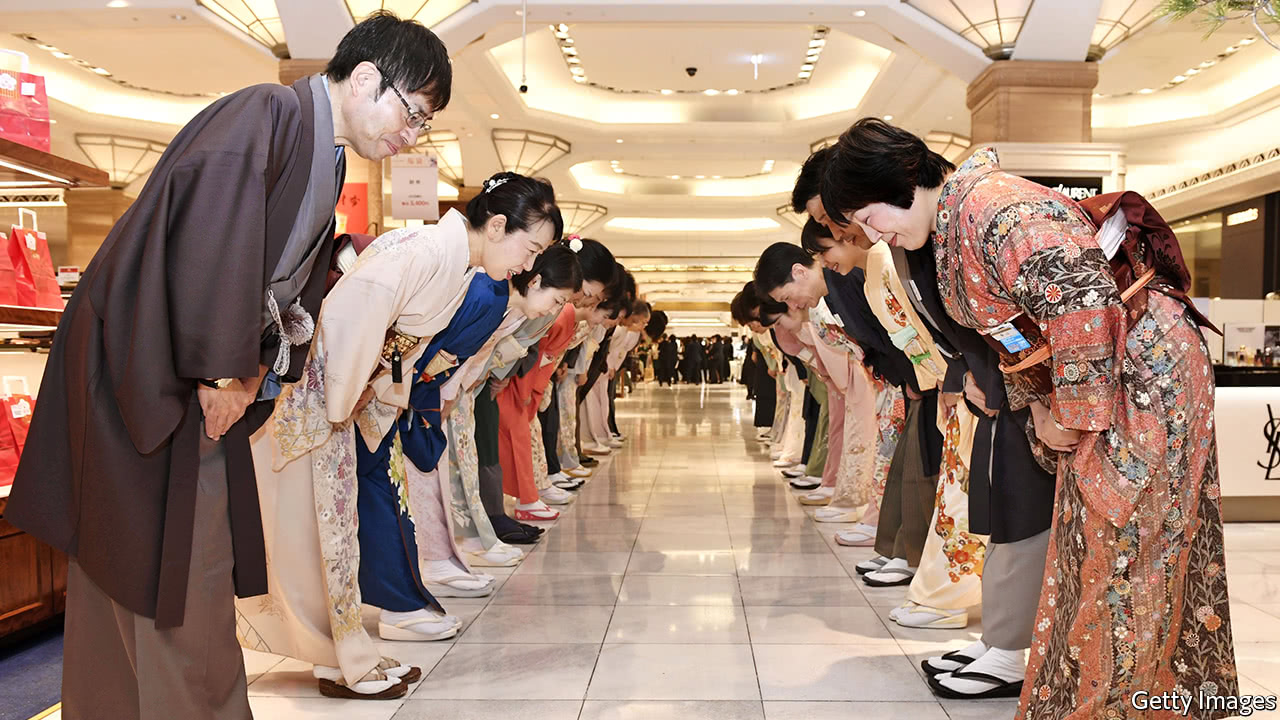
KUMIKO HIRANO has noticed a disquieting change when she goes to her neighbourhood konbini, one of Japan’s ubiquitous convenience stores. “No one is around and I have to use a loud voice to get someone to serve me,” says the 48-year-old worker in Tokyo. “It irritates me.”
This might not seem a big problem, but Japan prides itself on the standard of customer service, which approaches the level of bespoke attention elsewhere. Taxi drivers, who often wear white gloves, sometimes get out to bow when they drop off a passenger. Staff in shops and restaurants are unfailingly polite. Shoppers can order on Amazon and take delivery reliably the same day. Now Japanese are having slowly to adapt to levels of service long suffered by the rest of the world.
The human touch is becoming rarer. Lawson, another konbini chain, is automating payment during the small hours at selected stores. Some restaurants and supermarkets are following suit….Continue reading
The world’s largest-ever tech deal now depends on Qualcomm
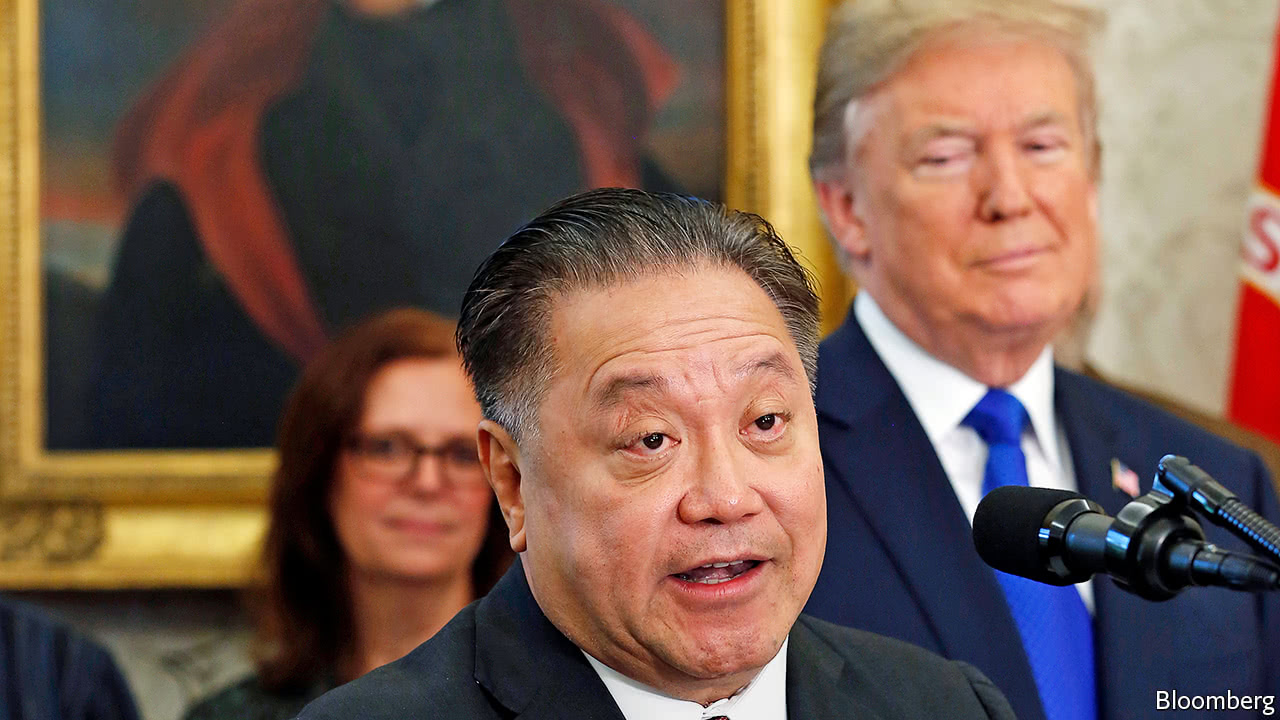
VALENTINE’S DAY might seem like a good time to discuss a proposal. But whether it brought luck to Broadcom’s attempt to woo its rival chipmaker, Qualcomm, is still unclear. As The Economist went to press, a meeting between the boards of both firms to discuss Broadcom’s bid of $146bn (including debt) proved inconclusive. Having rejected an initial approach in November, Qualcomm’s board will soon meet to discuss next steps.
Should the board reject Broadcom’s offer, the fate of the largest-ever tech acquisition would then lie with Qualcomm’s shareholders. The deal could still proceed if they elect a majority of Broadcom’s nominees to the board at Qualcomm’s annual investor meeting on March 6th. But it would have a complicated course to run.
Neither firm may be a household name like Intel or Samsung, but a merger would create the world’s third-largest chipmaker. Scale is critical in an…Continue reading
Will Comcast try to outbid Disney for Fox?

WHEN Disney struck a deal just before Christmas to buy much of 21st Century Fox for $66bn, it was a career-defining moment for the two firms’ bosses, Bob Iger and Rupert Murdoch. A third media mogul, Brian Roberts of Comcast, was left out in the cold. Having tried and failed last autumn to get Mr Murdoch to take a higher offer, Mr Roberts may now be preparing a still richer bid to upend the deal.
It is not hard to understand his motivation. Comcast is in an awkward position at a time when the media landscape is shifting. With millions of consumers dropping pay-TV for the likes of Netflix, media companies have suddenly become either buyers, to achieve scale, or sellers, to exit. Mr Roberts has always been a buyer, building the cable business his father started into a diversified empire through acquisitions, including AT&T’s broadband business in 2002 and NBC Universal in 2011. Comcast now has heft in a number of businesses—broadband and cable, television networks, a film studio…Continue reading
Ten years on from Norway's quota for women on corporate boards

THE centrepiece of the opening-bell ritual at the London Stock Exchange on February 2nd was a roll call to honour 27 global investors. They were lauded for pledging allegiance to the “30% Club”, a group which campaigns for precisely that proportion of women on corporate boards globally. Membership is a hot ticket, judging by the club’s expansion. Behemoths including BlackRock, J.P. Morgan Asset Management and Standard Life have joined, and are voting against boards that fail to appoint more women.
In much of western Europe, such efforts follow a decade-long push by governments. In 2008 Norway obliged listed companies to reserve at least 40% of their director seats for women on pain of dissolution. In the following five years more than a dozen countries set similar quotas at 30% to 40%. In Belgium, France and Italy, too, firms that fail to comply can be fined, dissolved or banned from paying existing directors. Germany, Spain and the Netherlands prefer soft-law quotas, with no sanctions….Continue reading