
Tag: Business
The dollar keeps weakening. Is that good news for the world?
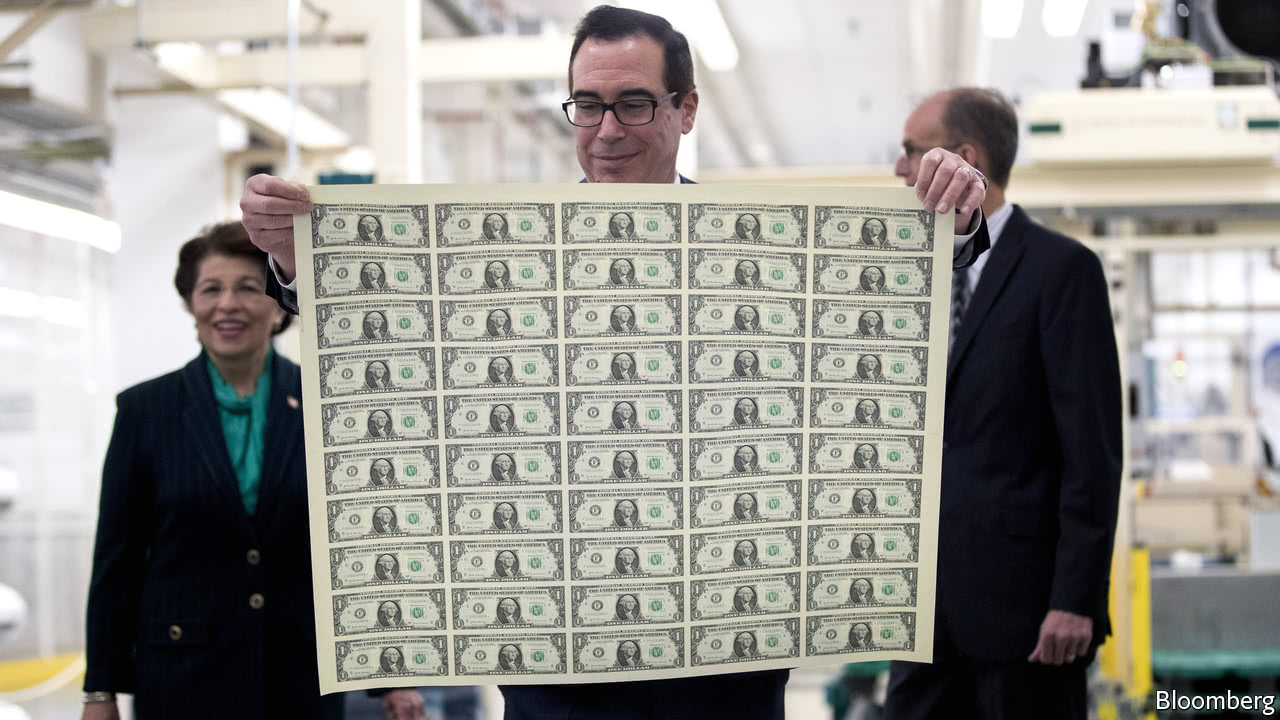
AT THE start of 2017, just before Donald Trump was inaugurated as president, a survey of fund managers by Bank of America Merrill Lynch (BAML) found they believed that being positive on the dollar was “the most crowded trade”. It turned out they were right to be cautious. On a trade-weighted basis, the currency has fallen by 9% against other major currencies in the past year.
It is not clear what the Trump administration thinks about this. At the recent World Economic Forum in Davos, Steven Mnuchin, the treasury secretary, said: “Obviously a weak dollar is good for us as it relates to trade and opportunities.” Although the rest of his statement was more nuanced, it is unusual for anyone in his position to depart from a “strong dollar” line. The greenback duly fell in price.
Mr Trump then followed up with a statement in favour of a strong dollar in the long term, which caused a rebound. Since it was only last April that he referred to the dollar as being “too…Continue reading
Droughts, storms and global demand tests America’s love affair with avocado

ALTHOUGH New Yorkers are not renowned for their patience, they do not seem to mind waiting their turn for a fresh serving of avocado. At Avocaderia, which claims to be the world’s first avocado bar, in Brooklyn, long queues stretch from the counter outward into a large food hall.
The venue’s popularity is a sign of the times: the avocado is fast becoming America’s favourite fruit. Although domestic production has stayed flat, imports have more than trebled over the past ten years, according to the Department of Agriculture. It estimates that the annual consumption of the average American has increased from about one pound (0.5 kilograms) in 1989 to more than seven pounds in 2016; total consumption that year weighed in at 2.3bn pounds.
America’s enthusiasm for avocados may be dented, however, by soaring prices. The wholesale price for a case of 48 avocados peaked at $83.75 in September, up from $34.45 a year before,…Continue reading
Richemont, the world’s second-biggest luxury firm, bets on digital
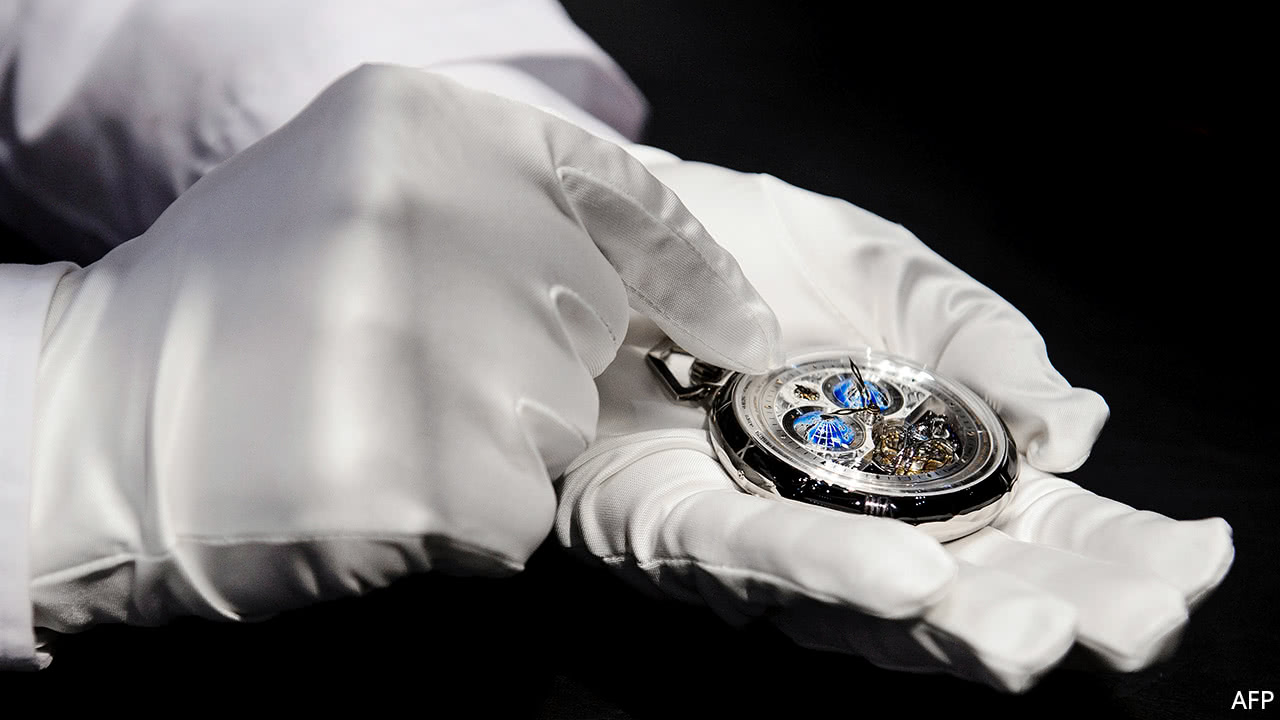
A YOUTUBE video featuring a woman sporting a gold watch and driving a convertible, which has been viewed online nearly 5m times. A social-media “influencer” with more than 11m followers on Instagram posting photos of herself wearing the same timepiece. A limited flash sale of the watch on Net-a-Porter, a website.
Purveyors of pricey jewellery and watches have been slow to embrace things digital. But last year’s social-media campaign to relaunch Panthère, a watch made by Cartier, a French jeweller, is evidence that they are waking up to the power of the online world. On January 22nd Richemont, a Swiss luxury conglomerate that counts Cartier among its brands, offered to buy the shares it does not already own in Yoox-Net-a-Porter group (YNAP), a leading luxury online retailer, for €2.7bn ($3.3bn). Although the deal still faces hurdles, it is likely to go ahead.
The days of double-digit growth in the luxury industry are gone—it…Continue reading
WhatsApp: Mark Zuckerberg’s other headache
“THERE’S too much sensationalism, misinformation and polarisation in the world today,” lamented Mark Zuckerberg, the boss of Facebook, recently. To improve things, the world’s largest social network will cut the amount of news in users’ feeds by a fifth and attempt to make the remainder more reliable by prioritising information from sources which users think are trustworthy.
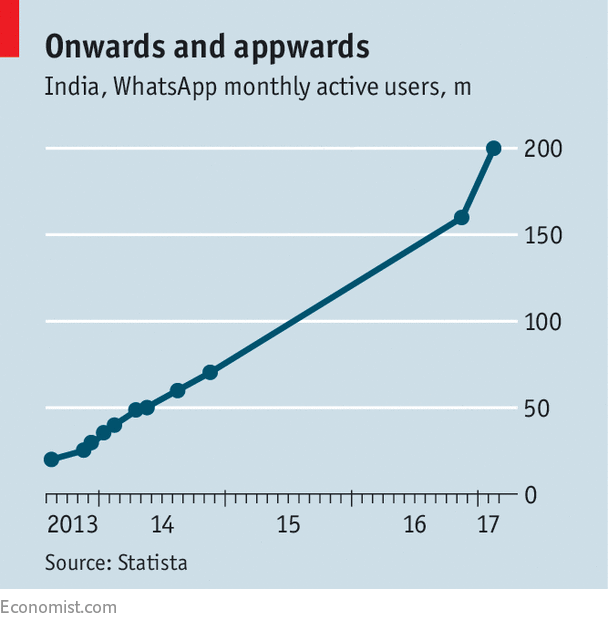
Many publishers are complaining: they worry that their content will show up less in users’ newsfeeds, reducing clicks and advertising revenues. But the bigger problem with Facebook’s latest moves may be that they are unlikely to achieve much—at least if the flourishing of fake news on WhatsApp, the messaging app which Facebook bought in 2014 for $19bn, is any guide.
In more ways than one, WhatsApp is the opposite of Facebook. Whereas posts on Facebook can be seen by all of a user’s friends, WhatsApp’s messages are encrypted. Whereas Facebook’s newsfeeds are curated by algorithms that try to maximise the time users spend on the service, WhatsApp’s stream of messages is solely generated by users. And whereas Facebook requires a fast connection, WhatsApp is not very data-hungry.
When you cannot sue your employer
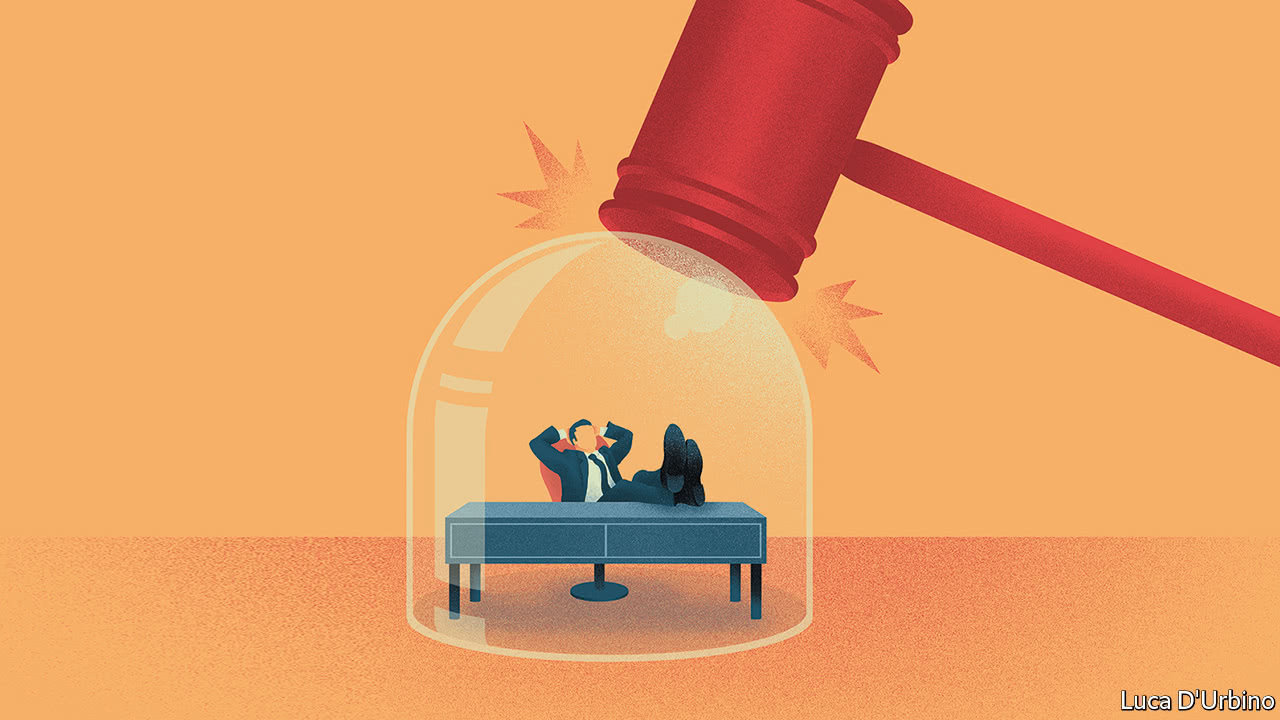
IMAGINE wanting to sue your employer, because you have been harassed or discriminated against, only to find that your access to the courts is blocked. It turns out you signed away your right to use the judicial system when you started the job: somewhere, hidden in the documents that came with your employment contract, was a clause obliging you to resolve future disputes through private arbitration, rather than in court.
An increasing number of American employees find themselves in this situation. Over half of non-unionised employees are covered by arbitration requirements, estimates Alexander Colvin of Cornell University, based on a survey in 2017 of 627 private-sector workplaces. Such agreements have come under greater scrutiny after the wave of workplace sexual-harassment revelations last year. Gretchen Carlson, a former news anchor for Fox, a broadcaster, has called arbitration “the harasser’s best friend”. Prevented by an arbitration clause from suing the network, Ms Carlson sued her boss…Continue reading
GM takes an unexpected lead in the race to develop autonomous vehicles

GENERAL MOTORS reveals barn-sized truck at Detroit motor show. What else is new, you might now ask. But the launch on January 20th of the Chevrolet Silverado, a pickup that will go on sale at the end of the year, highlights a surprising turnaround for America’s largest carmaker.
The good news is not just the Silverado’s outsized margins, which are important for a firm that relies heavily on trucks—after Mary Barra, GM’s boss, gave an ebullient performance at an investors’ conference that coincided with the motor show, the release of GM’s quarterly results on February 6th are likely to include record profits. It is also that the money thrown off by vehicles such as the Silverado will help the firm navigate the tricky terrain that lies ahead of all the world’s big carmakers.
One task is to ensure that their current business of selling vehicles with internal-combustion engines stays healthy. At the same time, they must prepare for a future of electric and autonomous cars (EVs…Continue reading
Qualcomm is fined for anti-competitive practices—again
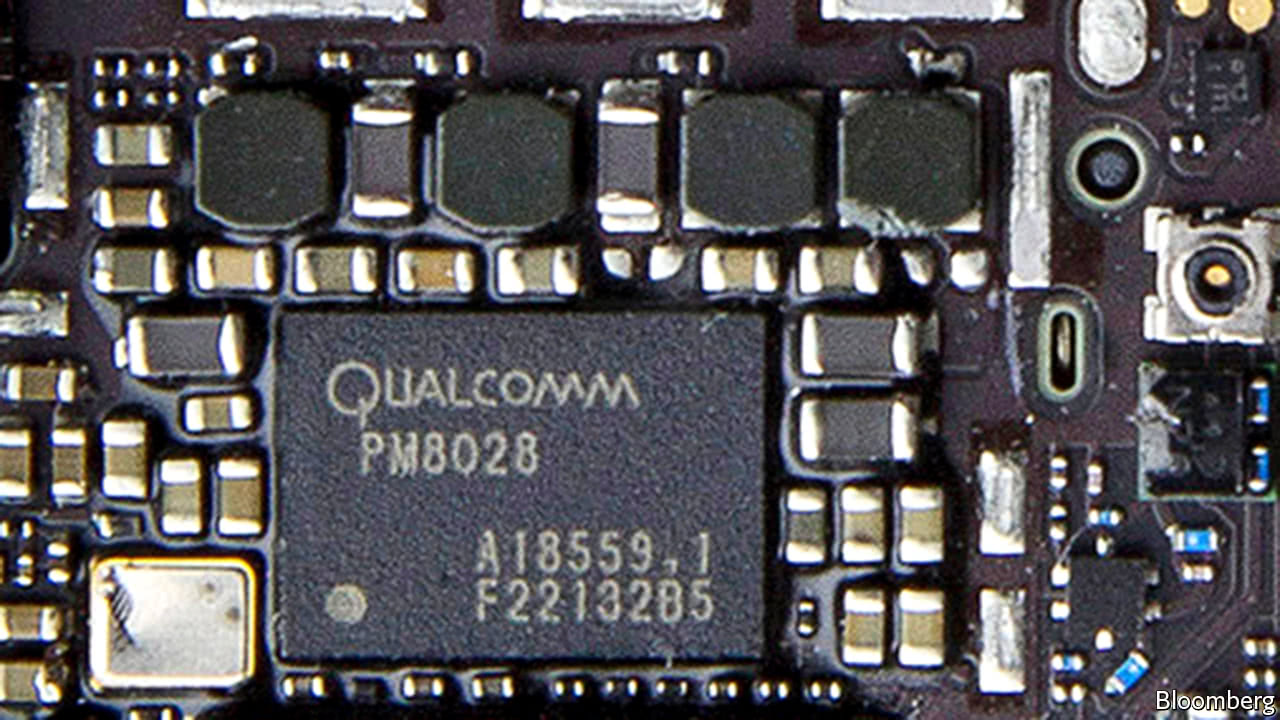
THE tech industry hardly needs another reminder that trustbusters are on its case. But the European Commission is always happy to oblige. On January 24th Europe’s executive body slapped a penalty of €1bn ($1.2bn) on Qualcomm, one of the world’s largest chip-designers, for abusing its dominance in baseband processors, a critical component in mobile phones.
Large fines are becoming something of a habit for Qualcomm, which will have paid out nearly $1bn a year, on average, to trustbusters the world over since 2015. This week’s penalty, which amounts to nearly 5% of the company’s global annual revenue, is a reflection of what Margrethe Vestager, the European competition commissioner, described as its “very illegal behaviour” between 2011 and 2016. During that time, according to Ms Vestager, the company attempted to shore up its dominant position—it is estimated to supply up to four-fifths of essential types of baseband chips—by paying Apple, its biggest customer, billions of dollars in…Continue reading
GE’s flow of financial information has become fantastically muddled

IN THEIR documentary “The Vietnam War”, Ken Burns and Lynn Novick, the directors, dwell on the flawed information that American politicians got from Indo-China. The generals on the ground focused on the “kill ratio”, or the number of enemies killed per American or South Vietnamese soldiers killed. That bore no relationship to victory—North Vietnam quickly replaced its dead soldiers. And it corrupted behaviour, leading American troops to embellish numbers and count dead civilians as “wins”.
The curse of rotten information can strike companies, too. That seems to be the case with General Electric (GE), which has had a vertiginous fall. Its shares, cashflow and forecast profits have dropped by about 50% since 2015. On January 16th it disclosed a huge, $15bn capital shortfall at its financial arm due to a revision in insurance reserves. And on January 24th it revealed a $10bn loss for the fourth quarter. In its core industrial arm, returns on capital have sunk from 20% in 2007 to a puny 5%…Continue reading
A weak market for football rights suggests a lower value for sport

FOR years the cost of rights to broadcast major sports in America and Europe has trended in one direction—up. This gravity-defying law shapes the economics of modern sport: as television operators bid ever more substantial sums, teams take in more revenue and star-player salaries (and transfer fees) climb higher. In 2017 that trajectory continued as broadcasters splurged on rights for Champions League football matches for 2018-21.
This year gravity is reasserting itself. Top-flight football rights are out for tender in two major European leagues—England and Italy—and are expected to be put up for sale this year in France and Spain, too. Analysts expect relatively small increases in pay-outs (though Spain’s La Liga boss predicts a 30% rise)—and possibly a decline in Italy. “The happy days are over,” says Claire Enders of Enders Analysis, a research firm.
The chief problem is fundamental weakness at the bidding…Continue reading
Masayoshi Son may raise yet more cash to pump into tech

AT AN investor briefing in 2015, Masayoshi Son, chief executive of SoftBank, flashed up a picture of a goose. The company is like the bird of legend that produces golden eggs, he explained. In his quest to encourage more laying, Mr Son has taken SoftBank well beyond its telecoms business. The firm also manages the world’s largest tech-investment fund, the $100bn Vision Fund, which has a slew of wealthy backers, including Saudi Arabia’s Public Investment Fund and Apple.
Using both the firm and the fund, Mr Son has acquired stakes in tech companies at a frenetic pace, by one count opening his chequebook once every four days on average in 2017. Such shopping sprees do not come cheap. SoftBank is one of Japan’s most highly leveraged companies, with debt exceeding ¥15trn ($139bn), not least because of its purchase in 2013 of a controlling stake in Sprint, an American mobilenetwork operator.
News reports this week suggest SoftBank is now hatching a plan to raise ¥2trn by…Continue reading