
Tag: Business
Cargill, an intensely private firm, sheds light on the food chain

ANGLERS love a record catch. Fish farmers, too. So when a salmon bred and raised near this village at the head of a Norwegian fjord was pulled out of captivity earlier this year weighing a sumo-sized 17kg, it was cause for jubilation. “It was fantastic,” says Einar Wathne, head of aquaculture at Cargill, the world’s biggest food-trading firm. Not only was it produced in 15 months, one-fifth faster than usual, it also looked and tasted good. Mr Wathne’s Norwegian colleagues celebrated by eating it sashimi-style shortly after its slaughter.
Cargill is a company usually associated with big boots rather than waders. America’s largest private company has built a reputation after 152 years of existence as middleman to the world, connecting farmers with buyers of human and animal food everywhere. Through a trading network that spans 70 countries (and that includes scores of ports, terminals, grain and meat-processing plants and cargo ships), it supplies information and finance to…Continue reading
Naspers comes under fire for free-riding on Tencent

SOUTH AFRICA’S stockmarket has Naspers largely to thank for its recent record highs. Shares in the media and internet group have soared by 45% this year; even before then it was Africa’s most valuable firm. So recent unrest among shareholders in Naspers might seem unwarranted. But in the days before its annual general meeting in Cape Town on August 25th, noisy debate erupted, chiefly about executive pay. Many investors reckon that Bob van Dijk, its boss, is being rewarded for success that he did little to create.
The source of good fortune for Naspers lies about 7,000 miles (11,265km) away. In 2001 Koos Bekker, Mr van Dijk’s predecessor, made a brilliant investment of $32m in a little-known Chinese technology firm called Tencent. Today its 33% stake is worth $130bn, as measured by Tencent’s value on the Hong Kong stock exchange; that dwarfs the $100bn valuation of Naspers itself on the Johannesburg stock exchange. Shares in the latter rise and fall on news from Hong Kong. In its…Continue reading
Pricey housing markets mean co-living buildings are on the rise
MONDAY is “Game of Thrones” night at The Collective’s Old Oak building. Millennials congregate in TV rooms around the 11-storey, 550-person block. Some gather at the cinema, lounging on bean bags decorated with old graphics from Life magazine. Nothing gets residents out of their rooms like the hit TV show. This is not a student dorm, however. It is home.
The Collective is a pioneer of a new property format known as “co-living”. Instead of self-contained flats, residents live in tiny rooms with 12 square metres of floor space. Most contain just a bed and a bathroom. During a two-night stay your correspondent could barely fit his shoulders into the shower cubicle.
It is outside these rooms that the building makes its pitch. It comes with a gym, spa, libraries, a good restaurant and a cinema. Residents get access to all of these amenities, as well as their room, for a rental payment of £800-£1,000 ($1,033-$1,292) a month. That includes all bills and high-speed Wi-Fi; they pay extra for meals in the restaurant. Residents have come up with their own services, too. The Collective houses a “library of things”, or a shared repository of useful objects—hammers, tape measures and even tents.
Rising rents have opened up a gap in the market. The ratio of average rents to incomes in London rose from a quarter…Continue reading
The parable of St Paul

PAUL POLMAN runs Europe’s seventh-most valuable company, Unilever, worth $176bn, but he is not a typical big cheese. A Dutchman who once considered becoming a priest, he believes that selling shampoo around the world can be a higher calling and detests the Anglo-Saxon doctrine of shareholder primacy, which holds that a firm’s chief purpose is to enrich its owners. Instead Mr Polman preaches that companies should be run “sustainably”—by investing, paying staff fairly, and by making healthy products with as little damage as possible to the environment. This is actually better for profits in the long run, he argues: society and shareholders need not be in conflict.
Mr Polman’s beliefs were tested in February when Unilever received a bid from Kraft-Heinz, a ketchup-to-hot dog gorilla controlled by Warren Buffett and 3G Capital, a fund known for ripping costs out of multinationals. If, in its own mind, Unilever is a good corporate citizen, then it sees Kraft as an angry American…Continue reading
Uber picks Dara Khosrowshahi as its new boss
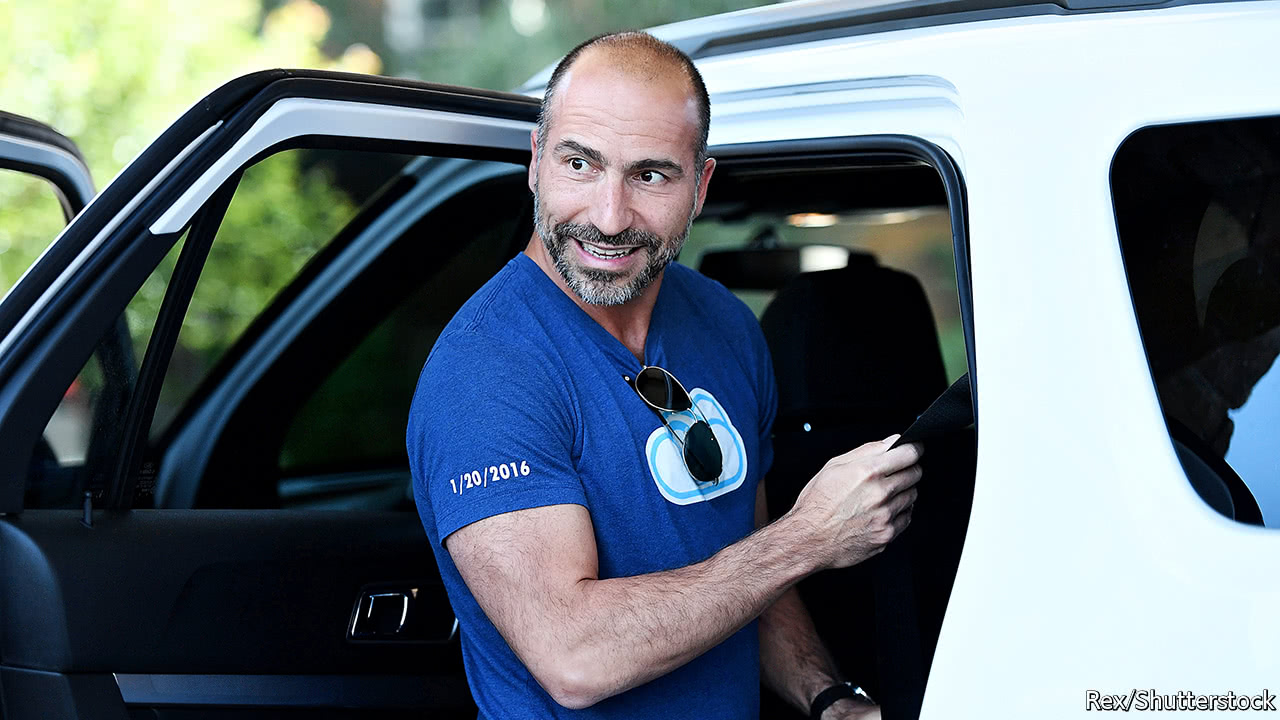
“A LEADER is a dealer in hope,” said Napoleon. For much of this year Uber, a ride-hailing firm, has lacked both leadership and optimism. But on August 27th news leaked that Uber had poached as its new chief executive Dara Khosrowshahi, the boss of Expedia, an online travel company. Mr Khosrowshahi is seen as an astute dealmaker and a canny manager. In his 12 years at the helm of Expedia, the gross value of its hotel and other travel bookings more than quadrupled and its pre-tax earnings more than doubled.
Can he rally the troops? Uber is fast-growing and was last year valued privately by investors at around $68bn, but has suffered a host of setbacks, which led to the ousting of Travis Kalanick, its co-founder and boss, in June. The firm faces a criminal probe by America’s Department of Justice into a covert software feature that showed regulators different versions of its app, as well as a new investigation into whether it…Continue reading
Samsung’s boss is sentenced to prison
SAMSUNG’S founding family, the Lees, have good reason to dislike room 417 of Seoul’s Central District Court. In 2008 it was where Lee Kun-hee, the chairman of the sprawling South Korean conglomerate, was found guilty of tax evasion. On August 25th his son, Lee Jae-yong, the vice-chairman of Samsung Electronics, stood in the same room and was sentenced to five years in prison on charges including bribery, embezzlement and perjury. The elder Mr Lee has been in hospital since suffering a heart attack in 2014. Samsung now lacks both its official and de facto bosses.
The younger Mr Lee, who plans to appeal against the verdict, was accused of paying bribes to Choi Soon-sil, a confidante of the country’s former president, Park Guen-hye. Prosecutors had argued that he hoped the payments would secure government support for an $8bn merger of two Samsung affiliates, Cheil Industries, the group’s unofficial holding company, and Samsung C&T, a construction firm. The state-run National Pension Service, the single biggest shareholder in C&T, voted for the plan in July 2015. The deal was controversial, but it helped Mr Lee consolidate his control over the group and clear the way for his succession.
The decision is a milestone in a broader influence-peddling scandal that brought down Ms Park. She was impeached in March and arrested soon after; she now…Continue reading
American bosses continue to lobby, more quietly

IN CORPORATE America, “Trump” seems to be a dirty word, at least in public. After President Donald Trump seemed to equate the actions of white supremacists and their opponents in Charlottesville earlier this month, dozens of chief executives abandoned his advisory councils. Several organisations cancelled fundraising galas booked at Mr Trump’s Mar-a-Lago resort in Florida. Lloyd Blankfein, the boss of Goldman Sachs, an investment bank, compared Mr Trump to the dark shadow cast over parts of America by a solar eclipse: “We got through one, we’ll get through the other.”
Look past the public repudiation, though, and the schism is less stark. As Jason Furman of Harvard University’s Kennedy School, who led the White House Council of Economic Advisers during Barack Obama’s presidency, points out, the bosses’ public rejection of Mr Trump has done nothing to sap their appetite to guide policy. Lower-ranking executives from large firms continue to serve on informal…Continue reading
Management turmoil at Infosys is particularly ill-timed
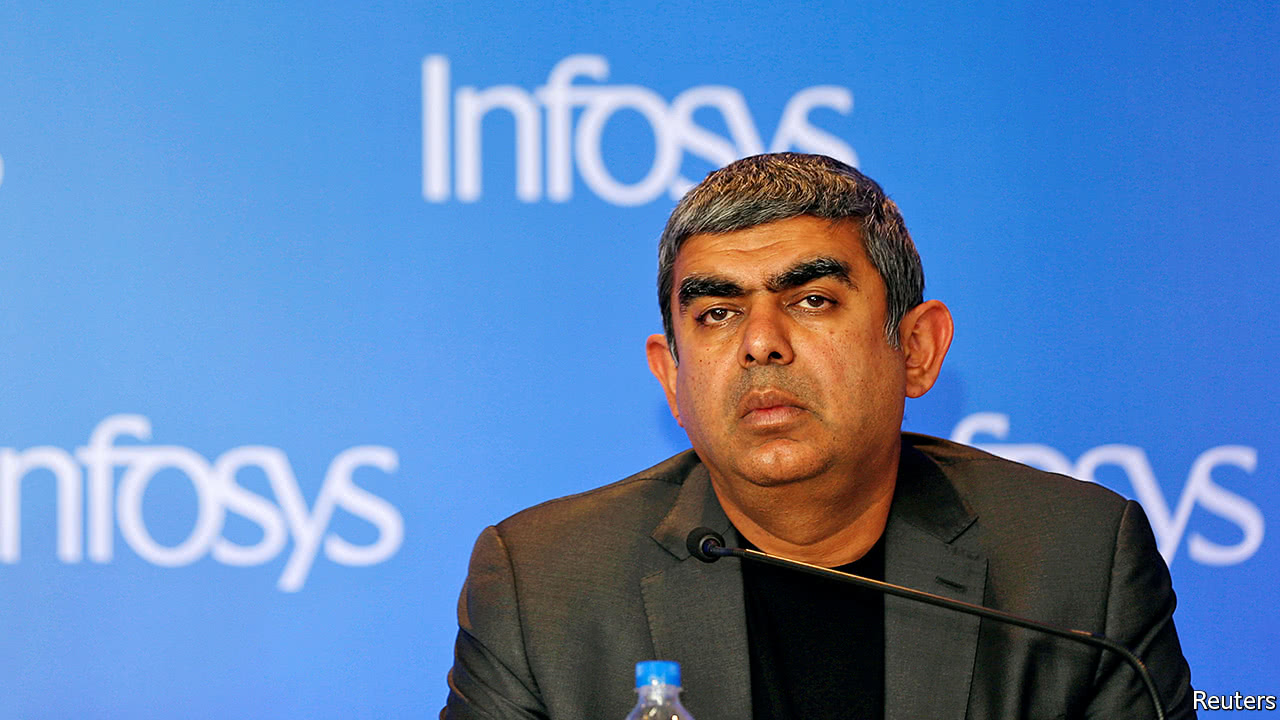
THE quickest way to start a Mexican wave in India is to head to the campus of Infosys, an IT outsourcing firm based in Bangalore, and ask all those who think they should be in charge to raise their hands. On August 18th the company’s chief executive, Vishal Sikka (pictured), resigned unexpectedly. But he still serves as executive vice-chairman. Now a chairman, a co-chairman, the interim chief executive who succeeded Mr Sikka, the board of directors and a retired founder all seem to think they should be running the show. The stalemate risks leaving the firm without a leader just as it had started the urgent work of overhauling its business.
The company’s management crisis is surprising. As one of only a few Indian IT firms that multinational companies trust to build and maintain their computer systems, Infosys has long sought to exude an aura of professionalism bordering on the dull. But clashing egos at the top now make it seem anything…Continue reading
Facebook, Twitter and Apple get into the television business

ON AUGUST 27th the season finale of HBO’s “Game of Thrones”, one of the most expensively produced series in television history, will air to an audience of more than 10m Americans. When it ends, viewers can switch to one of the most inexpensively produced shows in the industry, “Talk the Thrones”, in which boffins sit around and discuss HBO’s show. Hundreds of thousands are expected to watch.
Besides the obvious gap in entertainment value (one has dragons, the other has people talking about them), there is another distinction between the series. “Game of Thrones” is available only for a subscription on pay TV. “Talk the Thrones” is free on Twitter, produced by a digital site called The Ringer and sponsored by Verizon, a telecommunications giant. Although the HBO series is more popular, “Talk the Thrones” may be a better sign of how the TV industry might evolve.
A new generation of TV shows is being made for…Continue reading
Artificial intelligence will create new kinds of work
WHEN the first printed books with illustrations started to appear in the 1470s in the German city of Augsburg, wood engravers rose up in protest. Worried about their jobs, they literally stopped the presses. In fact, their skills turned out to be in higher demand than before: somebody had to illustrate the growing number of books.
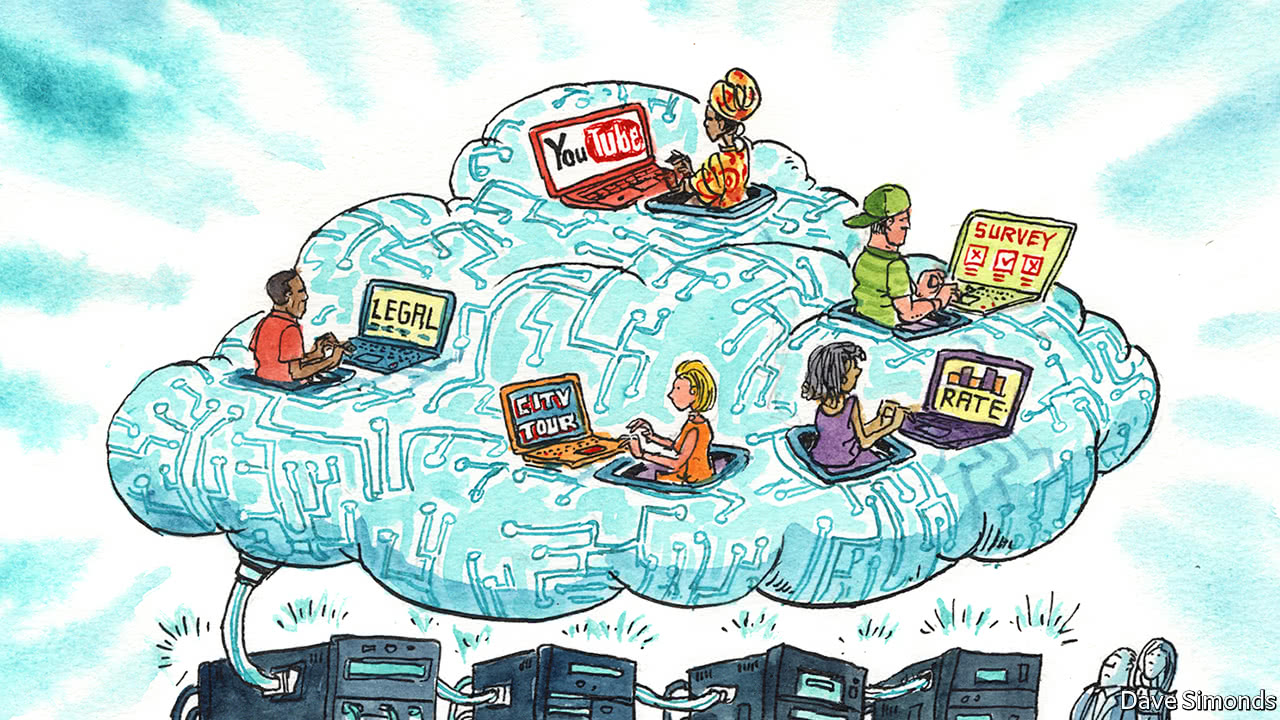
Fears about the impact of technology on jobs have resurfaced periodically ever since. The latest bout of anxiety concerns the arrival of artificial intelligence (AI). Once again, however, technology is creating demand for work. To take one example, more and more people are supplying digital services online via what is sometimes dubbed the “human cloud”. Counter-intuitively, many are doing so in response to AI.
According to the World Bank, more than 5m people already offer to work remotely on online marketplaces such as Freelancer.com and UpWork. Jobs range from designing websites to writing legal briefs, and typically bring in at least a few…Continue reading