
Tag: Business
Mistrust in America could sink the economy

AMERICA is a grumpy and confused place. For an overarching explanation of what has gone wrong, a decline in trust is a good place to start. Trust can be defined as the expectation that other people, or organisations, will act in ways that are fair to you. In the White House and beyond there is precious little of it about. People increasingly view institutions as corrupt, strangers as suspicious, rivals as illegitimate and facts as negotiable.
The share of Americans who say “most people can be trusted” fell from 44% in 1976 to 32% in 2016, according to a survey from the University of Chicago. In a new book, “The Retreat of Western Liberalism”, Edward Luce, a commentator for the Financial Times in Washington, argues that distrust will contribute to America’s decline and eventually, even, to autocracy. Lack of faith is chewed over in boardrooms, too. In his latest letter to shareholders, Jamie Dimon, JPMorgan Chase’s boss, describes trust as America’s…Continue reading
Airport profits: ready to depart
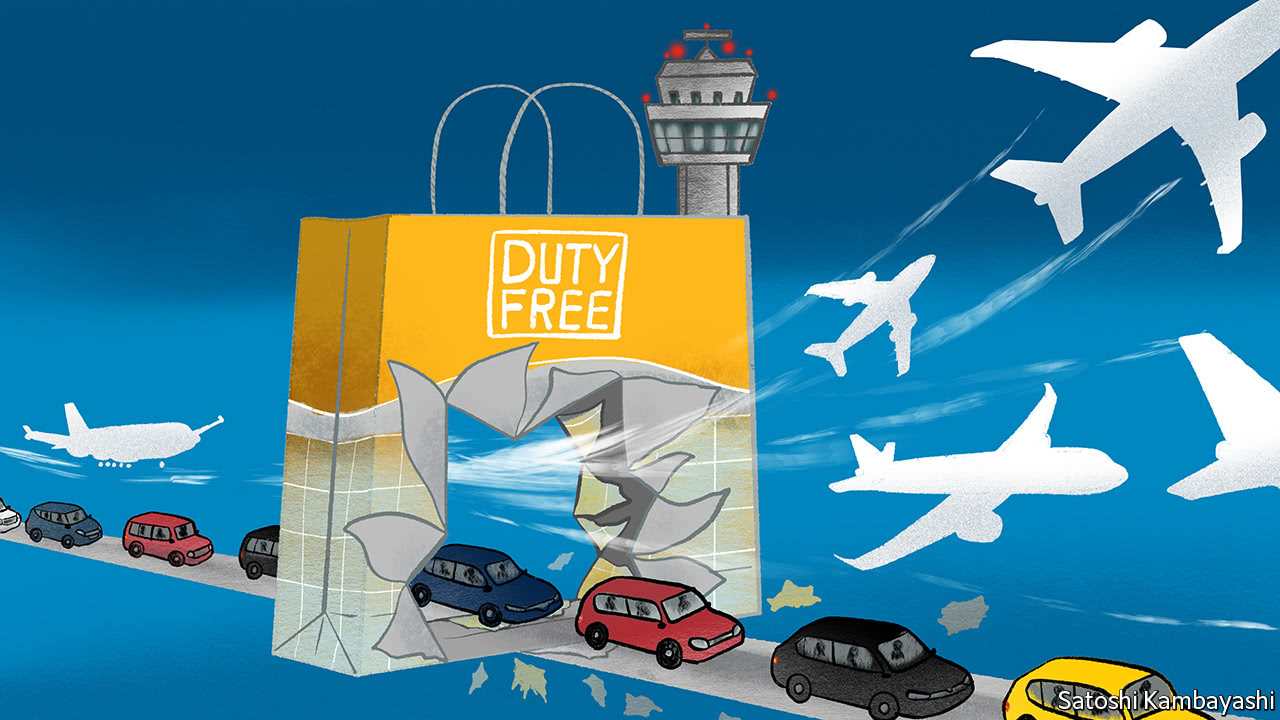
WHEN Heathrow airport opened, in 1946, the only retail facilities were a bar with chintz armchairs and a small newsagent’s. The first terminal was a tent, a far cry from the four halls, resembling vast shopping malls, at the London airport today. Retail spending per passenger is the highest of any airport. This summer’s consumer crazes include Harry Potter wands and cactus-shaped lilos.
Heathrow’s journey from waiting room to retail paradise is the story of many airports. Before the 1980s, most income came from airlines’ landing and passenger-handling charges. Then “non-aeronautical” revenue—from shops, airport parking, car rental and so on—rose to around two-fifths of their revenues, of $152bn worldwide in 2015. But amid signs that non-aeronautical income is peaking, especially in mature aviation markets such as North America and Europe, the industry fears for its business model.
When airports were state-owned, and run not for profit but for the benefit of the…Continue reading
A Google employee inflames a debate about sexism and free speech
“DON’T be evil” is Google’s corporate motto. If only it were so simple. The online-search giant is in a tricky spot after an employee published a long, anonymous memo online about why women are under-represented in the technology industry. The main reason may not be sexism, asserted James Damore, the young Harvard-educated software engineer later revealed to be the memo’s author, but biological factors. Women are more interested in people and emotions, he wrote, and tend towards “neuroticism”, meaning they are more anxious than men and worse at handling high-stress jobs.
The ten-page memo also lamented liberal Silicon Valley’s new willingness to “discriminate to create equal representation” and its reluctance to hear opinions that clash with the mainstream view on diversity. On August 7th Mr Damore told Bloomberg, a news service, that he had been fired by Google. Sundar Pichai, the company’s boss, said that portions of the memo violated its code of conduct…Continue reading
Dame Helen Alexander, former chief executive of The Economist Group, died on August 5th
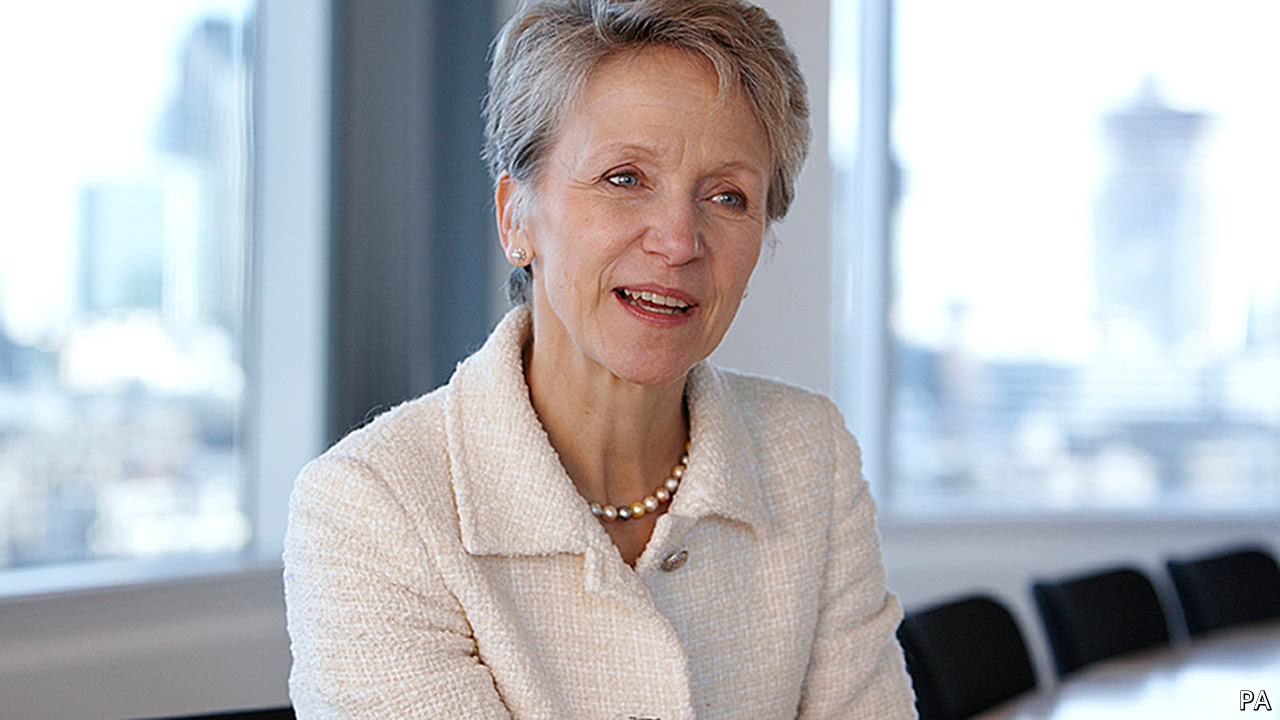
ROLE models for women in business are still too rare, not least in Britain. Last November an independent review backed by the government urged FTSE 100 companies to raise the share of women on their boards from 27% to 33% by 2020. Sadly, that push this week lost one of its leading champions, Helen Alexander, the deputy chair of the review.
Business had no better ambassador. She was self-effacing but a world-class networker—a winning combination that helps to explain, along with her intelligence and charm, why all sorts of firms flocked to have her on their board (from Northern Foods to Centrica, Rolls-Royce and the British arm of Huawei), to advise them (Bain Capital) or to chair them (the Port of London Authority and, more recently, UBM, an events business). In 2009 she became the first woman to be president of the Confederation of British Industry, the country’s main employers’ group.
But Helen had built her reputation in the media industry. From 1997 to…Continue reading
Helen Alexander, former CEO of The Economist Group, died on August 5th
ROLE models for women in business are still too rare, not least in Britain. Last November an independent review backed by the government urged FTSE 100 companies to raise the share of women on their boards from 27% to 33% by 2020. Sadly, that push this week lost one of its leading champions, Helen Alexander, the deputy chair of the review.
Business had no better ambassador. She was self-effacing but a world-class networker—a winning combination that helps explain, along with her intelligence and charm, why all sorts of firms wanted her on their board (from Northern Foods to Centrica, Rolls-Royce and the British arm of Huawei), to advise them (Bain Capital) or to chair them (the Port of London Authority and, more recently, UBM, an events business). In 2009 she became the first woman to be president of the Confederation of British Industry, the country’s main employers’ group.
But Helen had built her reputation in…Continue reading
Europe’s no business as usual summer
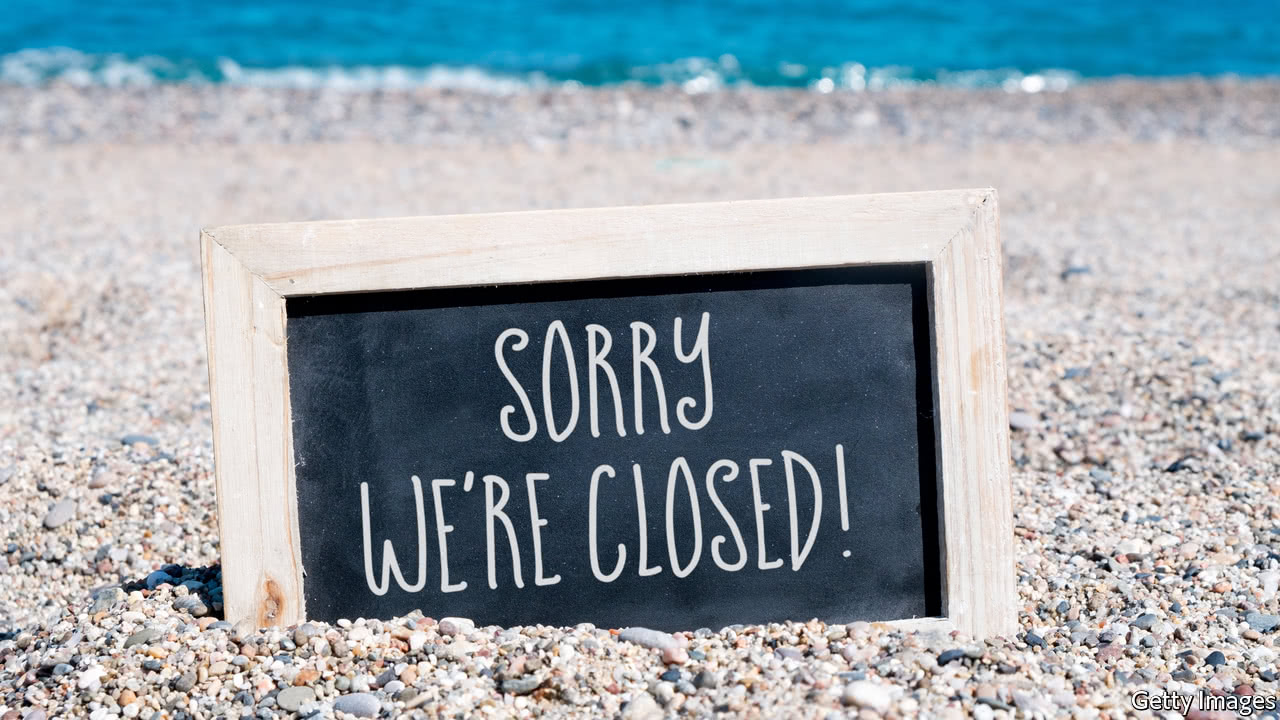
“DON’T you know about our summer?” asks a spokesperson of a Swedish multinational, himself presumably on holiday as kids chirp in the background. Almost everyone is gone until September, he says. At a German multinational, “the whole board is away for August,” admits a spokesperson. Faced with a slew of out-of-office messages across corporate Europe, there seems little choice for a business correspondent but to report on the phenomenon itself.
The practice of collectively taking July or August off dates from the Industrial Revolution, when it made sense to send off all assembly-line workers simultaneously. In England’s north entire factories used to descend on the same resorts. As any tourist who has found themselves in front of an cream shop that is closed during a sizzling southern European summer will know, it has spread beyond factory jobs.
Until 2015 France had a rule that mandated some bakeries to stay open in August, so that Parisians—or rather…Continue reading
Western firms are coining it along China’s One Belt, One Road
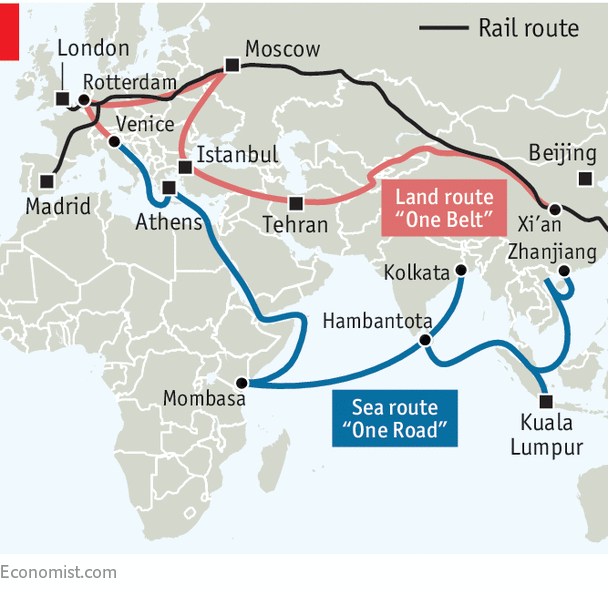
“MUTUAL benefit, joint responsibility and shared destiny,” sings a choir of enthusiastic schoolgirls in a music video called “The Belt and Road, Sing Along” from Xinhua, a news service run by the Chinese government, that mixes shots of cranes and shipping containers with people enjoying foreign landmarks. Western firms are scarcely less optimistic. Launched by China in 2013, the One Belt, One Road policy, known as OBOR, has two parts. There is a land-based “belt” from China to Europe, evoking old Silk Road trade paths, then a “road” referring to ancient maritime routes.
OBOR will span 65 countries (see map), and China has so far invested over $900bn in projects ranging from highways in Pakistan to railway lines in Thailand. Western multinationals, spotting a bonanza, are selling billions of dollars of equipment, technology and services to Chinese firms building along it.
America’s General Electric (GE) made sales of $2.3bn in equipment orders from OBOR projects in 2016,…Continue reading
A rush for immunotherapy cancer drugs means new bedfellows
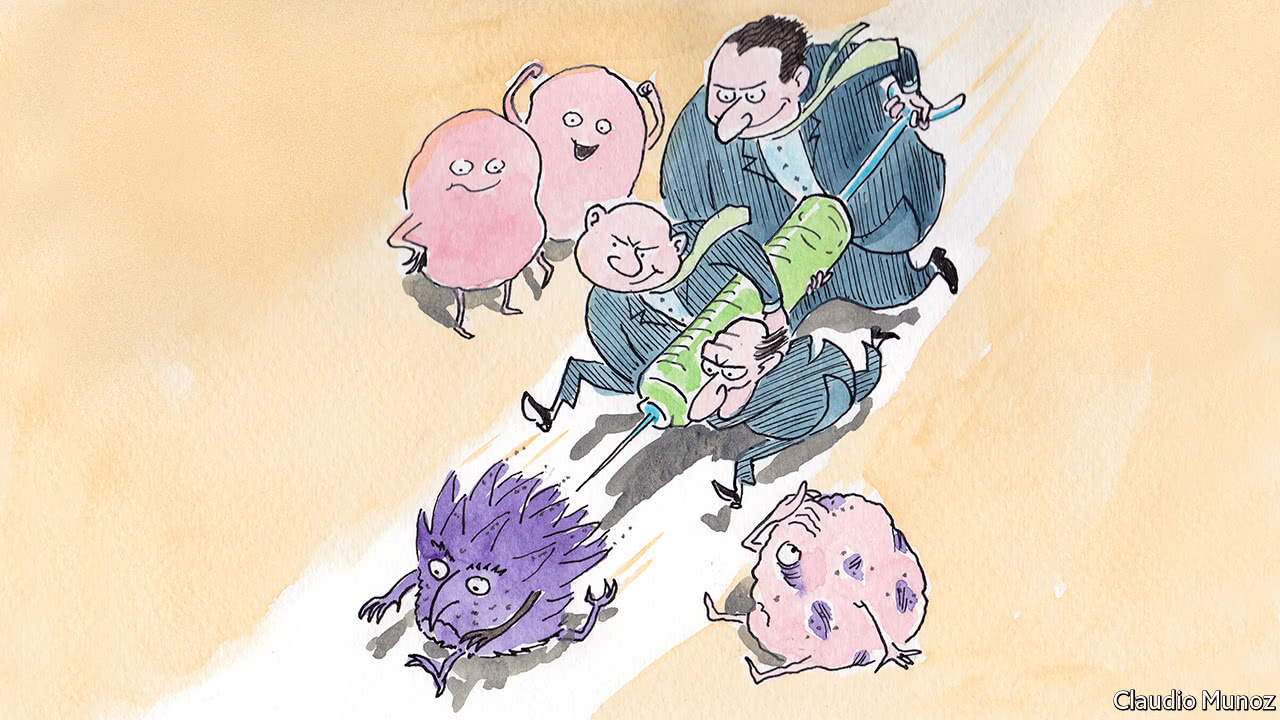
THE modern pharmaceutical firm lives or dies on the strength of its drug portfolio. As patents expire on lucrative medicines, they must replace the income that has been lost by inventing new drugs, or buying them in from outside. Both paths are expensive. But the costs of failure are greater, and this is how it was possible for a large and successful firm—such as British-based AstraZeneca—to shed 15% of its market value in a single day last week. Around £10bn ($13.2bn) was lost on news of disappointing results in one of its clinical trials (its shares have since rebounded by 4%).
The trial was to find out if a pair of drugs would treat a form of lung cancer. The drug, Imfinzi, and the experimental drug tremelimumab, belong to a new category of immunotherapy medicines called “checkpoint inhibitors”. Similar drugs are made by Bristol Myers Squibb (BMS), by Merck in America and Roche, a Swiss firm. In an interim finding, it was reported that Astra’s combination did not offer an…Continue reading
Shark Week meets Worst Cooks in America

FORGET your subscription to Netflix. Would you pay $5 a month for a collection of TV channels that gave you programmes such as “90 Day Fiancé”, “Pit Bulls and Parolees”, “My Cat from Hell”, “Worst Cooks in America” and “Shark Week”? Irresistible as this may seem, it is not yet on offer. But many believe that it has come closer. Discovery, a cable-network group, agreed on July 31st to buy another: Scripps Networks Interactive, owner of Food Network and HGTV, among other channels, in a $14.6bn deal. The combined firm will have 19 lifestyle- and reality-television-oriented channels including Animal Planet, DIY Network, Travel Channel and the flagship Discovery Channel (home of “Shark Week”).
The impetus for the combination is the declining market in America for expensive pay-TV bundles of 200 channels, which can cost close to $100 a month. In the past few years millions of consumers have spurned such bloated packages for…Continue reading
Is Emmanuel Macron serious about privatisation?
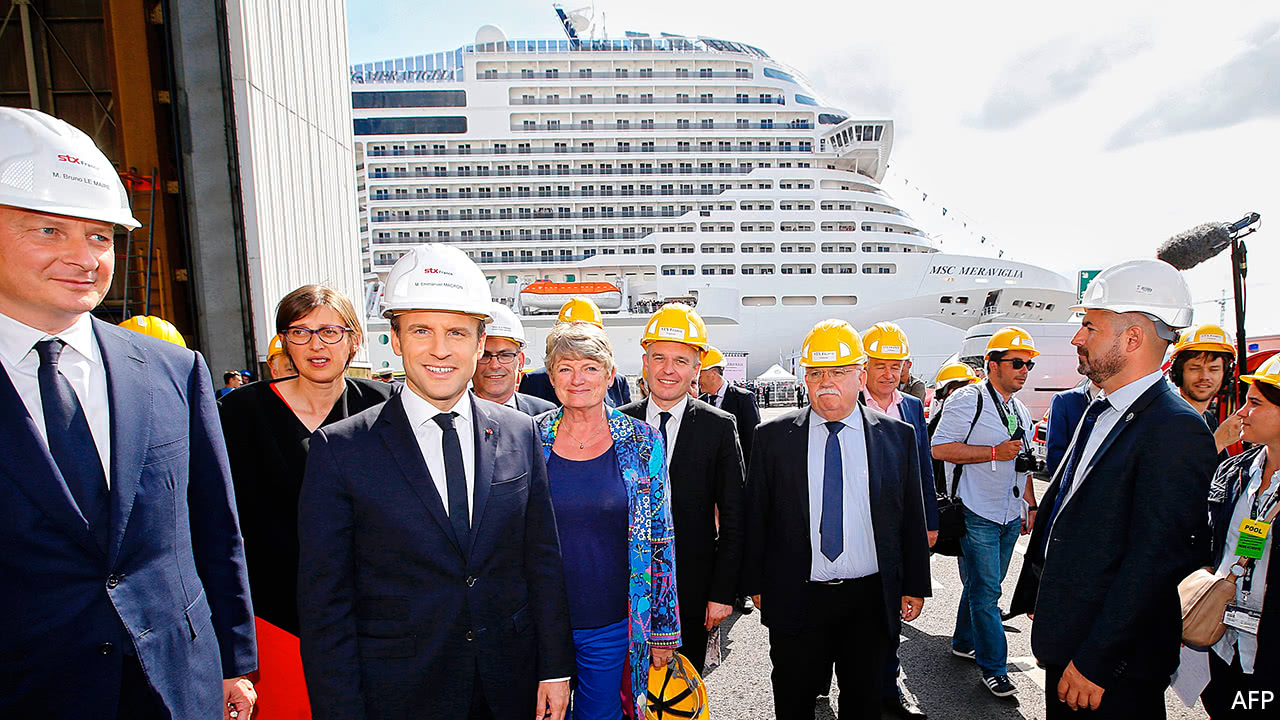
ONE reason for Italian anger over the decision on July 27th by Emmanuel Macron, France’s president, to stop Fincantieri, a shipbuilder from Trieste, winning control of a French shipyard at Saint-Nazaire, was that recent cross-border deals have mostly gone France’s way. Italian businesspeople have grown nervous about French firms’ “colonisation” by means of acquisitions in luxury goods, media and telecoms, including the €46bn ($55bn) merger between Luxottica, an Italian maker of spectacles, and France’s Essilor, announced in January (the group’s headquarters will be in Paris). The bad taste will linger even if the two governments strike a deal over Saint-Nazaire by the autumn, as they have pledged.
Yet Mr Macron’s move has been even more dismaying for those at home who want the state to get on with privatisation. During his presidential run Mr Macron promised to raise €10bn from sales of some of the state’s sprawling portfolio of holdings in firms. The aim was to pay…Continue reading