
Tag: Finance and economics
The gap between India’s richer and poorer states is widening

COUNTRIES find it easier to get rich once their neighbours already are. East Asia’s growth pattern has for decades been likened to a skein of geese, from Japan at the vanguard to laggards such as Myanmar at the rear. The same pattern can often be seen within big countries. Over the past decade, for example, China’s poorer provinces have grown faster than their wealthier peers. India is different. Far from converging, its states are getting ever more unequal. A recent shake-up in the tax system might even make matters worse.
Bar a few Mumbai penthouses and Bangalore startup offices, all parts of India are relatively poor by global standards. Taken together, its 1.3bn people make up roughly the third and fourth decile of the world’s population, with an income per person (adjusted for purchasing power) of $6,600 dollars. But that average conceals a vast gap. In Kerala, a southern state, the average resident has an annual income per person of $9,300, higher than Ukraine, and…Continue reading
Does ageing explain America’s disappointing wage growth?
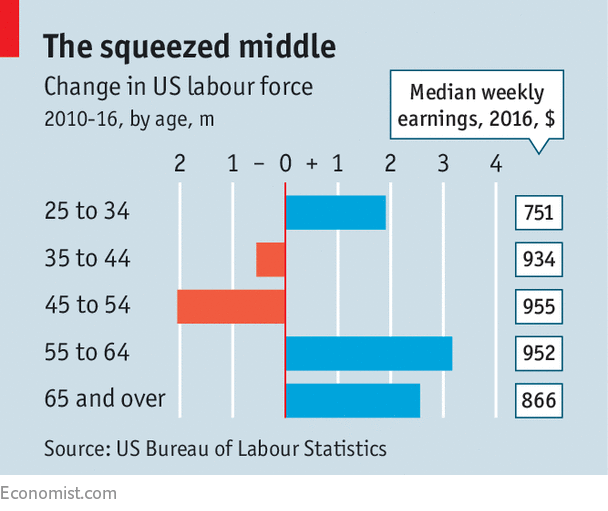
WHEN America’s unemployment was last as low as it has been recently, in early 2007, wages were growing by about 3.5% a year. Today wage growth seems stuck at about 2.5%. This puzzles economists. Some say the labour market is less healthy than the jobless rate suggests; others point to weak productivity growth or low inflation expectations. The latest idea is to blame retiring baby-boomers.
The thinking goes as follows. The average worker gains skills and seniority, and hence higher pay, over time. When he retires, his high-paying job will vanish unless a similarly-seasoned worker is waiting in the wings. A flurry of retirements could therefore put downward pressure on average wages, however well the economy does. The first baby-boomers began to hit retirement age around 2007, just as the financial crisis started. And since 2010, the first full year of the recovery, the number of middle-aged workers has shrunk considerably. They have been replaced partly by lower-earning youngsters (see…Continue reading
Are men more irrationally exuberant than women?
WOULD more women on the trading floor inject a dose of sanity into the world’s financial markets? This question gained prominence after the 2007-08 crisis. As Christine Lagarde, then France’s finance minister and now head of the IMF, quipped, had Lehman Brothers been Lehman Sisters, history would have been different. Many studies support this idea, showing that testosterone-laden men are prone to overconfidence in trading. Women are more cautious.
But things may not be so simple. Previous research has mostly used evidence from the West. To test if the conclusions apply universally, Wang Jianxin of China’s Central South University, Daniel Houser of George Mason University and Xu Hui of Beijing Normal University looked at both America and China. And they found that in China’s markets, women can be just as manic as men.
The economists arranged for 342 students to form experimental markets. They were allocated dividend-paying…Continue reading
Financial-market index-makers are growing in power
IT WAS in 1896 that Charles Dow, co-founder of Dow Jones & Company, created the index that still bears his name. Today, indices such as the Dow Jones Industrial Average and the S&P 500 (for shares listed in New York), or the FTSE 100 (for London), are among the best-known brands in financial markets. The role they play has expanded massively in recent years. Index-makers have become finance’s new kingmakers: arbiters of how investors should allocate their money.
Stockmarket indices were devised as a measure of the overall market, against which those trading in shares could compare their performance. At first they were concocted by the press or by exchanges themselves. For bonds, indices were compiled by the banks that traded them. Except for a few of the very earliest indices, such as the Dow, which is weighted by share price, nearly all are weighted by market capitalisation or, in the case of bond indices, by the volume of debt outstanding.
Three large firms—FTSE…Continue reading
How the shape of global banking has turned upside down
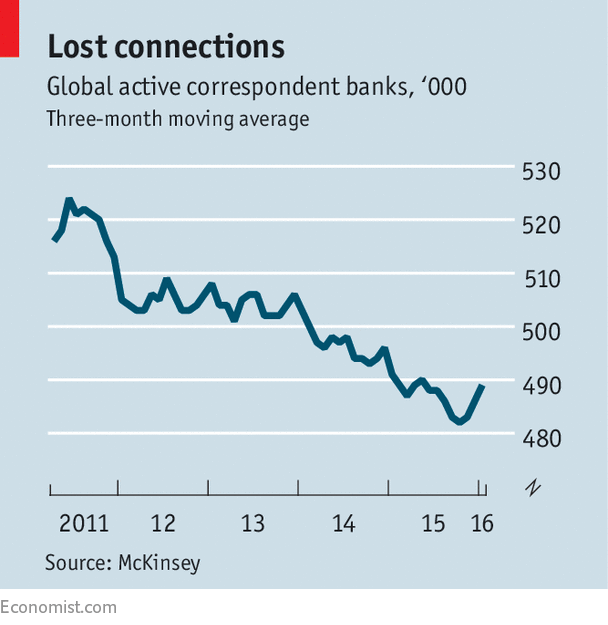
IN THE 1980s, when Citicorp was America’s largest bank and pursuing every avenue for international expansion, John Reed, the bank’s boss, would muse about moving its headquarters to a neutral location, notably the moon. Such sentiments are inconceivable today. Jamie Dimon, boss of JPMorgan Chase, Citi’s successor atop the league tables, recently said he is an American “patriot” first, head of a bank second. His strategy, though hardly shunning international markets, reflects this.
Mr Dimon turned down several big foreign acquisitions before and during the financial crisis. His stellar reputation may rest as much on those undone deals as on those completed. Citi, meanwhile, has been lopping off foreign affiliates. It has retail operations in just 19 countries, down from 50 in 2007. Further contraction may be in the offing. Bank of America has long chosen to live down to its name, as an almost entirely domestic bank.
The same process is under way in western Europe. Visible…Continue reading
Private-equity returns can be replicated with public shares
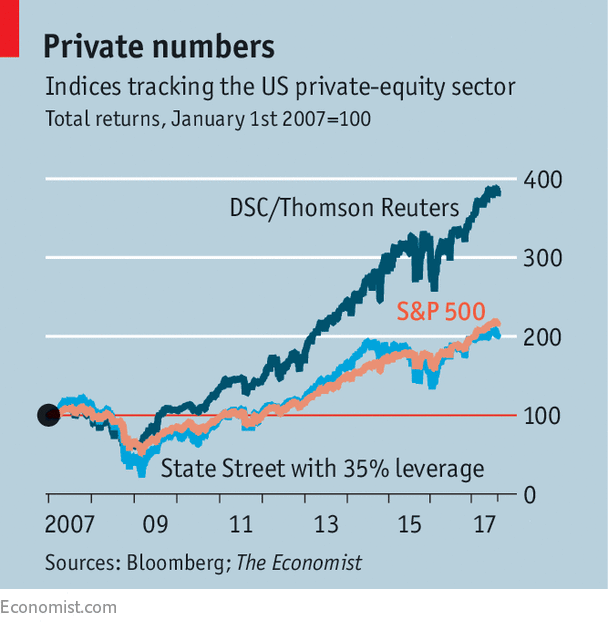
IT IS hard for individual investors to match the returns achieved by private-equity funds. But what if their success in outperforming the public markets could be tracked and replicated? A few pioneering firms claim to have done just that. DSC Quantitative Group, a Chicago-based fund, and State Street, an asset manager, both offer “investable” indices, launched in 2014 and 2015 respectively, that allow investors to mimic the performance of American private equity.
Both firms needed a measure of the industry’s returns. DSC teamed up with Thomson Reuters, a data firm, to compile an index; State Street had been making one since 2004, using data it gleans as a custodian of private-equity assets.
They then match the private-equity risk-and-return profile with a basket of public assets. DSC’s index first matches the sector weights of the private portfolio with equivalent public companies, and adds a modest amount of debt (around 25%) unevenly across the sectors—all using…Continue reading
Islamic banking grows in Bangladesh, no thanks to the authorities
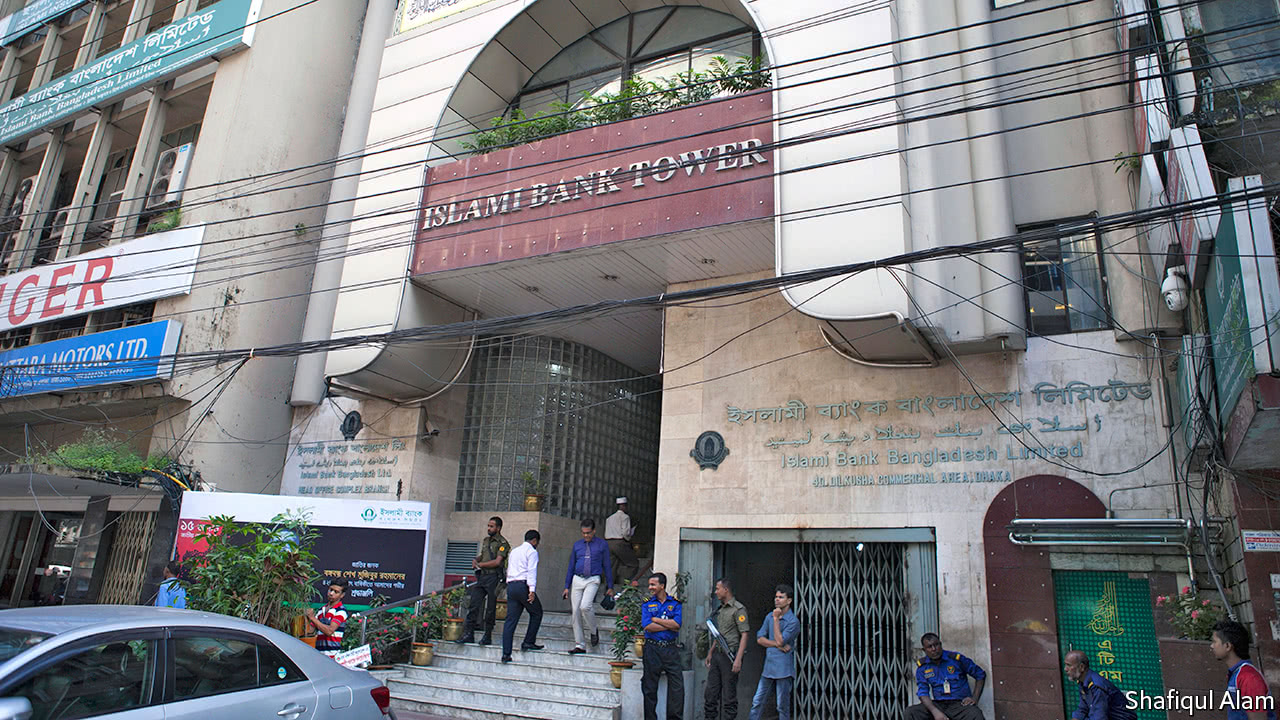
IN MOTIJHEEL, the main business district in Bangladesh’s capital, Dhaka, an iron fence and terrible traffic divide two branches of the country’s oldest private bank—a “conventional” one and an Islamic one. Abdus Sattar, manager of the Islamic one, says that when he joined AB Bank, in 2005, his was “a loser branch”. Today, like most Islamic banks in the country, it is more profitable and better run than its conventional peers. Islamic banking’s future in the country, however, remains murky.
Bangladesh has eight full-fledged Islamic banks; a handful of orthodox banks, like AB, also offer Islamic-banking services alongside others. Islami Bank Bangladesh, founded in 1983 by Saudi and Kuwaiti investors, commands 90% of Islamic-banking assets and deposits. It is also the biggest private lender overall, with 14,000 staff, 12m depositors and a balance-sheet of $10bn. Its success was built on the “two Rs”: remittances…Continue reading
The “free” economy comes at a cost

FACEBOOK, whose users visit for an average of 50 minutes a day, promises members: “It’s free and always will be.” It certainly sounds like a steal. But it is only one of the bargains that apparently litter the internet: YouTube watchers devour 1bn hours of videos every day, for instance. These free lunches do come at a cost; the problem is calculating how much it is. Because consumers do not pay for many digital services in cash, beyond the cost of an internet connection, economists cannot treat these exchanges like normal transactions. The economics of free are different.
Unlike conventional merchants, companies like Facebook and Google have their users themselves produce value. Information and pictures uploaded to social networks draw others to the site. Online searches, selections and “likes” teach algorithms what people want. (Now you’ve bought “The Communist Manifesto”, how about a copy of “Das Kapital”?)
The prevalence of free services is partly a…Continue reading
The Catholic church becomes an impact investor
“YOU cannot serve both God and money,” admonishes the Bible. But the church has always tried. In the Middle Ages monasteries were what would now be termed social enterprises. They would produce bread, books or other goods. A Franciscan monk is credited with codifying double-entry book-keeping.
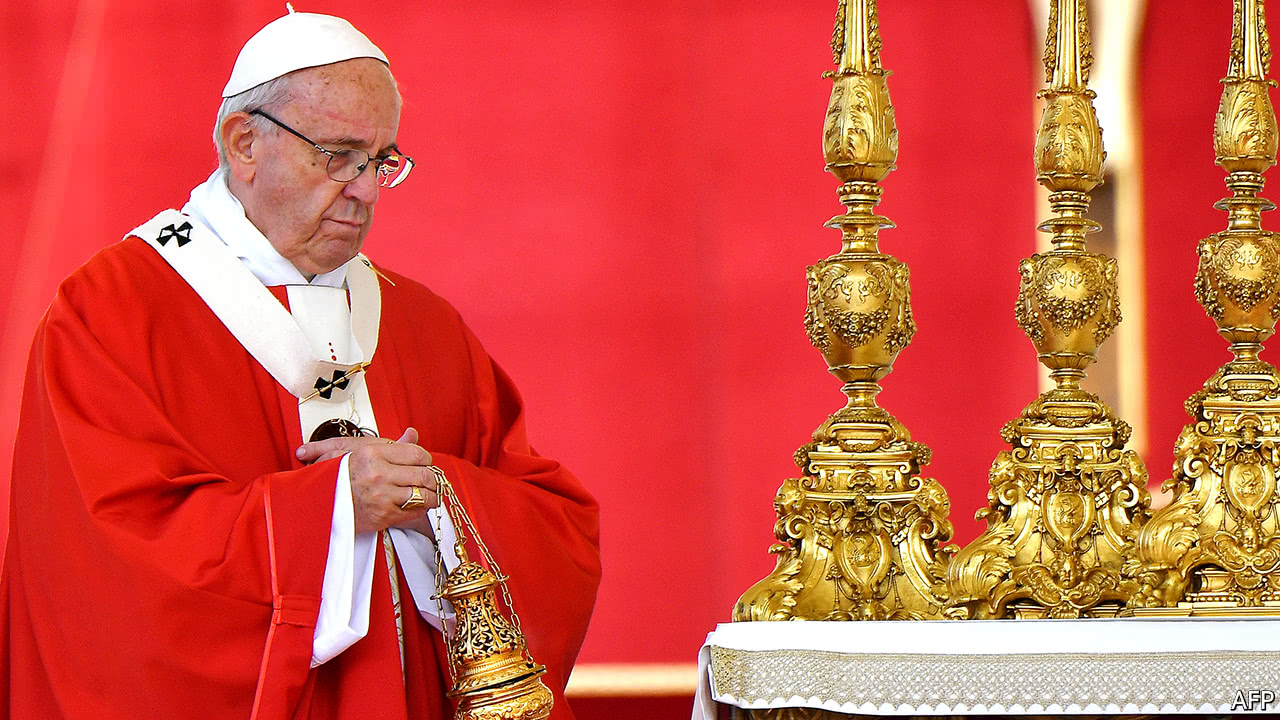
These days the Catholic church and related institutions control many billions of dollars. Some is invested to earn income; some is given away for good works. The two activities have been seen as separate. But, in the pontificate of Pope Francis, that divide is blurring. “Impact” investing—intended to make money and do good at the same time—is growing in importance. It is also creating some controversy.
In 2014 the pope, speaking to a conference in the Vatican on impact investing, called on Christians to rediscover “this precious and primordial unity between profit and solidarity”. His church has responded. Some…Continue reading
China modernises its monetary policy
QIN SHIHUANG was the emperor who first unified China, through bloody conquest more than two millennia ago. Known for starting the Great Wall and burying scholars alive, he has a new claim to fame: the central bank has drawn on his construction of a national road system to help explain its new monetary system. In a report on August 11th, the People’s Bank of China seized on an idiom derived from his road-building experience: it had “shaved off mountain peaks and filled valleys” in managing liquidity.
The modernisation of monetary policy is in its own way a monumental project for China. Over the past two decades, the central bank’s conduct of policy had two defining features. It focused on the quantity, not the price, of money. And it relied on inflows of foreign cash to generate new money. Both features are now slowly changing, bringing China closer to the norm in developed markets, an essential transition for an increasingly complex economy.
Start with interest rates. These used to be of secondary importance in China. Regulators instead used quotas to dictate how much banks lent and in effect fixed their deposit and lending rates. This made sense when China was in the early stages of moving away from a planned economy. Crude targets were still needed. But as a bigger, rowdier financial system took shape, these targets became less relevant. With the…Continue reading