
Tag: Finance and economics
The Trump administration is investigating Chinese trade practices

BEING tough on China was a constant theme of President Donald Trump’s election campaign. On August 14th he had another chance to wield his presidential pen to show that he is making good on his promises—in this case of a “zero-tolerance policy on intellectual-property theft and forced technology transfer”. With the cameras rolling, he formally instructed Robert Lighthizer, the United States Trade Representative, to consider launching an investigation into China’s alleged crimes. “This is just the beginning,” was Mr Trump’s final flourish for the news bulletins.
His record of translating signatures into policies is patchy. Two others, launching investigations into whether imports of steel and aluminium threaten America’s national security, seem to have fizzled. But whereas proposals for import restrictions on these commodities met fierce resistance from consumers and America’s allies, China’s trade practices provoke much more agreement. It is one of the few…Continue reading
The North American Free-Trade Agreement renegotiation begins
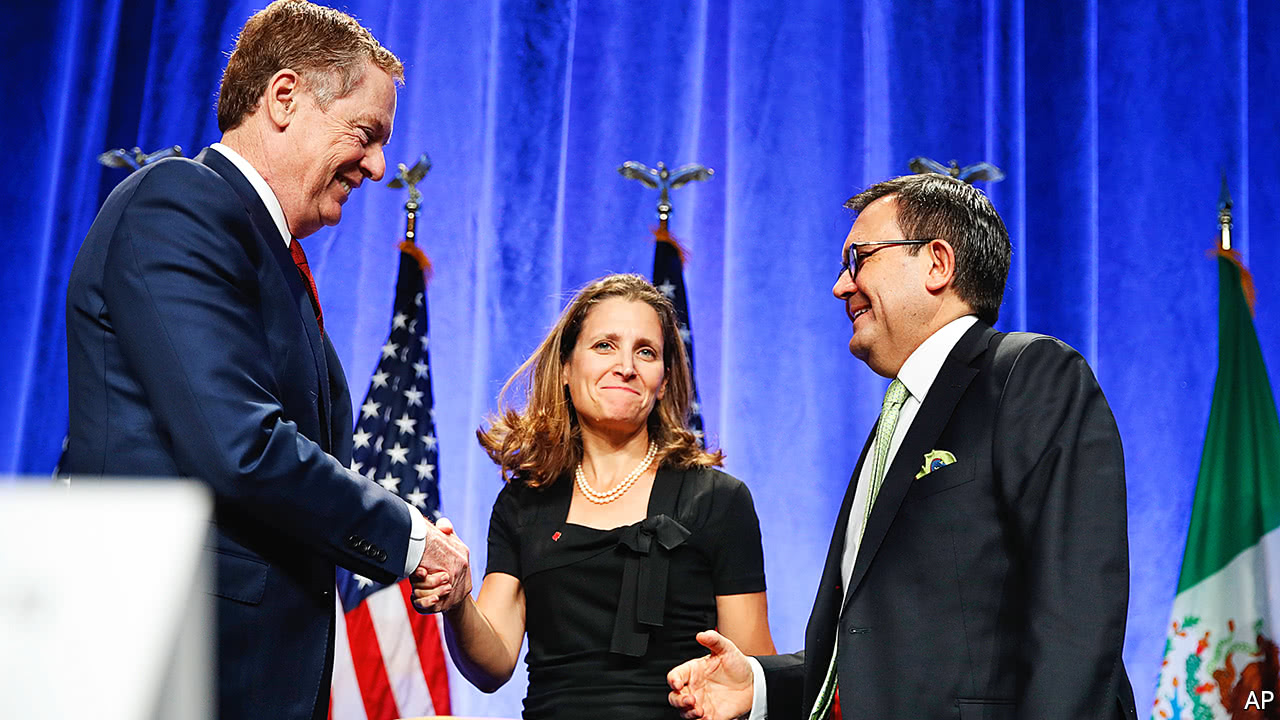
THE North American Free-Trade Agreement (NAFTA), a 23-year-old trade deal between America, Mexico and Canada, is being revamped. On August 16th, after months of threats, taunts and tweets, the first round of talks started in Washington. The negotiators face a daunting challenge, straddling domestic and foreign policy. They must please their political masters while grappling with devilishly detailed policy problems. If they fail, it will not be for lack of experience. The professionals are in the room.
This negotiation will be more tense than most. Participation in trade talks is usually by mutual consent. In this one, President Donald Trump is trying to hold his trade partners hostage, by threatening to withdraw from the original deal if a better one cannot be agreed on. That such an outcome would also hurt America does not make the exercise any easier.
Pressure is added by a desperately tight, if unacknowledged, deadline, set by the presidential-election timetable in Mexico….Continue reading
Hedge funds try to promote sports betting as an asset class

WHEN he was 12, Warwick Bartlett bought “100 Famous Greyhound Systems”, a guide for betting on dog races. After spending a year tracking every stratagem and picking the best two, he went to the races to take his first punts. He lost. Mr Bartlett, now the boss of GBGC, a betting consultancy, says it taught him a good lesson: “A system can win for a period of time. And then it’s had its day.”
Two trading companies are trying to prove him wrong. Melbourne-based Priomha Capital, which claims to be the “world’s premier sports hedge fund”, wagers on European football, cricket and golf. Founded in 2010, the firm manages about $20m. Stratagem, a rival based in Britain that styles itself as a technology business, wants to raise $25m from rich individuals.
Both argue that techniques imported from the investment world can help turn sports betting into an alternative asset class. By crunching data, they analyse the pricing…Continue reading
Why Africa’s development model puzzles economists
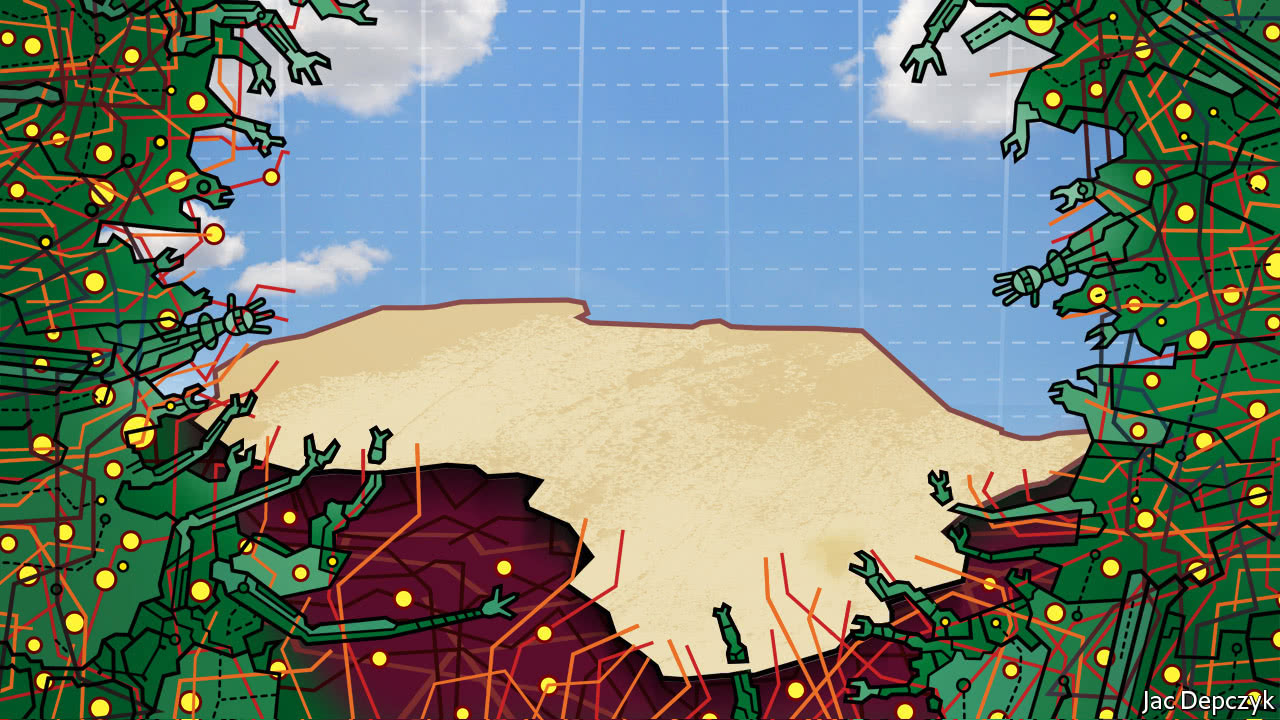
IT IS easy to buy a rolex in Uganda—albeit not one that will tell the time. Sold at ubiquitous roadside stalls, the Ugandan rolex is a greasy snack, made from an omelette wrapped in a chapati (“roll eggs”). Sellers compete side-by-side for the same custom. So do the motorcycle-taxi drivers, hustling for rides; or the countless small shopkeepers, stocking near-identical goods. In Uganda, as in much of Africa, the informal service economy is a crowded place to be. But it is hard to find work anywhere else.
Last year GDP in sub-Saharan Africa grew by just 1.4%. Income per person fell. But growth in itself is not the issue that troubles policymakers and intrigues academics: for most of this century, after all, African economies have been among the fastest-growing in the world. What has flummoxed observers is where that growth comes from. In 1954 Arthur Lewis, a Nobel prize-winning economist, argued that development occurs as labour shifts from an unproductive…Continue reading
A firm that shares a name with its founder earns higher profits

A GOOD business name can be pricey. An entrepreneur looking for the perfect one can hire a naming agency to offer ideas, but that can cost tens of thousands of dollars. That may explain why many founders follow the example set by the American President and name their businesses after themselves. A recent article* by academics from the Fuqua School of Business at Duke University in North Carolina suggests that doing so does not just save money—it can also boost profits.
The study looked at small businesses in western Europe. It relied on a sample of almost 2m firms, data for which are contained in a commercial database called Amadeus. The database includes information about owners, managers and financial performance from 2002 to 2012. Firms in the sample tended to be, on average, fairly young, with few shareholders and employees. Checking against the surnames of the largest shareholders, the authors found…Continue reading
Investment in American infrastructure is falling

IT IS not a number to tweet about. President Donald Trump plans to plough $1trn of spending into America’s crumbling infrastructure. And a dearth of capital is not a problem: investors are keen on such assets. But investment seems to be falling.
Government infrastructure spending in the second quarter fell to 1.4% of GDP, the lowest share on record (see chart). According to Thomson Reuters, investment by American municipalities in the first seven months of this year, at $50.7bn, was nearly 20% below the same period in 2016. Private-sector infrastructure funds show a similar trend, according to Preqin, another data provider: deal volume in the first half of 2017 fell by 7.5%, year on year, to $36.6bn; the number of deals fell by a quarter.
Not long ago optimists were expecting an infrastructure-spending boom. In May Blackstone, a private-equity firm, announced with much fanfare a new $40bn fund for American infrastructure, with a $20bn investment from one of Saudi Arabia’s…Continue reading
Investors are not great at predicting politics
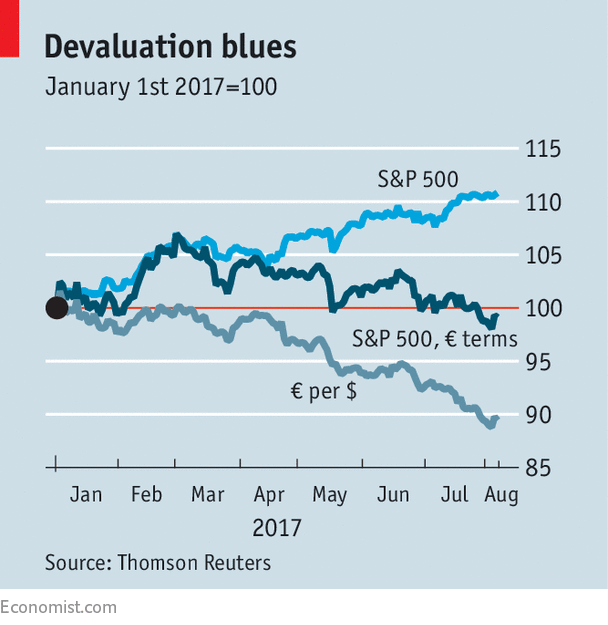
FINANCIAL markets are supposed to be the font of all wisdom, weighing up the information available and condensing it into a set of prices. Investors are presumed to have an insight into the future—falling bond yields are seen as a sign that the economy is slowing, for example.
But are investors that clever when it comes to politics? Gambling markets show how they assess political risk. They expected the Remain campaign to win the Brexit referendum and Hillary Clinton to become America’s president, and were proved wrong. Indeed, on Brexit, the mass of gamblers (the general public, in other words) backed Leave, but the odds were skewed by some wealthy punters who favoured Remain. Those rich gamblers were probably people who trade in financial markets; the plunge in the pound after the result suggests that most investors were caught on the hop.
Before the presidential election, most people on Wall Street to whom Buttonwood spoke thought that a victory for Donald Trump would be…Continue reading
Chasing higher yields, investors pile into risky countries
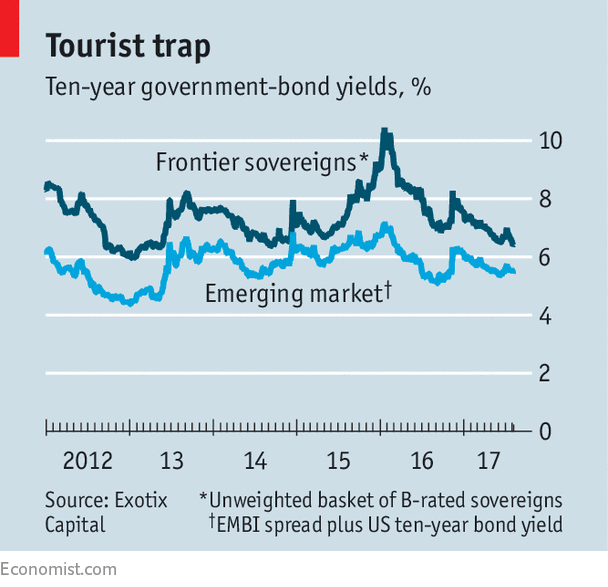
WHERE can you find a 7% interest rate on a sovereign dollar-bond? You would have to take a time-machine to the mid-1990s to find such a yield on a ten-year American Treasury. Alternatively, you could slip back a few days to August 2nd and bid for the $1bn of five-year bonds sold by the government of Iraq. The yield was expected to be 7%, but it was trimmed to 6.75% once orders rose above $6bn.
Such eagerness for hard-currency debt from a country still reeling from a civil war shows just how far bond investors will now go to get a decent yield. Oversubscribed issues for risky sovereign bonds have become almost normal. The Iraqi sale came just a week after Greece (whose privately held debt was partly written off in 2012) raised €3bn ($3.5bn) in its first bond sale for three years. In June Argentina was inundated with bids for its 100-year eurobond, as dollar-denominated bonds are known. Sceptics noted that Argentina had defaulted on its debts six times in the previous century, with the most…Continue reading
Why the world’s best footballers are cheaper than they seem

FOR football clubs, August is often the costliest month, when they make vast bids for each other’s players. This year has been particularly lavish. On August 3rd Paris Saint-Germain (PSG), a French team, signed Neymar da Silva Santos Júnior, a Brazilian forward, from Barcelona for €222m ($264m), more than double the previous record price for a footballer.
With three weeks of the transfer “window” left, teams in Europe’s “big five” leagues—the top divisions in England, Spain, Germany, Italy and France—have paid €3.2bn, just short of the record of €3.4bn set last year. The €179m splurged by Manchester City, an English club, on defenders outstrips 47 countries’ defence budgets. Arsène Wenger, a veteran manager of Arsenal, a London team, and an economics graduate, describes the modern transfer market as “beyond calculation and beyond rationality”.
Australia’s CommBank is accused of abetting money-laundering
WHEN the Commonwealth Bank of Australia on August 9th reported its profit for the year to June—above forecasts and just shy of A$10bn ($7.9bn)—it faced questions about cashflows of another sort. Six days earlier the Australian Transaction Reports and Analysis Centre (AUSTRAC), a regulator charged with gathering financial intelligence to combat money-laundering and terrorism, had launched proceedings against it for “serious and systemic non-compliance”. Citing “collective responsibility” for the bank’s reputation, Catherine Livingstone, its chairwoman, has announced cuts to bonuses for Ian Narev, the chief executive, and others.
Founded 106 years ago, CommBank, as it is known, is one of Australia’s biggest banks. AUSTRAC traces its case to 2012, when the bank started installing “intelligent deposit machines”. They accept cash, let depositors stay anonymous and allow money to be switched to other accounts in Australia and overseas straight away. CommBank sets…Continue reading