
Finanzas
Islandia exigirá pruebas a las empresas para que paguen igual a hombres y mujeres
Las compañías tendrán que demostrar que ofrecen el mismo sueldo con el objetivo de acabar con la brecha salarial, según recoge la agencia de noticias AP
Can a railway legend deliver at America’s CSX?
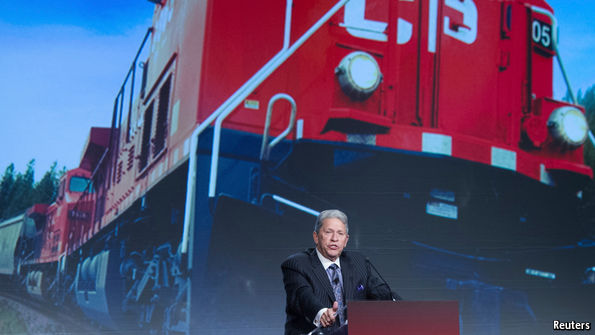
E. HUNTER HARRISON, a veteran railway executive, tried retiring in 2010, after he made Canadian National (CN), a formerly state-owned company, the best-performing of the large railways in North America. But once he pocketed the gold watch and attended the retirement party he faced a void that raising and training horses for showjumping did not fill. By mid-2012 he was back at the helm of another railway, Canadian Pacific (CP), whose glory days were long past. Once he had turned around CP, he didn’t make the same mistake again. On January 18th the 72-year-old Tennesseean both announced his departure and entered negotiations with Florida-based CSX to become that railway’s CEO.
Just the rumour that Mr Harrison might be moving to CSX caused the share price to rise by 23% in 24 hours. It continued to rise when the negotiations became public. At last, on March 6th, CSX appointed Mr Harrison as CEO and met the condition set by Mantle Ridge, an activist hedge fund with which he has partnered, to name five new board directors. Mr Harrison made long-term shareholders in CP and CN rich, tripling profits at both during his tenures. CSX shareholders expect…Continue reading
New technologies could slash the cost of steel production
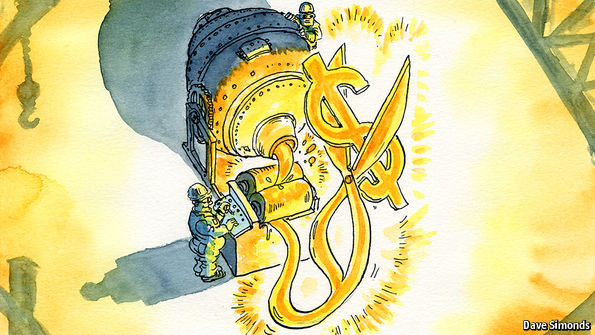
ALTHOUGH he is best known for developing a way to mass-produce steel, Henry Bessemer was a prolific British inventor. In the 1850s in Sheffield his converters blasted air through molten iron to burn away impurities, making steel the material of the industrial revolution. But Bessemer knew he could do better, and in 1865 he filed a patent to cast strips of steel directly, rather than as large ingots which then had to be expensively reheated and shaped by giant rolling machines.
Bessemer’s idea was to pour molten steel in between two counter-rotating water-cooled rollers which, like a mangle, would squeeze the metal into a sheet. It was an elegant idea that, by dint of having fewer steps, would save time and money. Yet it was tricky to pull off. Efforts to commercialise the process were abandoned.
Until now. Advances in production technology and materials science, particularly for new types of high-tech steel, mean that Bessemer’s “twin-roll” idea is being taken up successfully. An alternative system that casts liquid steel directly onto a single horizontally moving belt is also being tried. Both techniques could cut energy…Continue reading
A deal sparks talk of car-industry mega-mergers

THE Peugeot 3008, a striking SUV, was voted European car of the year on March 6th, the eve of the opening of the Geneva motor show, an annual industry shindig. PSA Group, the maker of Peugeots and Citroëns, would doubtless view it as the second prize it scooped that day. News also came that the French carmaker was buying Opel (branded as Vauxhall in Britain), the European operation of America’s General Motors (GM). Few of the car-industry experts at the show, however, would call Opel a trophy.
The consensus was that GM was right to rid itself of a business that had lost money for 16 years straight. Opel has around 6% of the European market; that makes it too small and inefficient in a business where scale is key. It has been confined mostly to Europe for three reasons: the particular tastes of the region’s car buyers (for instance, for small diesel cars); tighter emissions regulations outside Europe; and GM’s fear of taking sales from its other brands further afield. The result has been to leave it boxed in and isolated.
Shorn of Opel, the American firm can redirect investment to China and America, where its profit margins are…Continue reading
Mining companies have dug themselves out of a hole
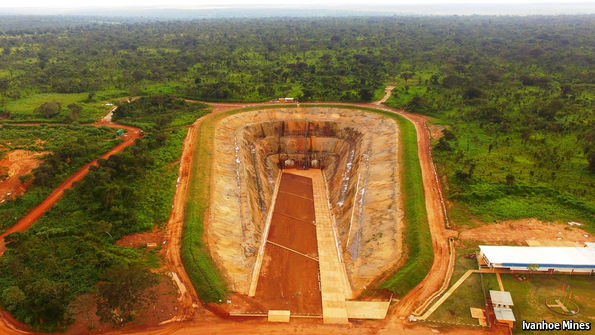
FOR mining investors there is something sinfully alluring about Glencore, an Anglo-Swiss metals conglomerate. It is the world’s biggest exporter of coal, a singularly unfashionable commodity. It goes where others fear to tread, such as the Democratic Republic of Congo (DRC), which has an unsavoury reputation for violence and corruption. It recently navigated sanctions against Russia to strike a deal with Rosneft, the country’s oil champion.
Yet Glencore could still acquire a halo for itself. It is one of the world’s biggest suppliers of copper and the biggest of cobalt, much of which comes from its investment in the DRC. These are vital ingredients for clean-tech products and industries, notably electric vehicles (EVs) and batteries.
The potential of “green” metals and minerals, which along with copper and cobalt include nickel, lithium and graphite, is adding to renewed excitement about investing in mining firms as they emerge from the wreckage of a $1trn splurge of over-investment during the China-led commodities supercycle, which began in the early 2000s. The most bullish argue that clean energy could be an even bigger source of…Continue reading
Chinese startups push into foreign markets
 They’re coming your way
ON THE outskirts of Guangzhou, a city in southern China, lies an abandoned park filled with crumbling replicas of the wonders of the world. To the right are fading golden spires that are meant to represent Angkor Wat, a temple in Cambodia. On the left, a row of dusty Egyptian statues towers over a desolate Greek amphitheatre. Adding to the surrealism, the tops of the trees have been lopped off and a buzzing noise fills the night air.
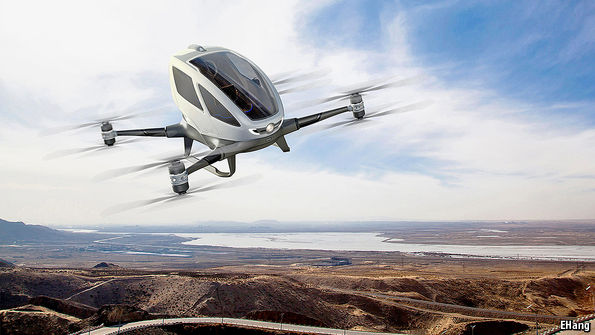
This strange place is the testing ground for EHang, a Chinese startup that makes drones. (The treetops were chopped off, an employee explains, because drones kept crashing into them.) Hu Huazhi, EHang’s founder, is beaming. His firm has just set a world record for a drone-swarm light show in Guangzhou, where it flew a thousand small drones in perfect unison. Next it plans to launch an autonomous flying-taxi service with a giant drone big enough to take a person (pictured). Dubai has just signed a deal with EHang to launch drone taxis this summer.
EHang is an example of a new kind of Chinese firm, labelled “micro-multinationals” by some. In the past,…Continue reading
Draghi resiste la presiones de los ‘halcones’ y mantiene los tipos al 0%
El BCE revisa ligeramente al alza sus previsiones de crecimiento e inflación para la eurozona
El BCE mantiene los tipos de interés en el mínimo histórico del 0%
Mario Draghi resiste las presiones de ‘los halcones’ que le reclaman un cambio tras un año con tipos cero
Casi el 20% de las empresas no ganan lo suficiente para pagar los intereses de la deuda
Un informe del Banco de España muestra que una de cada tres sociedades no generaba suficientes ingresos para cubrir los costes financieros en 2012
A clause in Donald Trump's new travel ban could cause problems for everyone

IF YOU are an Iraqi, or a Syrian refugee, President Donald Trump’s new travel ban will seem like an improvement over the old one. But a little-noticed clause in the measure could make travelling to America a much greater hassle, even for people carrying passports that spare them the toughest restrictions, such as Europe and Asia.
The major provisions of the updated executive order, which Mr Trump signed on March 6th, have been well publicised. The decree will once again face swift legal challenges but, if it survives, citizens of six majority-Muslim countries will still be barred from entering America for the next three months. Iraqis, though, will now be exempt from the ban and the indefinite exclusion on Syrian refugees has also been lifted, once a 120-day period has expired.
However, the Daily Beast spotted a provision on the collection of biometric data. The issue is not actually new. After the 9/11 attacks, Congress passed a law mandating the collection of such things as fingerprints and photos from…Continue reading