
Finanzas
A volatile start for shares in Snap
 Filter bubble?
WHEN Snap, the parent company of Snapchat, an app popular among teenagers for its disappearing messages, staged a public offering on March 2nd, Evan Spiegel, its 26-year-old boss, became a self-made billionaire. (Only John Collison of Stripe, an online payments startup, rivals him for such youthful tycoonery). Whether public-market investors will strike it rich remains to be seen. In its first day of trading Snap’s shares rose by 44%; they have since fallen by 16% from their peak, meaning around $5bn of market value vanished in days.
The volatility will probably continue. Optimists reckon that Snap’s market value could increase more than fourfold from around $26bn today as it adds users and advertisers. Very few large internet companies have gone public recently, which gives it tremendous scarcity value, says Roger Ehrenberg of IA Ventures, an early-stage investment firm.
But sceptics are growing in number. Every analyst who has started covering Snap’s stock has issued a negative rating. They question its high valuation and underline all the challenges. Snap’s growth has slowed in recent…Continue reading
Mukesh Ambani has made the business world’s most aggressive bet

SOME businesspeople are guided by experts, spreadsheets and crunchy questions. What is your three-year target for market share? Will a project deliver a reasonable return on the capital invested? A few hurl all the forecasts and reports into the bin and surrender to their own hunger to make a mark.
One such figure is Mukesh Ambani, India’s richest man. In September 2016 he placed one of the biggest business bets in the world by launching Jio, a mobile-telecoms network that allows India’s masses to access data on an unprecedented scale. In the past six months it has won 100m customers. Only one other firm on the planet has such an acquisition rate—Facebook. From Kolkata’s slums to the banks of the Ganges, millions of Indians are using social media and streaming videos for the very first time.
To achieve this, Mr Ambani has spent an incredible $25bn on Jio, without making a rupee of profit, terrifying competitors and many investors. The motivation for his gamble probably lies with his turbulent family history. Reliance Industries Limited (RIL), Mr Ambani’s company, was set up by his father, Dhirubhai, in 1957. Born in humble…Continue reading
La niña que desafía al toro de Wall Street
Uno de los mayores gestores de activos del mundo planta una estatua de bronce para defender la igualdad de género en los cargos ejecutivos
¿Por qué mi jubilación será peor si soy mujer?
Varios estudios muestran que las mujeres creen que su pensión no cubrirá sus necesidades básicas. ¿Qué factores afectan a esta prestación de la Seguridad Social?
GM says ‘au revoir’ to Europe
General Motors has sold its Vauxhall and Opel brands to PSA in France. Adam Roberts our European business editor asks how the car industry is reacting to the consolidation. Also: can Snapchat succeed as a public company? And might President Trump’s accusation that China hasn’t been playing by the rules have a point? Simon Long hosts.
El Tribunal de Cuentas critica deficiencias de personal y organización del Banco de España
Apunta la falta de inspectores en los equipos de supervisión y el escaso control sobre los nombramientos de altos cargos bancarios
Why some airlines remove Israel from their online route maps
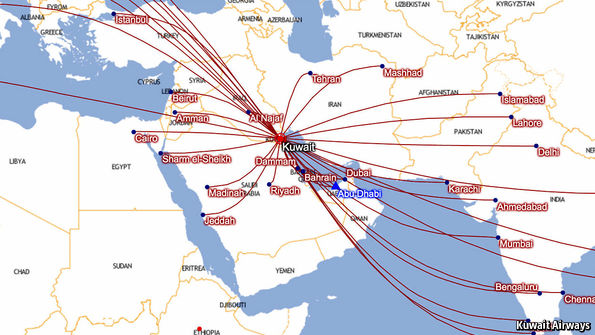
STARING at an airline’s route map can cause the heart to flutter. It seems to divide the world into two distinct groups, between memories and possibilities. But on some carriers’ maps, a third classification exists: the non-existent.
Many airlines’ route maps show every country in the world, regardless of whether they fly there. Those that do not usually illustrate their network by showing only those cities and countries served by the airline. But a few are more selective still, omitting only a single country from their worldview: Israel.
A new paper*, which is currently under peer review, by Joel Waldfogel and Paul Vaaler, both of the University of Minnesota, looks into the phenomenon. The pair classified 111 of the world’s international airlines depending on how they treat Israel on their online route maps. Outside the Middle East, all dealt with it consistently: either Israel was shown as part of a comprehensive map, or it its inclusion was dependent on whether the airline served the country.
Not so for those based in the Middle East. Here, many airlines simply erase Israel’s name off otherwise comprehensive maps (this is often done by…Continue reading
Los españoles usan ya más la tarjeta de crédito que el cajero automático
La subida de las comisiones y el pago por el móvil desplazan el uso del efectivo en favor del dinero de plástico
Los españoles usan ya más la tarjeta que el cajero automático
La subida de las comisiones y el pago por el móvil desplazan el uso del efectivo en favor del dinero de plástico
La OCDE ve riesgos para la economía global en la divergencia de tipos de interés
Gurría pide a los Gobiernos que no retrocedan en los «adelantos logrados por la cooperación internacional»