
Tag: Business and finance
Financial-market index-makers are growing in power
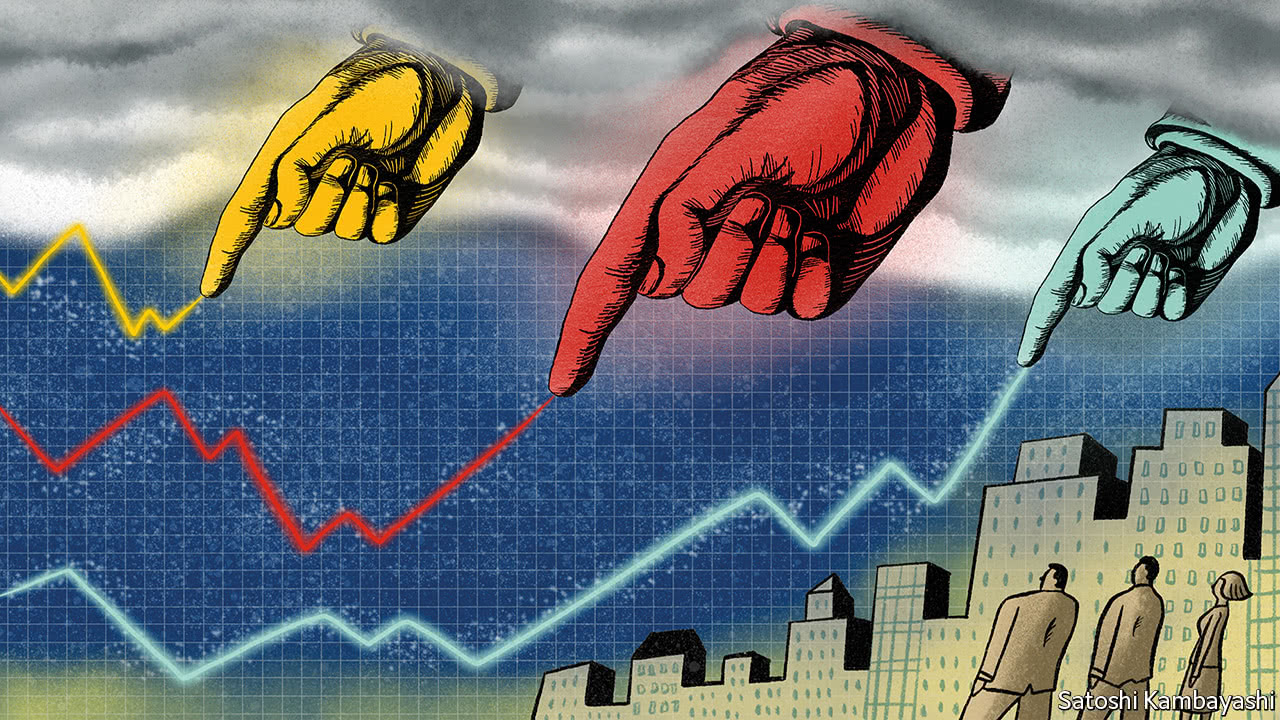
IT WAS in 1896 that Charles Dow, co-founder of Dow Jones & Company, created the index that still bears his name. Today, indices such as the Dow Jones Industrial Average and the S&P 500 (for shares listed in New York), or the FTSE 100 (for London), are among the best-known brands in financial markets. The role they play has expanded massively in recent years. Index-makers have become finance’s new kingmakers: arbiters of how investors should allocate their money.
Stockmarket indices were devised as a measure of the overall market, against which those trading in shares could compare their performance. At first they were concocted by the press or by exchanges themselves. For bonds, indices were compiled by the banks that traded them. Except for a few of the very earliest indices, such as the Dow, which is weighted by share price, nearly all are weighted by market capitalisation or, in the case of bond indices, by the volume of debt outstanding.
Three large firms—FTSE…Continue reading
How the shape of global banking has turned upside down
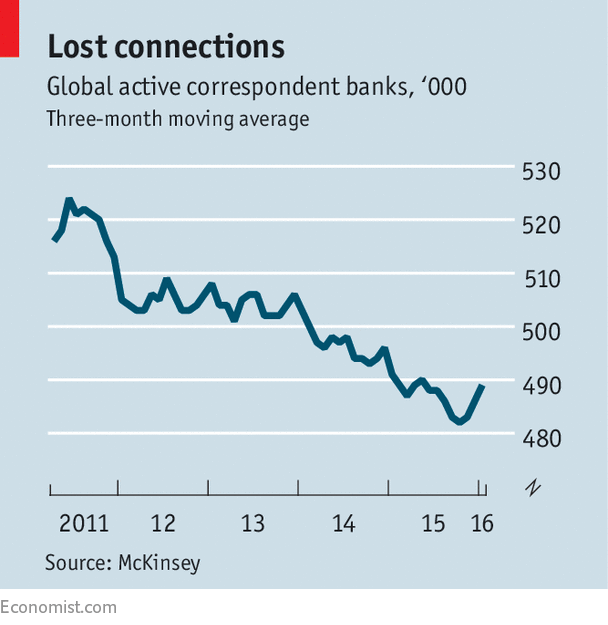
IN THE 1980s, when Citicorp was America’s largest bank and pursuing every avenue for international expansion, John Reed, the bank’s boss, would muse about moving its headquarters to a neutral location, notably the moon. Such sentiments are inconceivable today. Jamie Dimon, boss of JPMorgan Chase, Citi’s successor atop the league tables, recently said he is an American “patriot” first, head of a bank second. His strategy, though hardly shunning international markets, reflects this.
Mr Dimon turned down several big foreign acquisitions before and during the financial crisis. His stellar reputation may rest as much on those undone deals as on those completed. Citi, meanwhile, has been lopping off foreign affiliates. It has retail operations in just 19 countries, down from 50 in 2007. Further contraction may be in the offing. Bank of America has long chosen to live down to its name, as an almost entirely domestic bank.
The same process is under way in western Europe. Visible…Continue reading
Investor activism is surging in continental Europe
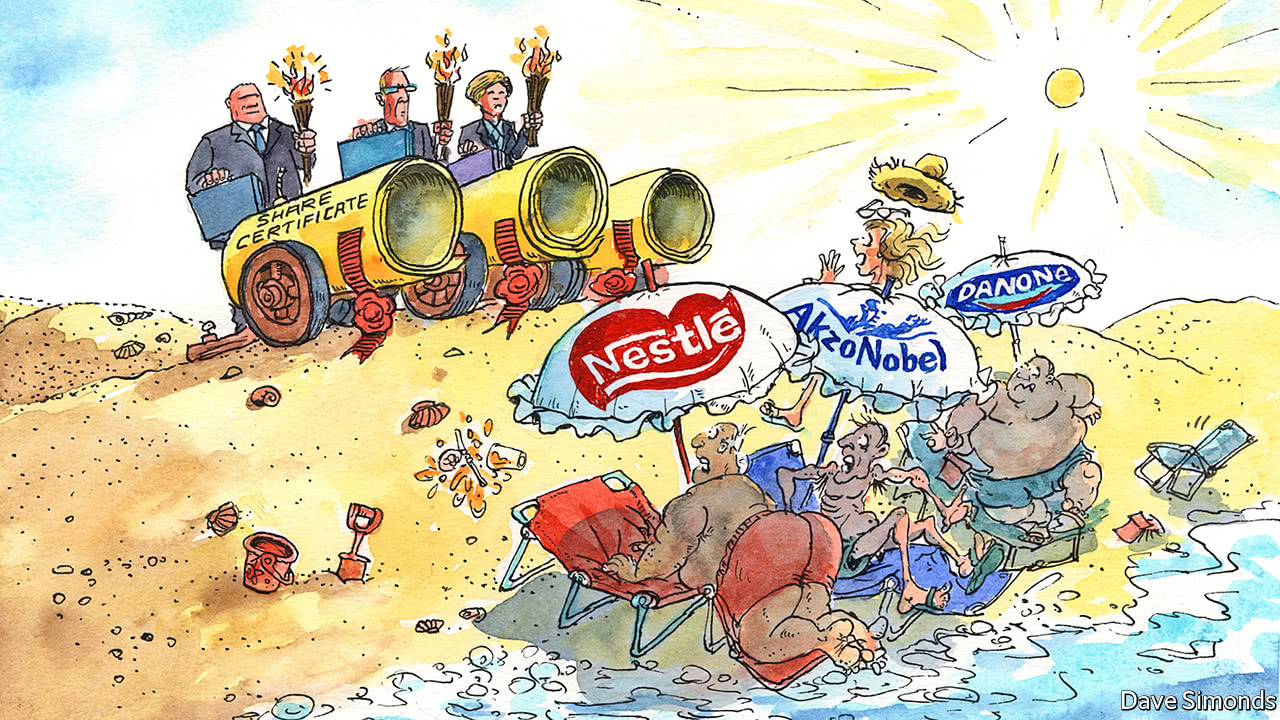
LEAVE it to the Americans to besiege European companies in August, when the entire continent is on holiday. It emerged this month that Corvex Management, an American hedge fund, had built up a $400m position in Danone, a French food giant. AkzoNobel, a Dutch paints-and-chemicals firm which has been under heavy fire from Elliott Advisors, a subsidiary of another American activist fund, agreed to appoint three new directors to its board. An even bigger skirmish is under way in Switzerland, where Third Point, an American fund run by Daniel Loeb, is seeking to shake up Nestlé, the world’s biggest food company. Ulf Mark Schneider, Nestlé’s new boss, is under pressure to present bold plans to investors in September.
Such tussles used to be relatively rare in Europe. But shareholder activism is on the rise, with restive investors demanding corporate overhauls. Armand Grumberg, a mergers lawyer in Paris, last year counted 70 such campaigns in continental Europe. He expects this year to be…Continue reading
Private-equity returns can be replicated with public shares
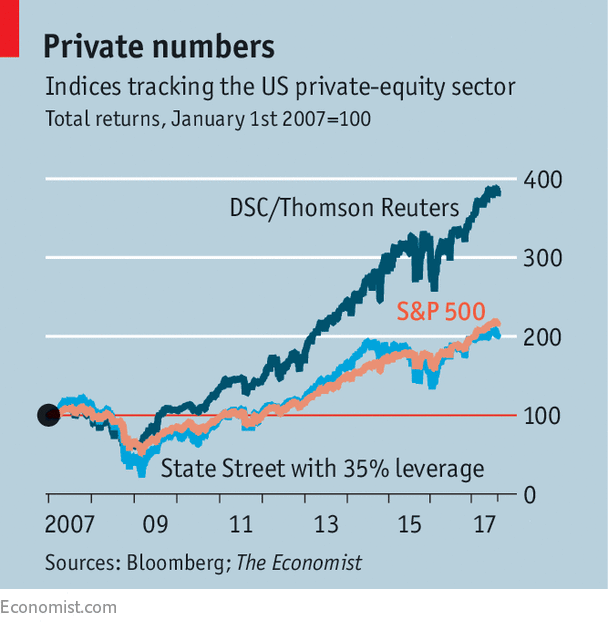
IT IS hard for individual investors to match the returns achieved by private-equity funds. But what if their success in outperforming the public markets could be tracked and replicated? A few pioneering firms claim to have done just that. DSC Quantitative Group, a Chicago-based fund, and State Street, an asset manager, both offer “investable” indices, launched in 2014 and 2015 respectively, that allow investors to mimic the performance of American private equity.
Both firms needed a measure of the industry’s returns. DSC teamed up with Thomson Reuters, a data firm, to compile an index; State Street had been making one since 2004, using data it gleans as a custodian of private-equity assets.
They then match the private-equity risk-and-return profile with a basket of public assets. DSC’s index first matches the sector weights of the private portfolio with equivalent public companies, and adds a modest amount of debt (around 25%) unevenly across the sectors—all using…Continue reading
Islamic banking grows in Bangladesh, no thanks to the authorities
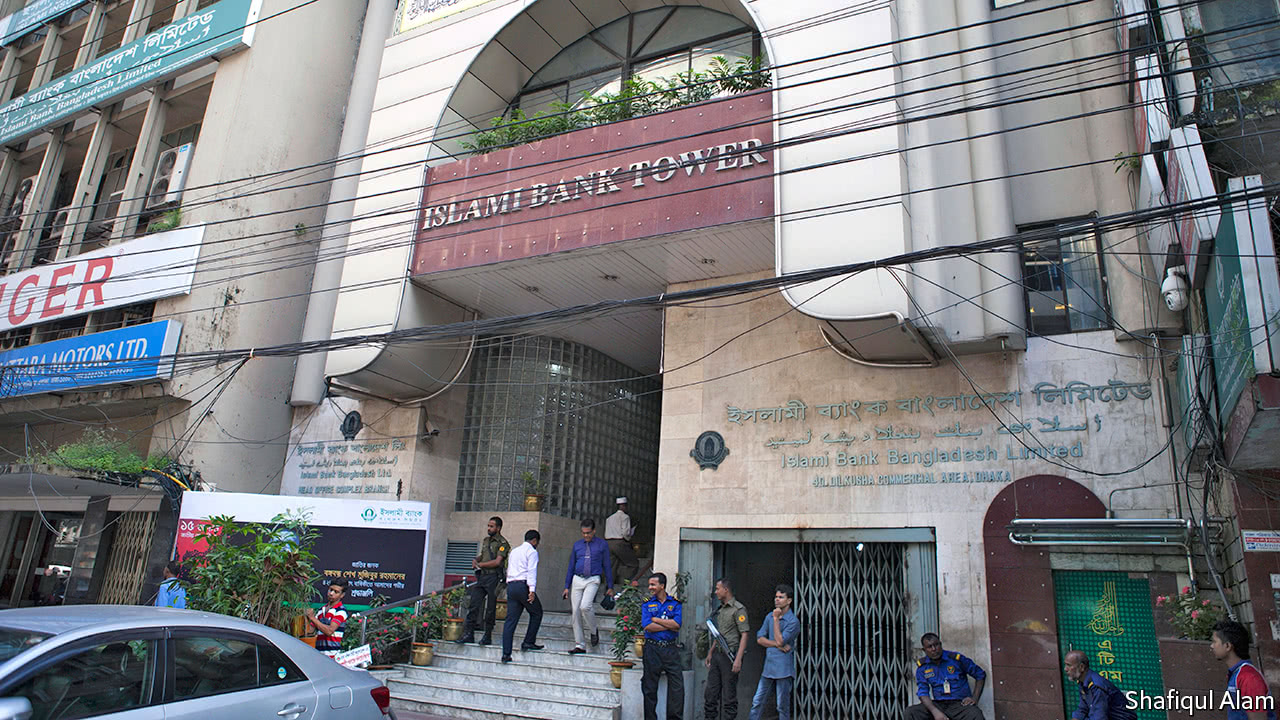
IN MOTIJHEEL, the main business district in Bangladesh’s capital, Dhaka, an iron fence and terrible traffic divide two branches of the country’s oldest private bank—a “conventional” one and an Islamic one. Abdus Sattar, manager of the Islamic one, says that when he joined AB Bank, in 2005, his was “a loser branch”. Today, like most Islamic banks in the country, it is more profitable and better run than its conventional peers. Islamic banking’s future in the country, however, remains murky.
Bangladesh has eight full-fledged Islamic banks; a handful of orthodox banks, like AB, also offer Islamic-banking services alongside others. Islami Bank Bangladesh, founded in 1983 by Saudi and Kuwaiti investors, commands 90% of Islamic-banking assets and deposits. It is also the biggest private lender overall, with 14,000 staff, 12m depositors and a balance-sheet of $10bn. Its success was built on the “two Rs”: remittances…Continue reading
The “free” economy comes at a cost
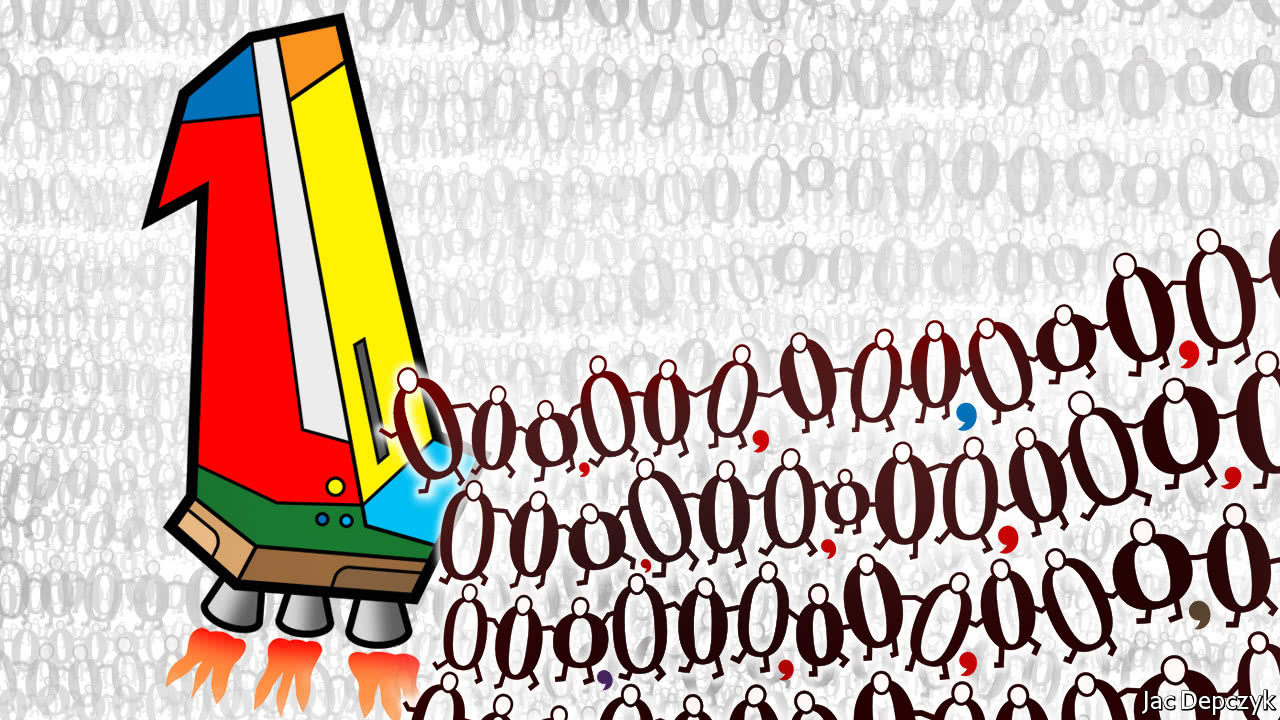
FACEBOOK, whose users visit for an average of 50 minutes a day, promises members: “It’s free and always will be.” It certainly sounds like a steal. But it is only one of the bargains that apparently litter the internet: YouTube watchers devour 1bn hours of videos every day, for instance. These free lunches do come at a cost; the problem is calculating how much it is. Because consumers do not pay for many digital services in cash, beyond the cost of an internet connection, economists cannot treat these exchanges like normal transactions. The economics of free are different.
Unlike conventional merchants, companies like Facebook and Google have their users themselves produce value. Information and pictures uploaded to social networks draw others to the site. Online searches, selections and “likes” teach algorithms what people want. (Now you’ve bought “The Communist Manifesto”, how about a copy of “Das Kapital”?)
The prevalence of free services is partly a…Continue reading
The way airlines board planes affects how easily bugs are spread among passengers

IT IS an often-heard office conversation. Someone returns from a trip with a nasty bug, and colleagues say he must have caught it from a germ-ridden plane. It is not unusual to come come down with something nasty after flying. And as a fellow Gulliver reported last week, contaminated air on flights is widespread.
Someone has to carry those bugs into the cabin in the first place, before infecting fellow flyers. Researchers at Arizona State University, Florida State University and Embry-Riddle Aeronautical University have found that the way airlines board planes can have a huge effect on the potential for disease contagion. The researchers considered a hypothetical outbreak of the Ebola virus and the effect that different boarding methods could have on infection rates. With the standard boarding method of dividing the plane into three sections and boarding…Continue reading
Computer-game tournaments go mainstream

FIREWORKS detonated, smoke wafted over the stage and confetti began to fall. Seventeen thousand fans cheered the European players of Team Liquid, with monikers like “MinD_ContRoL” and “MATUMBAMAN”, who had just triumphed over a Chinese side to win The International, a tournament held in Seattle’s KeyArena on August 7th-12th. In the stands Max Martinez, a 25-year-old bartender from Phoenix, was in a state of nirvana. “This is like my Super Bowl,” he said.
But the players in this tournament had no need to catch, throw or run. Their most important muscles are those in their fingers. MinD_ContRoL, a bespectacled Bulgarian named Ivan Ivanov, excels at a computer game called “Dota 2”. Valve Corporation is the producer of “Dota 2”. It has put on The International since 2011, offering more than $10m to this year’s winners. The prize money is particularly rich, but the tournament itself is not unusual. E-sports, in which computer…Continue reading
A trade dispute threatens America’s booming solar industry

LAST year California Solar Systems (CSS), a small installer of residential solar panels, decided to “Buy American”. It turned to Suniva, a Chinese-owned firm that makes photovoltaic panels in Georgia and Michigan, rather than use cheap imports. But according to CSS’s boss, Bastel Wardak, Suniva was unable to deliver what it promised, leading to unacceptable delays. He then tried SolarWorld, a more expensive producer in Oregon whose panels could also be marketed as “Made in the USA”. But troubles at SolarWorld’s German parent put a stop to that. Now Suniva and SolarWorld are seeking new protections from America’s International Trade Commission (ITC). On August 15th Mr Wardak was one of many to testify that the two firms did not deserve them.
The case pits American solar-cell makers against solar-panel installers. It could have big implications. Solar was the biggest source of power-generating capacity built in America last year, thanks to falling prices (see…Continue reading
The Catholic church becomes an impact investor
“YOU cannot serve both God and money,” admonishes the Bible. But the church has always tried. In the Middle Ages monasteries were what would now be termed social enterprises. They would produce bread, books or other goods. A Franciscan monk is credited with codifying double-entry book-keeping.
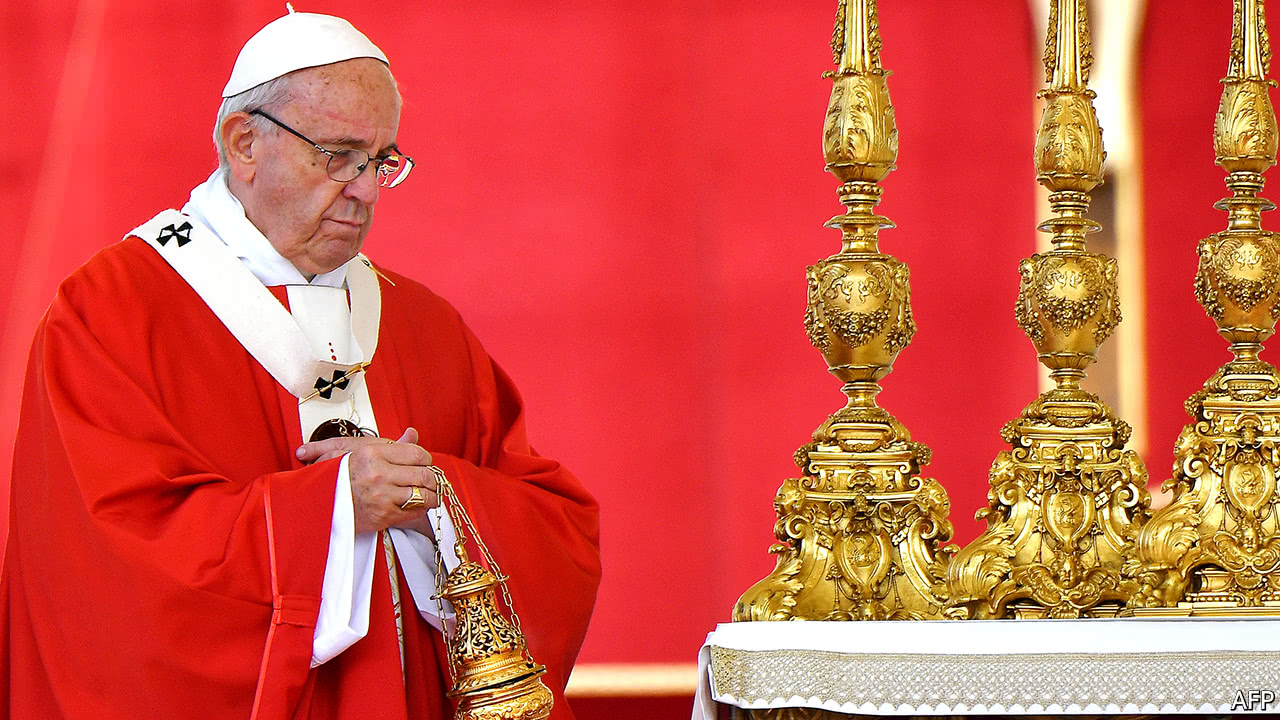
These days the Catholic church and related institutions control many billions of dollars. Some is invested to earn income; some is given away for good works. The two activities have been seen as separate. But, in the pontificate of Pope Francis, that divide is blurring. “Impact” investing—intended to make money and do good at the same time—is growing in importance. It is also creating some controversy.
In 2014 the pope, speaking to a conference in the Vatican on impact investing, called on Christians to rediscover “this precious and primordial unity between profit and solidarity”. His church has responded. Some…Continue reading