
Tag: Business and finance
China modernises its monetary policy
QIN SHIHUANG was the emperor who first unified China, through bloody conquest more than two millennia ago. Known for starting the Great Wall and burying scholars alive, he has a new claim to fame: the central bank has drawn on his construction of a national road system to help explain its new monetary system. In a report on August 11th, the People’s Bank of China seized on an idiom derived from his road-building experience: it had “shaved off mountain peaks and filled valleys” in managing liquidity.
The modernisation of monetary policy is in its own way a monumental project for China. Over the past two decades, the central bank’s conduct of policy had two defining features. It focused on the quantity, not the price, of money. And it relied on inflows of foreign cash to generate new money. Both features are now slowly changing, bringing China closer to the norm in developed markets, an essential transition for an increasingly complex economy.
Start with interest rates. These used to be of secondary importance in China. Regulators instead used quotas to dictate how much banks lent and in effect fixed their deposit and lending rates. This made sense when China was in the early stages of moving away from a planned economy. Crude targets were still needed. But as a bigger, rowdier financial system took shape, these targets became less relevant. With the…Continue reading
The Trump administration is investigating Chinese trade practices

BEING tough on China was a constant theme of President Donald Trump’s election campaign. On August 14th he had another chance to wield his presidential pen to show that he is making good on his promises—in this case of a “zero-tolerance policy on intellectual-property theft and forced technology transfer”. With the cameras rolling, he formally instructed Robert Lighthizer, the United States Trade Representative, to consider launching an investigation into China’s alleged crimes. “This is just the beginning,” was Mr Trump’s final flourish for the news bulletins.
His record of translating signatures into policies is patchy. Two others, launching investigations into whether imports of steel and aluminium threaten America’s national security, seem to have fizzled. But whereas proposals for import restrictions on these commodities met fierce resistance from consumers and America’s allies, China’s trade practices provoke much more agreement. It is one of the few…Continue reading
The North American Free-Trade Agreement renegotiation begins
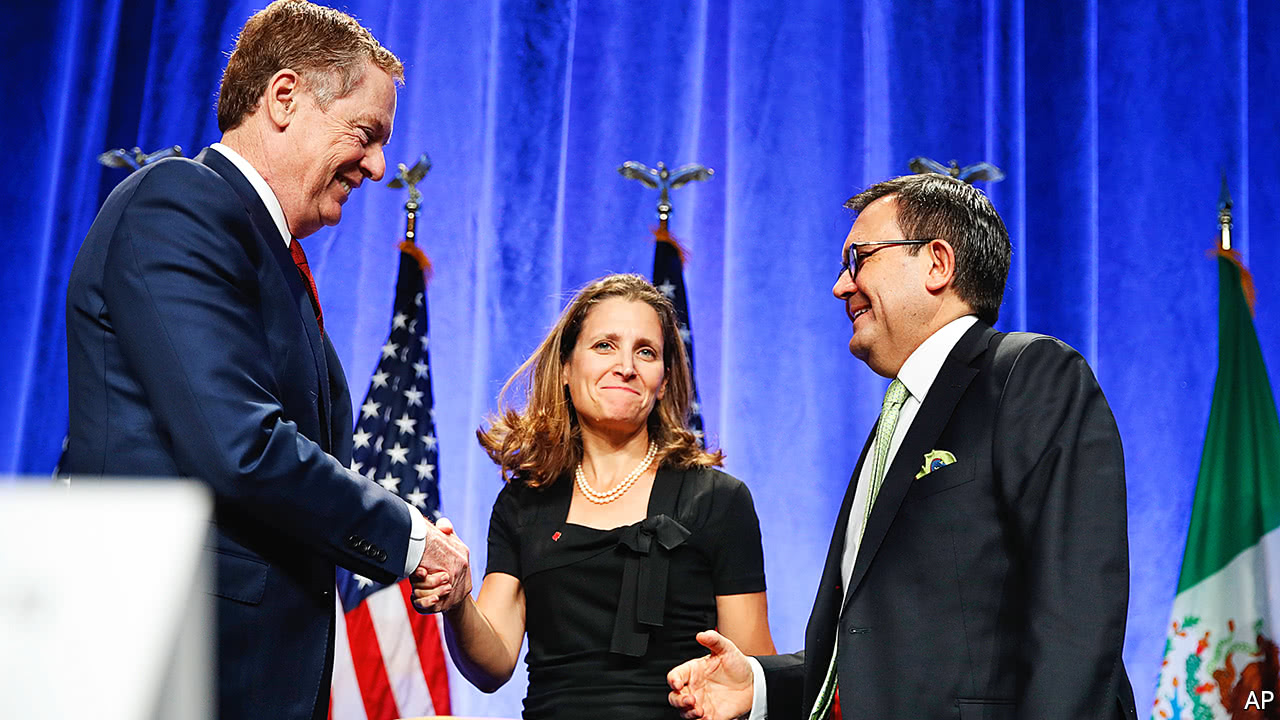
THE North American Free-Trade Agreement (NAFTA), a 23-year-old trade deal between America, Mexico and Canada, is being revamped. On August 16th, after months of threats, taunts and tweets, the first round of talks started in Washington. The negotiators face a daunting challenge, straddling domestic and foreign policy. They must please their political masters while grappling with devilishly detailed policy problems. If they fail, it will not be for lack of experience. The professionals are in the room.
This negotiation will be more tense than most. Participation in trade talks is usually by mutual consent. In this one, President Donald Trump is trying to hold his trade partners hostage, by threatening to withdraw from the original deal if a better one cannot be agreed on. That such an outcome would also hurt America does not make the exercise any easier.
Pressure is added by a desperately tight, if unacknowledged, deadline, set by the presidential-election timetable in Mexico….Continue reading
Marine contractors have made huge leaps in productivity
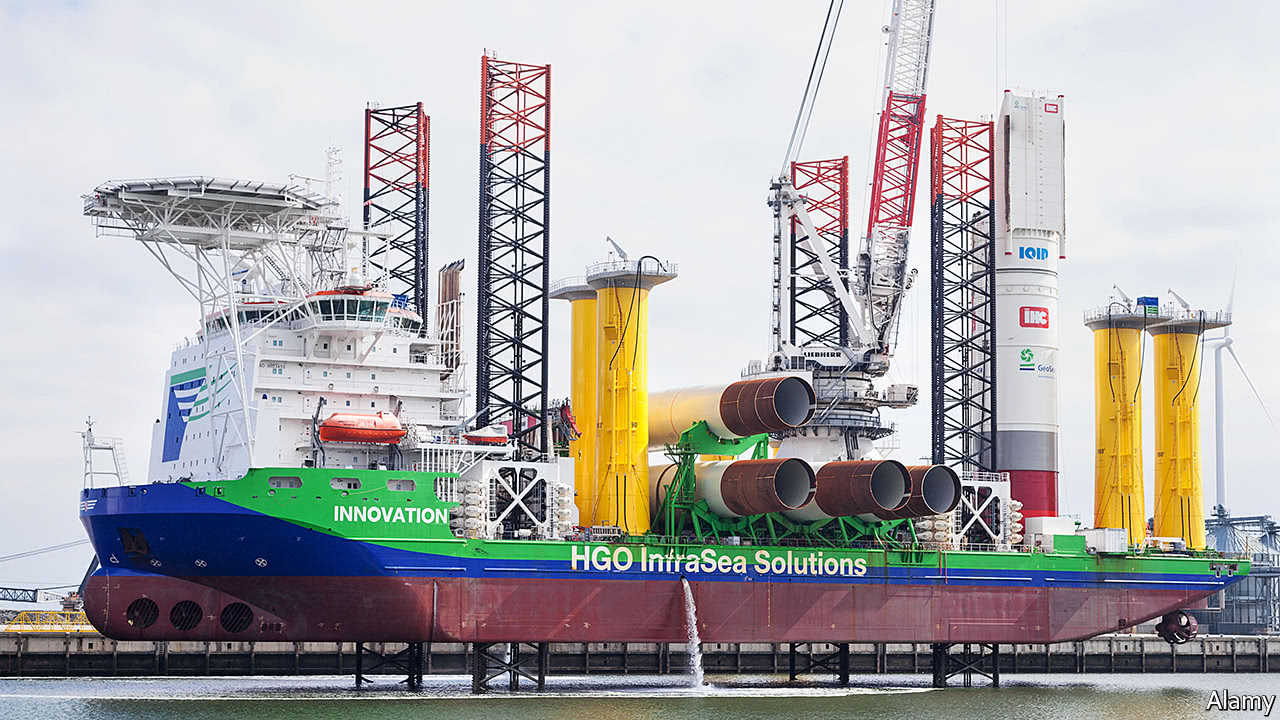
THE Innovation, a 147-metre ship docked in Rotterdam, looks like a cross between an oil rig and a robot from a “Transformers” film. Her crane has been loading on giant pipes throughout the night. Soon the ship will travel to sea, where an automated hammer will drive the pipes into the ocean floor to support wind turbines. “Everything in our industry has become larger,” says Koen Vanderbeke of DEME, a Belgian dredging firm that owns the ship. “But we’ve become smarter, too.”
Unlike their counterparts on dry land, marine contractors have made big leaps in productivity in recent years. From dredging and land reclamation to offshore construction of oil platforms, costs have dropped even as the speed and quality of work have increased. In Belgium, home to two of the world’s five biggest dredgers, efficiency gains have been so large that they have skewed productivity figures for the entire building…Continue reading
Hedge funds try to promote sports betting as an asset class

WHEN he was 12, Warwick Bartlett bought “100 Famous Greyhound Systems”, a guide for betting on dog races. After spending a year tracking every stratagem and picking the best two, he went to the races to take his first punts. He lost. Mr Bartlett, now the boss of GBGC, a betting consultancy, says it taught him a good lesson: “A system can win for a period of time. And then it’s had its day.”
Two trading companies are trying to prove him wrong. Melbourne-based Priomha Capital, which claims to be the “world’s premier sports hedge fund”, wagers on European football, cricket and golf. Founded in 2010, the firm manages about $20m. Stratagem, a rival based in Britain that styles itself as a technology business, wants to raise $25m from rich individuals.
Both argue that techniques imported from the investment world can help turn sports betting into an alternative asset class. By crunching data, they analyse the pricing…Continue reading
Efficiency eludes the construction industry
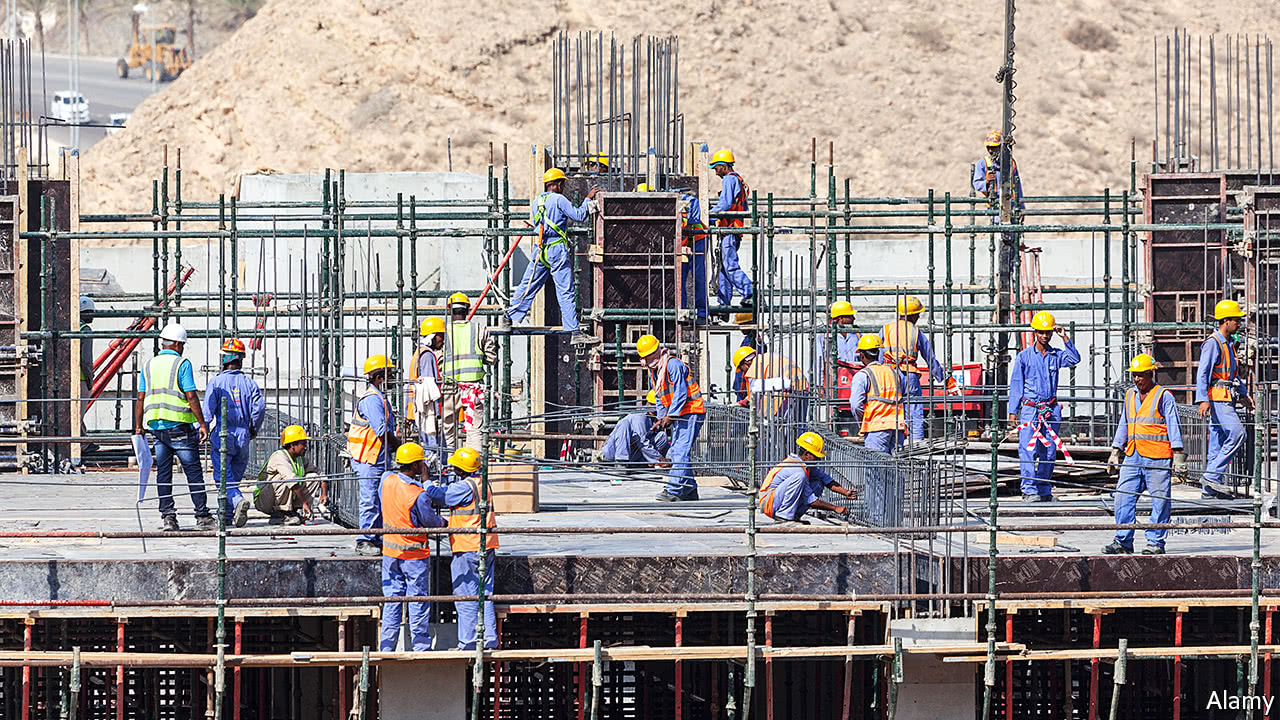
NINE years ago the first concrete was poured for Berlin Brandenburg airport. It was expected to open in 2012, to cost €1.2bn ($1.8bn) and to welcome 34m passengers each year. Today the only people in its terminals are those with hard hats. Six times over budget, the project has had 66,500 building errors in need of fixing. Last year its spokesman was sacked after calling the project a “shit-show” and saying no manager who was not “addicted to pills” could guarantee an opening date.
Berlin’s airport is an extreme example of a broader problem. Superficially, the construction industry would seem healthy enough. The global market is worth $10trn. Euler Hermes, an insurer, expects 3.5% growth this year. Yet more than 90% of the world’s infrastructure projects are either late or over-budget, says Bent Flyvbjerg of Saïd Business School at Oxford University. Even the sharpest of tech firms suffer. Apple’s new headquarters in Silicon Valley opened two years behind schedule and cost…Continue reading
Why Africa’s development model puzzles economists
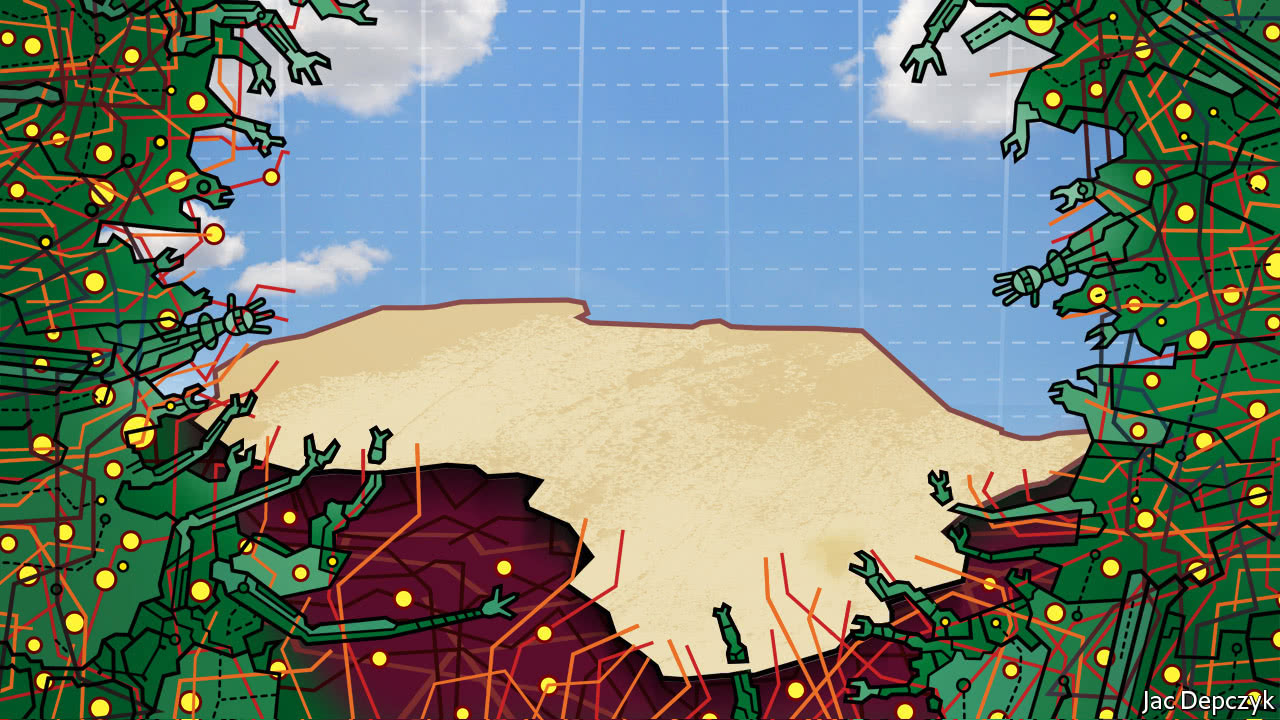
IT IS easy to buy a rolex in Uganda—albeit not one that will tell the time. Sold at ubiquitous roadside stalls, the Ugandan rolex is a greasy snack, made from an omelette wrapped in a chapati (“roll eggs”). Sellers compete side-by-side for the same custom. So do the motorcycle-taxi drivers, hustling for rides; or the countless small shopkeepers, stocking near-identical goods. In Uganda, as in much of Africa, the informal service economy is a crowded place to be. But it is hard to find work anywhere else.
Last year GDP in sub-Saharan Africa grew by just 1.4%. Income per person fell. But growth in itself is not the issue that troubles policymakers and intrigues academics: for most of this century, after all, African economies have been among the fastest-growing in the world. What has flummoxed observers is where that growth comes from. In 1954 Arthur Lewis, a Nobel prize-winning economist, argued that development occurs as labour shifts from an unproductive…Continue reading
China’s digital-payments giant keeps bank chiefs up at night

IN WESTERN countries it is common to talk about American technology being dominant. From an Asian perspective that seems off. Fresh from visiting the region, where buskers and kerbside fishmongers can be paid by presenting a phone, Schumpeter has found it a shock being back in New York. There, buying most things involves signing bits of paper and PIN numbers are viewed as dangerously transgressive. Only 2% of credit- and debit-card transactions in America are authenticated with PIN numbers; 19bn cheques are written in the country every year.
Asian firms have leapfrogged ahead, offering a new model of financial technology. Exhibit A is Ant Financial, a payments company affiliated with Alibaba, one of China’s two giant internet firms (the other is Tencent, whose WeChat messaging app is ubiquitous and supports payments). Ant is popular in China and has ambitions outside it. Already the world’s most valuable “fintech” firm, worth $60bn, it has 520m payments customers at home and its…Continue reading
American business leaders break with Donald Trump
“I’VE never known it to be an embarrassment for a business leader to be associated with an American president,” declares Max Bazerman of Harvard Business School. Donald Trump, in particular, has positioned himself as a businessman-president, whose corporate acumen would unleash a new era for American business. Investors seemed to believe him—his election prompted a giddy “Trump bump” in the stockmarket—and corporate bosses flocked to his side. This week they fled. For many, it seems as much a clear-eyed business calculation as a moral awakening.
Some distanced themselves more quickly than others. The trigger was Mr Trump’s reluctance to condemn neo-Nazis and white supremacists who staged violent protests in Virginia on August 12th. Kenneth Frazier (pictured), chief executive of Merck, a big pharmaceutical firm, was the first to leave Mr Trump’s advisory council on manufacturing. On August 14th Mr Trump denounced racist groups in a scripted statement. But the bosses of Under Armour, a sporting-goods outfit, and Intel, a computer-chip giant, defected, too.
On August 15th Mr Trump appeared once again to equate white supremacists with demonstrators opposing them. As word leaked the next day that chief executives might resign en masse, Mr Trump swiftly tweeted that he was disbanding his manufacturing council and his strategic and policy forum,…Continue reading
Involuntary bumping seems to be a thing of the past

IF AVIATION had an astrological sign, 2017 would surely be the Year of the Bump. Most infamously, it was the year that a United Airlines passenger who refused to leave an overbooked flight in April was dragged violently from the plane. There followed airline policy changes to reduce involuntary bumping, a novel system to make bumping less inconvenient, and even bipartisan action in Congress to render involuntary bumping illegal.
Such headlines suggest that the practice is spiralling out of control. In fact it is at its lowest level since the government began recording data in 1995, according to a Department of Transportation