
Tag: Business and finance
Two Chinese tourists are arrested for making a Hitler salute in Germany
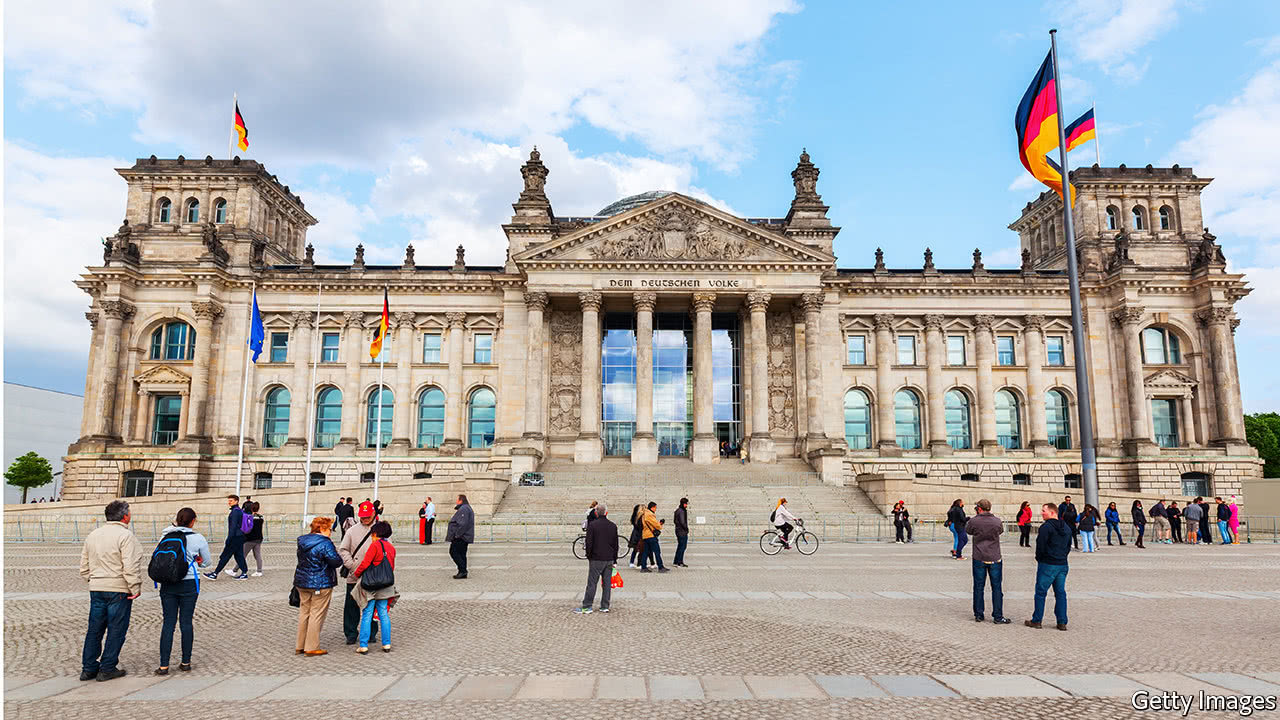
IGNORANCE of the law is no excuse for breaking it. Over the weekend two Chinese tourists were arrested in Germany for photographing themselves making Hitler salutes outside the Reichstag building in Berlin. The country has strict anti-hate laws, which prohibits pro-Nazi symbols and speech. The Chinese pair were released on €500 ($590) bail; police said they could face as much as three years in prison. However, the men were told they were free to leave the country, and that if a fine was handed down at trial, the bail money could be used to cover it.
Gulliver does not intend to get into the rights and wrongs of Germany’s anti-hate laws. (For what it’s worth, he would think the Hitler salute crass, insensitive and insulting while not considering that a high enough bar to curb freedom of expression.) But the incident provides an opportunity to think about the extent to which foreigners should make themselves aware of local laws and sensitivities.
We do not know for certain the Chinese travellers’ motivation for their…Continue reading
Dame Helen Alexander, former chief executive of The Economist Group, died on August 5th
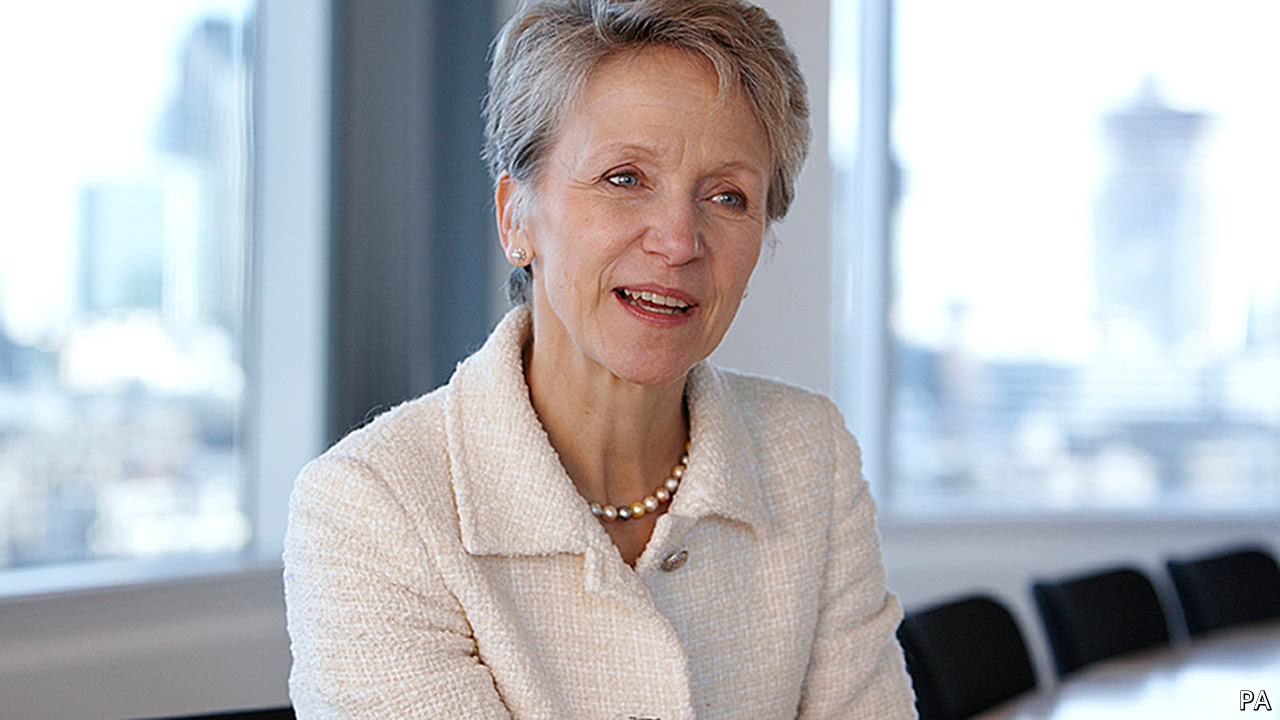
ROLE models for women in business are still too rare, not least in Britain. Last November an independent review backed by the government urged FTSE 100 companies to raise the share of women on their boards from 27% to 33% by 2020. Sadly, that push this week lost one of its leading champions, Helen Alexander, the deputy chair of the review.
Business had no better ambassador. She was self-effacing but a world-class networker—a winning combination that helps to explain, along with her intelligence and charm, why all sorts of firms flocked to have her on their board (from Northern Foods to Centrica, Rolls-Royce and the British arm of Huawei), to advise them (Bain Capital) or to chair them (the Port of London Authority and, more recently, UBM, an events business). In 2009 she became the first woman to be president of the Confederation of British Industry, the country’s main employers’ group.
But Helen had built her reputation in the media industry. From 1997 to…Continue reading
Helen Alexander, former CEO of The Economist Group, died on August 5th
ROLE models for women in business are still too rare, not least in Britain. Last November an independent review backed by the government urged FTSE 100 companies to raise the share of women on their boards from 27% to 33% by 2020. Sadly, that push this week lost one of its leading champions, Helen Alexander, the deputy chair of the review.
Business had no better ambassador. She was self-effacing but a world-class networker—a winning combination that helps explain, along with her intelligence and charm, why all sorts of firms wanted her on their board (from Northern Foods to Centrica, Rolls-Royce and the British arm of Huawei), to advise them (Bain Capital) or to chair them (the Port of London Authority and, more recently, UBM, an events business). In 2009 she became the first woman to be president of the Confederation of British Industry, the country’s main employers’ group.
But Helen had built her reputation in…Continue reading
The hubris of ten-year budgets
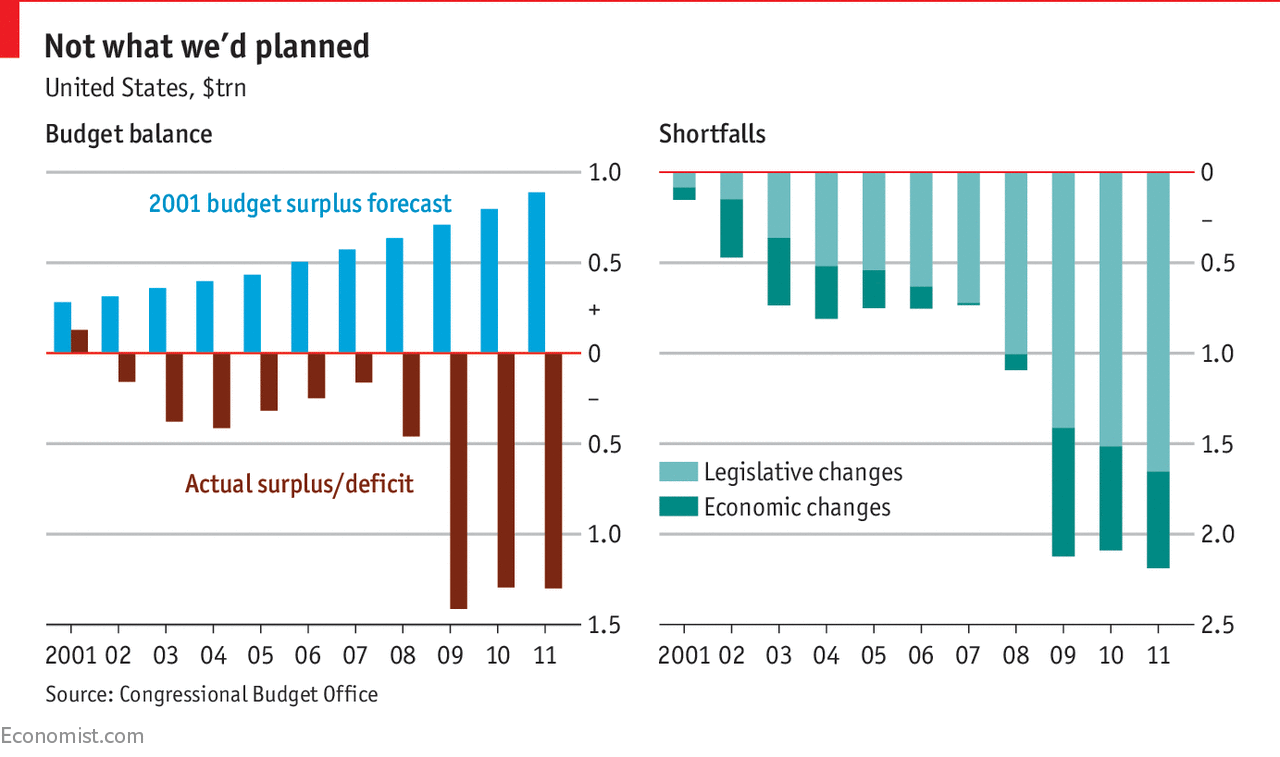
IN February of 2001, Alan Greenspan, then still the chairman of the Federal Reserve, and still called the “Maestro”, testified to the Senate Budget Committee. The committee wanted to get started on the tax cuts George W. Bush had promised during his campaign. Mr Greenspan gave them his qualified blessing, with an argument that now sounds incredible: he was worried that America would pay down its debt too soon.
That week the Clinton administration’s Office of Management and Budget had released its final ten-year budget projections. Firms had just completed several years of capital investments in desktop computers, and workers had become more productive. This had increased corporate revenue, and consequently taxes paid to the government. A long bull market in stocks meant that the Treasury was taking in more in capital gains taxes, too. “The experience of the last five to seven years,” said Mr Greenspan, “has truly been without precedent.” The Clinton administration had apparently left Washington with a gift. The…Continue reading
Investors prefer airlines with good customer service

THE trend seems clear. Spirit Airlines became the most profitable carrier in America at the same time that it was the most complained about. Frontier Airlines cut costs, became a no-frills budget carrier, and went from posting big losses to notching big gains. American, Delta and United scrambled to keep up, slashed comforts and amenities, and introduced their own no-frills budget fare class to compete with Spirit and Frontier, which turned out to be rather lucrative. The message was obvious: cut service, make money.
Or maybe not. A new study by Watermark…Continue reading
Europe’s no business as usual summer

“DON’T you know about our summer?” asks a spokesperson of a Swedish multinational, himself presumably on holiday as kids chirp in the background. Almost everyone is gone until September, he says. At a German multinational, “the whole board is away for August,” admits a spokesperson. Faced with a slew of out-of-office messages across corporate Europe, there seems little choice for a business correspondent but to report on the phenomenon itself.
The practice of collectively taking July or August off dates from the Industrial Revolution, when it made sense to send off all assembly-line workers simultaneously. In England’s north entire factories used to descend on the same resorts. As any tourist who has found themselves in front of an cream shop that is closed during a sizzling southern European summer will know, it has spread beyond factory jobs.
Until 2015 France had a rule that mandated some bakeries to stay open in August, so that Parisians—or rather…Continue reading
A crucial interest-rate benchmark faces a murky future

EVERY working day, shortly before noon, British time, the London Interbank Offered Rate, or LIBOR, is published. For five currencies and seven maturities, from overnight to 12 months, it is the average, trimmed of outliers, of up to 20 banks’ estimates of the interest rate at which they can borrow from other banks. It is also the benchmark for financial contracts reckoned to be worth $350trn. Derivatives depend on it most. But plenty of asset-management products, as well as corporate loans and mortgages, are based on LIBOR and similar rates, notably EURIBOR, an interbank rate for euros.
Yet LIBOR’s days may be numbered. Regulators are promoting other benchmarks. On July 27th Andrew Bailey, the head of Britain’s Financial Conduct Authority, said that the FCA had spoken to banks about sustaining LIBOR until the end of 2021, but no longer. In April a working group set up by the Bank of England concluded that SONIA (the Sterling Overnight Interbank Average Rate), which the central bank…Continue reading
Western firms are coining it along China’s One Belt, One Road
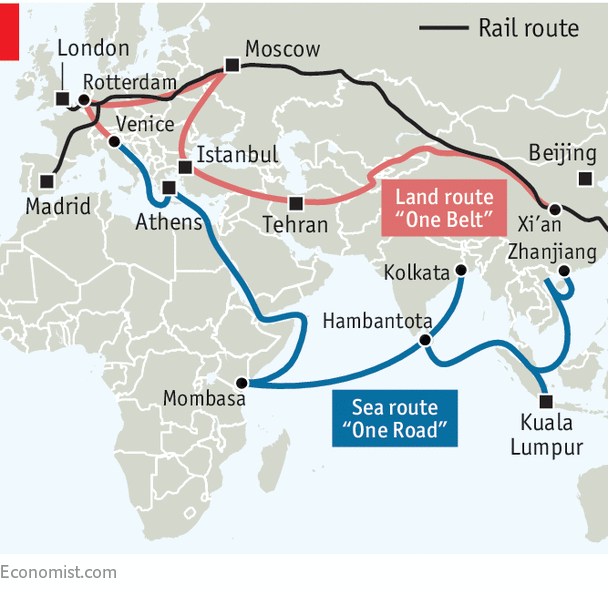
“MUTUAL benefit, joint responsibility and shared destiny,” sings a choir of enthusiastic schoolgirls in a music video called “The Belt and Road, Sing Along” from Xinhua, a news service run by the Chinese government, that mixes shots of cranes and shipping containers with people enjoying foreign landmarks. Western firms are scarcely less optimistic. Launched by China in 2013, the One Belt, One Road policy, known as OBOR, has two parts. There is a land-based “belt” from China to Europe, evoking old Silk Road trade paths, then a “road” referring to ancient maritime routes.
OBOR will span 65 countries (see map), and China has so far invested over $900bn in projects ranging from highways in Pakistan to railway lines in Thailand. Western multinationals, spotting a bonanza, are selling billions of dollars of equipment, technology and services to Chinese firms building along it.
America’s General Electric (GE) made sales of $2.3bn in equipment orders from OBOR projects in 2016,…Continue reading
A rush for immunotherapy cancer drugs means new bedfellows
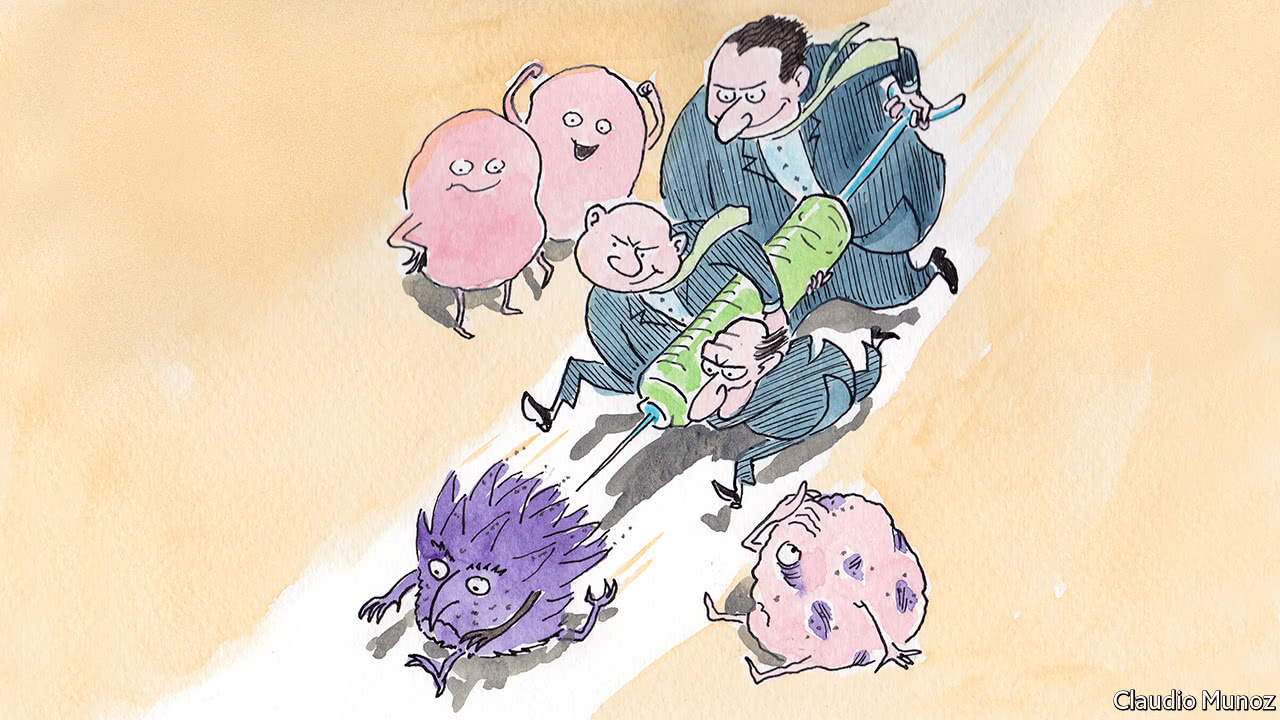
THE modern pharmaceutical firm lives or dies on the strength of its drug portfolio. As patents expire on lucrative medicines, they must replace the income that has been lost by inventing new drugs, or buying them in from outside. Both paths are expensive. But the costs of failure are greater, and this is how it was possible for a large and successful firm—such as British-based AstraZeneca—to shed 15% of its market value in a single day last week. Around £10bn ($13.2bn) was lost on news of disappointing results in one of its clinical trials (its shares have since rebounded by 4%).
The trial was to find out if a pair of drugs would treat a form of lung cancer. The drug, Imfinzi, and the experimental drug tremelimumab, belong to a new category of immunotherapy medicines called “checkpoint inhibitors”. Similar drugs are made by Bristol Myers Squibb (BMS), by Merck in America and Roche, a Swiss firm. In an interim finding, it was reported that Astra’s combination did not offer an…Continue reading
Shark Week meets Worst Cooks in America

FORGET your subscription to Netflix. Would you pay $5 a month for a collection of TV channels that gave you programmes such as “90 Day Fiancé”, “Pit Bulls and Parolees”, “My Cat from Hell”, “Worst Cooks in America” and “Shark Week”? Irresistible as this may seem, it is not yet on offer. But many believe that it has come closer. Discovery, a cable-network group, agreed on July 31st to buy another: Scripps Networks Interactive, owner of Food Network and HGTV, among other channels, in a $14.6bn deal. The combined firm will have 19 lifestyle- and reality-television-oriented channels including Animal Planet, DIY Network, Travel Channel and the flagship Discovery Channel (home of “Shark Week”).
The impetus for the combination is the declining market in America for expensive pay-TV bundles of 200 channels, which can cost close to $100 a month. In the past few years millions of consumers have spurned such bloated packages for…Continue reading