
Tag: Business
Saudi Aramco’s IPO is a mess

THE proposal to sell shares in Saudi Aramco, the world’s biggest oil company, stunned the financial markets last year. Muhammad bin Salman, now Saudi Arabia’s crown prince, promised that it would be the biggest initial public offering (IPO) of all time, valuing Aramco at $2trn. It was to be the centrepiece of his plan to transform the Saudi economy, reducing its dependence on oil. It was meant to foster financial transparency and accountability in one of the world’s most hermetic kingdoms. Above all, it would cement the young prince’s image as a bold moderniser soon to inherit the throne.
Alas, youthful impatience appears to have got the better of him. His tendency to micromanage the IPO and vacillate over where Aramco should be listed has caused delay and confusion. Matters came to a head this week when advisers, speaking anonymously, and company executives doing the same, gave conflicting reports, suggesting a mutinous atmosphere.
The kingdom’s advisers say…Continue reading
Why Airbus’s tie-up with Bombardier is so damaging for Boeing

LIKE an airliner in service, Bombardier’s C-Series programme has had multiple highs and lows. In 2008 the Canadian firm began its attempt to break Airbus and Boeing’s duopoly on smaller jets, spooking the pair into upgrading their own models. Costs and delays pushed it near bankruptcy in 2015, followed by a bail-out from the Quebec government worth C$2.8bn ($2.2bn). The next year an order for 75 C-Series jets from Delta, the world’s third-biggest carrier, kept the programme aloft. But decisions in September and October by America’s Commerce Department to agree to demands by Boeing, an aerospace giant, to impose a total tariff of 300% on importing those planes into America risked the C-Series project crashing once and for all.
On October 16th came a surprise surge. Bombardier said it would hand over half the project to Airbus, a European aerospace firm, free of charge. Bombardier and Investissement Québec, the province’s…Continue reading
An Indian aviation visionary runs into bureaucratic turbulence

ALL great aviation ventures start with mavericks willing to defy both the laws of physics and the scepticism of their peers. William Boeing, Oleg Antonov and Howard Hughes are some of the best-known examples. Next, perhaps, is Amol Yadav, who for much of the past decade has been building aeroplanes on the roof of the Mumbai flat he shares with 18 family members, and battling the Indian authorities to let him fly them.
Admittedly, only experts would be able to distinguish the six-seater propeller plane (pictured) Mr Yadav has designed from scratch from a run-of-the-mill Cessna. But his plane is the only one in decades with wholly Indian credentials, he says. Much larger outfits have tried but struggled to get an indigenous craft certified for production, including National Aerospace Laboratories, one of several state-owned aviation mastodons.
Self-identified visionaries are commonplace in…Continue reading
IBM lags in cloud computing and AI. Can tech’s great survivor recover?

TECHNOLOGY giants are a bit like dinosaurs. Most do not adapt successfully to a new age—a “platform shift” in the lingo. A few make it through two and even three. But only a single company spans them all: IBM, which is more than a century old, having started as a maker of tabulating machines that were fed with punch cards.
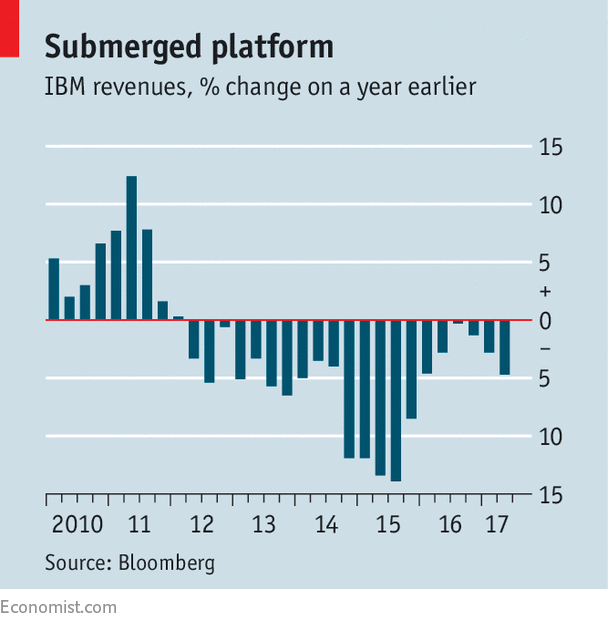
Yet after 21 quarters with falling year-on-year revenues (see chart), doubts had been growing about whether IBM would manage the latest big shifts: the move into the cloud, meaning computing delivered as an online service; and the rise of artificial intelligence (AI), which is a label for…Continue reading
Companies that burn up $1bn a year are sexy, dangerous, and statistically doomed
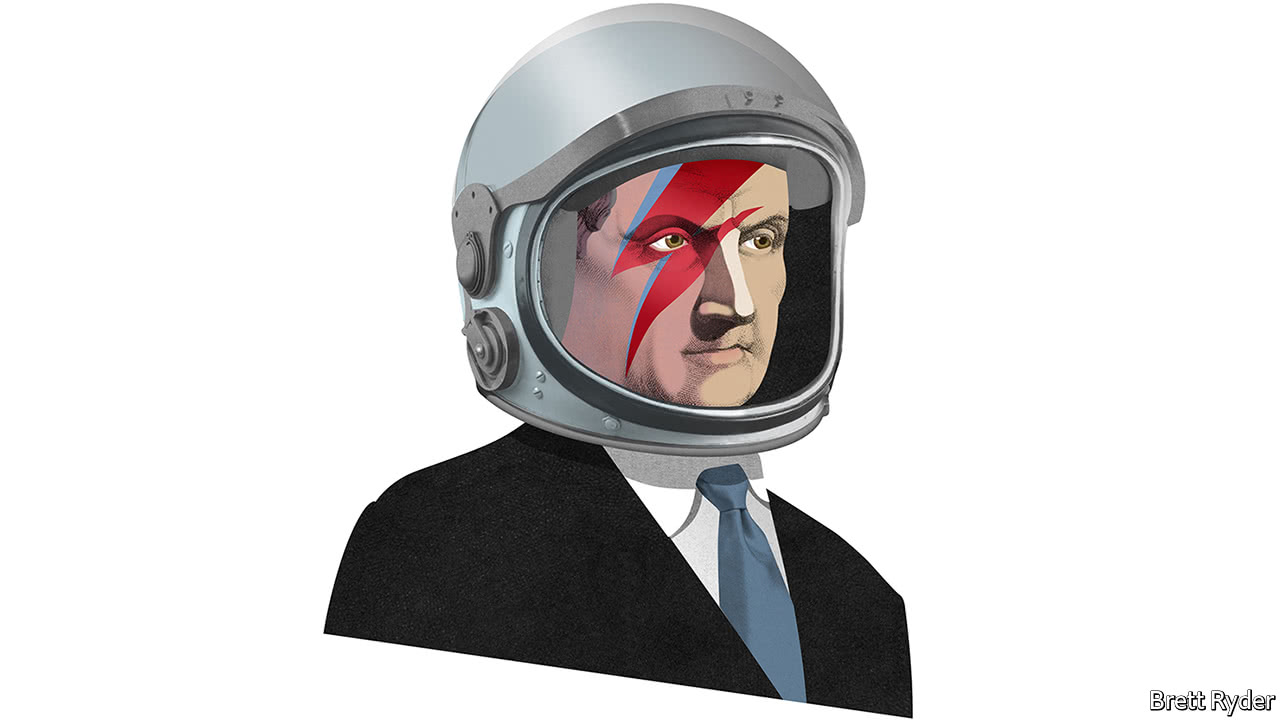
YVES SAINT LAURENT, Lady Gaga, David Bowie. Some people do not operate by the same rules as everyone else. Might the same be true of companies? Most bosses complain of being slaves to short-term profit targets. Yet a few flout the orthodoxy in flamboyant fashion. Consider Tesla, a maker of electric cars. This year, so far, it has missed its production targets and lost $1.8bn of free cashflow (the money firms generate after capital investment has been subtracted). No matter. If its founder Elon Musk muses aloud about driverless cars and space travel, its shares rise like a rocket—by 66% since the start of January. Tesla is one of a tiny cohort of firms with a licence to lose billions pursuing a dream. The odds of them achieving it are similar to those of aspiring pop stars and couture designers.
Investing today for profits tomorrow is what capitalism is all about. Amazon lost $4bn in 2012-14 while building an empire that now makes money. Nonetheless, it is rare for big companies to…Continue reading
Firms that burn up $1bn a year are sexy but statistically doomed
YVES SAINT LAURENT, Lady Gaga, David Bowie. Some people do not operate by the same rules as everyone else. Might the same be true of companies? Most bosses complain of being slaves to short-term profit targets. Yet a few flout the orthodoxy in flamboyant fashion. Consider Tesla, a maker of electric cars. This year, so far, it has missed its production targets and lost $1.8bn of free cashflow (the money firms generate after capital investment has been subtracted). No matter. If its founder Elon Musk muses aloud about driverless cars and space travel, its shares rise like a rocket—by 66% since the start of January. Tesla is one of a tiny cohort of firms with a licence to lose billions pursuing a dream. The odds of them achieving it are similar to those of aspiring pop stars and couture designers.
Investing today for profits tomorrow is what capitalism is all about. Amazon lost $4bn in 2012-14 while building an empire that now makes money. Nonetheless, it is rare for big companies to…Continue reading
Kobe Steel admits falsifying data on 20,000 tonnes of metal
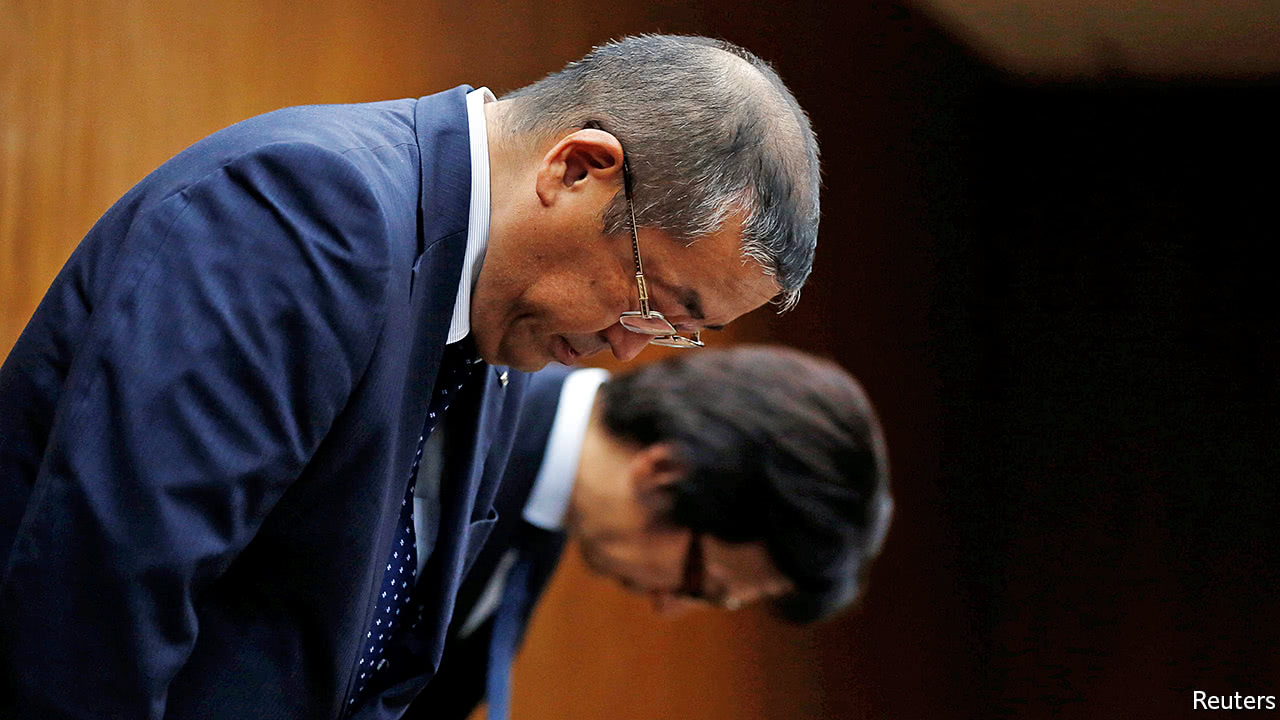
THE port city of Kobe, on the southern side of Japan’s main island, is known for luxury beef from pampered cattle, fine sake and precision engineering. Its reputation for the last of those products took a blow on October 8th when one of its oldest industrial firms, Kobe Steel, admitted that that it had falsified data on many of its aluminium, copper and steel products. By October 11th, the company’s shares had fallen by a third, reducing its market value by ¥180bn ($1.6bn).
Kobe Steel has admitted to falsification over the past year relating to large quantities of four types of material; 19,300 tonnes of aluminium sheets and poles; 19,400 aluminium components; 2,200 tonnes of copper products and an unspecified amount of iron powder that was supplied to over 200 customers. These items were certified as having properties—such as a level of tensile strength, meaning stiffness—that they did not in fact possess.
No deaths or accidents have yet resulted, but the…Continue reading
Crafty app developers are ripping off big-name brands

THE new app for an upmarket British department store certainly looks the part. Released on Google Play, a shop for Android software, on September 5th, it has the right logo, the correct vibrant colour and offers fashionable clothes and accessories. But the app is not authorised by the brand, is littered with pop-up ads and is painfully slow (furious users gave it one-star ratings). Its developer, Style Apps, has also launched apps for other clothing brands that are household names in America.
Such fake apps are designed by crafty developers to trick inattentive users. Google and Apple police their app stores but many impostors get through. In third-party app stores, unofficial platforms run by someone other than the two tech giants, the problem is even worse. Users are tricked in two ways. Some apps fill a gap in the market. Selfridges, a chain of British fashion stores, for instance, has a legitimate app for Apple devices but not for Android ones. RadioShack, an American electronics…Continue reading
An epic but inconsequential proxy vote at Procter & Gamble

SHAREHOLDER meetings in Ohio are not usually the stuff of high drama, but a recent gathering was a nail-biter. Nelson Peltz of Trian Fund Management, an activist hedge fund, sought a seat on the board of Procter & Gamble (P&G), the world’s largest consumer-goods company, in a proxy vote on October 10th. It was the biggest such battle ever. In the weeks leading up to P&G’s shareholder meeting, the fight resembled a political contest, complete with carefully crafted videos, lengthy white papers, mass mailings and tens of thousands of phone calls urging shareholders to vote blue (P&G) or white (Trian).
As The Economist went to press, P&G said it had won and Mr Peltz was contesting the tally. “Everybody but [P&G’s] current employees voted for us,” he said after P&G declared victory. “Maybe that’s why they keep so much overhead.” So the brawl is not over. Yet the outcome may not matter much. Mr Peltz will push P&G for…Continue reading
Why McKinsey is under attack in South Africa
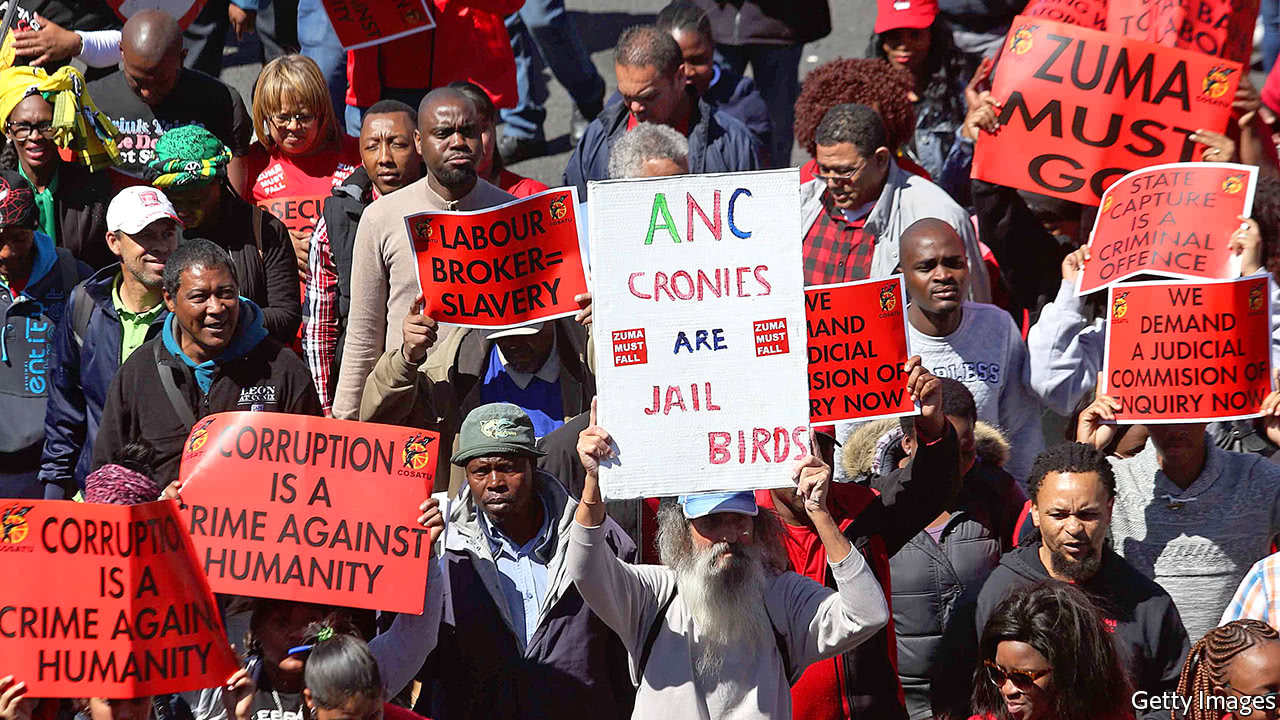
MCKINSEY, a global management consultancy known for its discreet profile and rarefied air, is unused to the sort of tub-thumping popular revolt it is experiencing in South Africa. Such is public outrage over the Guptas, an Indian-born business dynasty accused of growing rich off their relationship with President Jacob Zuma, that a few professional-services firms linked to the family, including McKinsey—as well as SAP, a German software giant—have become targets of Twitter storms and protest banners.
Anti-corruption groups and the opposition Democratic Alliance (DA) have drawn blood in the case of Bell Pottinger, a British public-relations firm accused of orchestrating a racially divisive public-relations campaign on behalf of the Guptas. A complaint by the DA to a British PR industry association set in motion Bell Pottinger’s swift implosion in September. At KPMG, a global audit firm, eight senior executives in South…Continue reading