
Tag: Business and finance
Chinese companies’ weak record on foreign deals

CONSIDERING the size of China’s economy, it seems inevitable that its firms will eventually play a huge role on the world stage. Yet China Inc’s adventures abroad in the past 15 years have been a mixed bag. Thousands of small deals have taken place, some of which will succeed. But of the mergers and acquisitions that have been worth $1bn or more, it is a different story. There have been 56 abandoned deals, 39 state-backed acquisitions of commodities firms at frothy prices, and, lately, wild sprees by tycoons scooping up trophies such as hotels and football clubs.
Some deals defy any conventional logic. Last month HNA, an airlines-and-tourism conglomerate from Hainan, said it had bought a 10% stake in Deutsche Bank, having earlier considered buying a Landesbank. The Chinese firm, which runs a beach-volleyball tournament in Beijing, appears to think it can consolidate Germany’s fragmented banking industry—the financial equivalent of bringing peace to the Middle East. If China Inc is…Continue reading
How sham food became big business in Japan

GUESTS to the factory of Tsuyoshi Iwasaki are presented with a rasher of bacon. The succulent marbled sliver is branded with his name, title and e-mail address—an apt introduction to the owner of Japan’s biggest manufacturer of replica food. At the headquarters of Iwasaki Co on the outskirts of Tokyo, racks of golden-brown gyoza jostle for attention with boat-shaped dishes of lustrous raw tuna, bowls of creamy ramen and a dozen pinkish scallops in iridescent shells. The acrid smell of resin and paints is the only hint that everything on show is utterly tasteless.
Most of these Japanese sampuru, from the word “sample”, will go on display in restaurant windows, from fast-food outlets to izakaya (bars), throughout the east of the country, in the hope of luring hungry customers. A sister company, managed by Mr Iwasaki’s brother, covers the western half of Japan. Together they make over ¥5bn ($46m) in annual…Continue reading
How retailers are watching shoppers’ emotions

FOR eight months up to this April, a French bookstore chain had video in a Paris shop fed to software that scrutinises shoppers’ movements and facial expressions for surprise, dissatisfaction, confusion or hesitation. When a shopper walked to the end of an aisle only to return with a frown to a bookshelf, the software discreetly messaged clerks, who went to help. Sales rose by a tenth.
The bookseller wants to keep its name quiet for now. Other French clients of the Paris startup behind the technology, Angus.ai, are testing it in research shops that are not open to the public. They include Aéroports de Paris, an airport owner; LVMH, a luxury conglomerate; and Carrefour, a chain of hypermarkets. In a test at a Mothercare shop in Tallinn, Estonia, software from Realeyes, an emotion-detection firm based in London, showed that shoppers who entered smiling spent a third more than others.
Simple video yields a lot of insight. But…Continue reading
To err is human; so is the failure to admit it

A NEWSPAPER cannot publish for 174 years without some mistakes. This one has made its share. We thought Britain was safe in the European exchange-rate mechanism just weeks before it crashed out; we opined, in 1997, that Indonesia was well placed to avoid financial crisis; we noted in 1999 that oil, at $10 per barrel, might well reach $5, almost perfectly timing the bottom of the market; and in 2003 we supported the invasion of Iraq. For individuals, like publications, errors are painful—particularly now, when the digital evidence of failure is both accessible and indelible. But they are also inevitable. The trick, then, is to err well: to recognise mistakes and learn from them. Worryingly, humanity may be getting worse at owning up to its goofs.
Few enjoy the feeling of being caught out in an error. But real trouble starts when the desire to avoid a reckoning leads to a refusal to grapple with contrary evidence. Economists often assume that people are rational. Faced with a new fact,…Continue reading
Why government-bond yields have been falling again
EVERY year it seems that analysts and investors play a ritual game. They begin by asserting that government bonds are terrible value and that, accordingly, this must be the year when yields will rise (and prices fall). And then they get mugged by reality.
The same pattern seems to be playing out in 2017. Back in December, a poll of fund managers by Bank of America Merrill Lynch (BAML) found that pessimists on global bonds outnumbered optimists by 58 percentage points. Investors believed in a “reflation trade”, with tax cuts from Donald Trump’s administration leading to faster American growth, to which the Federal Reserve would respond with higher interest rates.
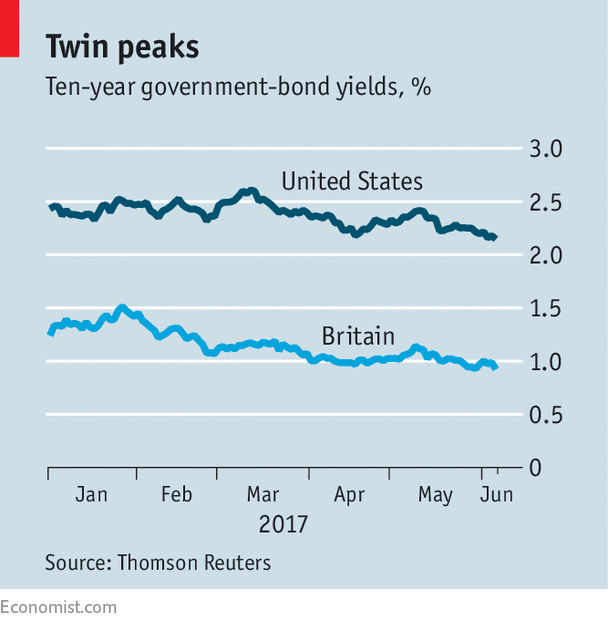
For a while, such forecasts seemed to be on the money. The yield on the ten-year Treasury bond picked up to 2.63% by March 13th (see chart). But since then the trend has changed. The Treasury-bond yield recorded a low for the year of 2.13% on June 6th. In Britain the yield on the ten-year gilt dipped below 1% on June 6th…Continue reading
Green bonds channel private-sector funding to the climate
WHEN Donald Trump announced America’s withdrawal from the Paris climate agreement on June 1st, he spelled out that it would no longer contribute to the Green Climate Fund. This is a UN initiative to use rich countries’ money to bring climate finance to developing ones. But even if the fund were going swimmingly, public-sector finance would only be able to provide a small part of the cash needed by poor countries, and indeed the world.
Private markets, however, are mobilising—notably that for “green bonds”, which tie the proceeds of bond issues to environmentally friendly investments. The market started a decade ago with issues from municipalities and multilateral development banks, worth just a few hundred million dollars annually.
By 2016 issuance had grown to $97bn, of which $32bn came from China alone; SEB, a Swedish bank, reckons volumes may hit $125bn this year. Public-sector issuers together accounted for only around 30% of the total last year. The largest portion, over 35%, was issued by financial institutions; around 20% came from other companies. Investor demand, too, is booming. Zurich Insurance, a Swiss insurer, has already invested over $1.2bn in green bonds, with plans to reach $2bn; BlackRock and other asset managers have set up dedicated green-bond funds.
As for the proceeds, over 40% is used to finance clean energy; nearly…Continue reading
Four BRICs don’t quite make a wall

EMERGING markets have been through a lot over the past four years. The “taper tantrum” in 2013 (prompted by fears of a change in American monetary policy); the oil-price drop in 2014; China’s botched devaluation of its currency in 2015; and India’s botched “demonetisation” of much of its own currency in late 2016 (removing high-value banknotes from circulation). But 2017 has started more brightly. Indeed, for the first time in two and a half years, the world’s four biggest emerging economies (Brazil, Russia, India and China, known as the BRICs) are all growing at the same time.
Russia’s GDP bottomed out at the end of 2015 (using seasonally adjusted figures) after the longest recession since the 1990s. It has expanded at a gathering pace for the past three quarters. Higher oil prices have helped, though Russia cannot profit fully from the improved market by ramping up sales without violating the production limits that caused the market’s recovery.
During the…Continue reading
In praise of America’s third-party debt collectors

FEW cheer the rising levels of America’s household debt, which reached a record $12.7trn at the end of the first quarter. Nearly 5% of the total, or $615bn, was in some stage of delinquency. One group, however, can barely hide its glee: third-party debt-collection firms, which try to recover mostly consumer loans on behalf of creditors without the resources to chase down bad borrowers themselves.
Business is expanding “at a robust rate”, says Keith Kettelkamp, the boss of Remex, a debt collector based in New Jersey whose clients include banks, utilities and musical-instrument sellers. Across the country more than 6,000 collection firms contact debtors more than 1bn times a year. One in eight Americans has an account with a third-party collector. The average amount outstanding is just over $1,300.
Third-party collectors have, it is fair to say, a dubious reputation: they are the target of more complaints from consumers than…Continue reading
Don’t trust an airline with your instrument
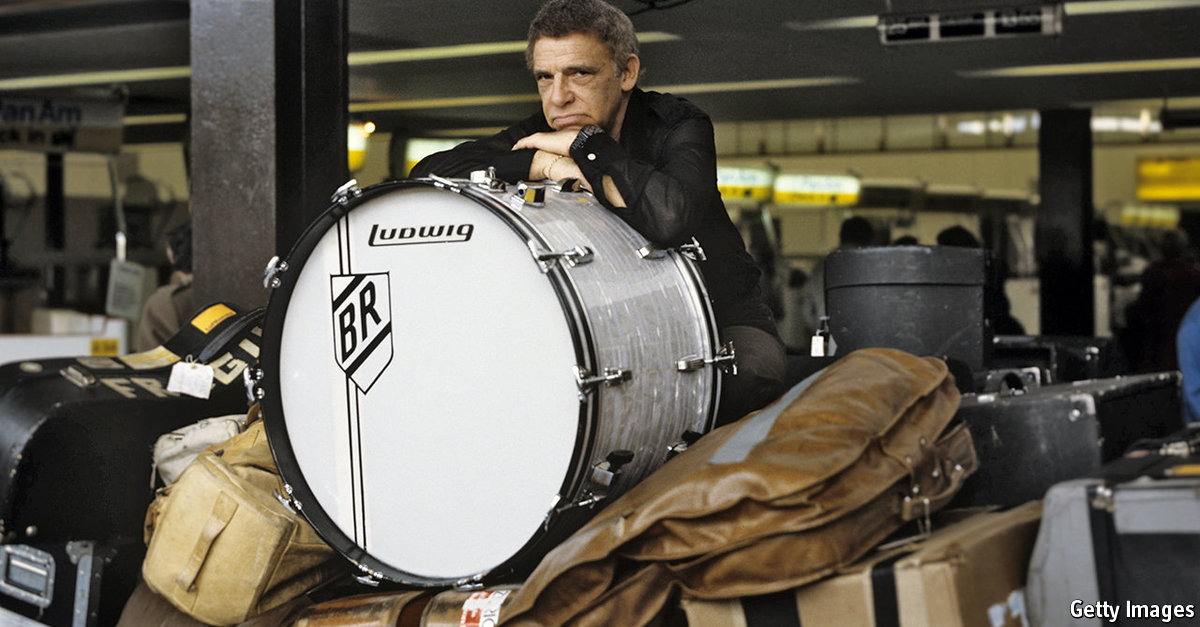
B.B. KING was famous for being inseparable from Lucille, his Gibson guitar. So much so that when taking a plane, he would book his six-string its own seat, often under the unimaginative nom de guerre of “Mr Guitar”. It is understandable that musicians prefer not to check their precious instruments into the hold. Airlines do not have a history of treating them so gently. Even a steel guitar can be made to weep.
Perhaps the most infamous horror story resulted in “United Breaks Guitars” a series of revenge songs recorded by Dave Caroll that went viral in 2009. Mr Carroll watched aghast from his plane window as ground handlers tossed about his $3,500 axe, after retrieving it from the hold. Though the neck of his guitar was plainly broken, it took nine months and the release of three mocking songs before the airline coughed up $1,200 for the repairs.
That incident may have been on…Continue reading
Podcast: Super Mario to the rescue
As the European Central Bank meets in Estonia this week, is it time for Mario Draghi to withdraw support from the Eurozone economy? Emerging Markets Editor Simon Cox on why the BRICs label is still relevant. And, how investors are taking care of the planet. Simon Long presents