
Tag: Business and finance
Why the Fed is likely to raise rates, despite low inflation

CREDIBILITY is a thing you have to worry about with toddlers. You cannot reason with them. The best you can hope to do is respond consistently to undesirable behaviour. Get this wrong and your work becomes harder. If your correspondent doesn’t actually go and hide the box of Legos every time he has to count to three, for example, his child will not find his threats to be credible, and will fail to respond to them.
This is the problem the Federal Reserve has now with financial markets. For six months the Federal Open Market Committee (FOMC) has been carefully managing its speeches, meeting minutes and economic projections to one end: convince debt markets that it will raise the benchmark interest rate by a quarter of a percentage point at its June meeting. It has succeeded. FedWatch, a tool that estimates how markets think monetary policy will go, pegs the probability of a June rate hike at 91%. This leaves the committee with a familiar…Continue reading
Political ostracism means more woe for Qatar Airways
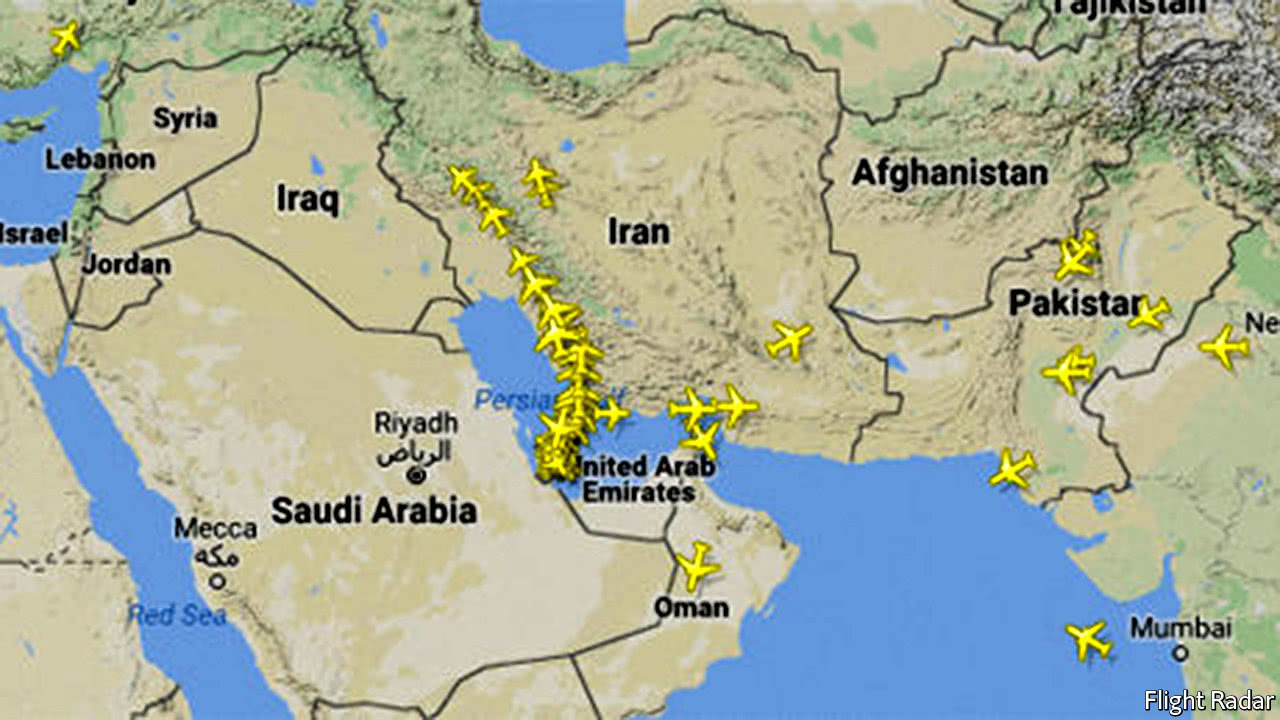
AFTER years of ascension, the three Gulf superconnectors, Emirates, Etihad and Qatar Airways, have recently suffered a bad spell. The low price of oil—usually a boon for airlines—has reduced spending power in oil-rich states, which has dampened demand for flights from the region. Terrorist attacks throughout the Middle East, too, have proved a deterrent. Then came Donald Trump. The president’s attempts to ban travel from some Muslim-majority countries put many off flying to America, which is a big market for these long-haul carriers. American restrictions on electronic devices on flights from the three carriers’ home airports to America made things even worse.
Qatar Airways must have hoped that the only way from here on in was upwards. Those hopes were dashed on July 5th when Qatar’s neighbours, Saudi Arabia, the UAE and Bahrain, decided to sever diplomatic relations with the country, followed swiftly by others, including Egypt. The
What will the markets do if Labour wins?

WHEN the British election started, a victory for Theresa May looked a nailed-on certainty. The Conservative lead was as high as 20 percentage points and the party was 1/20 on to claim the most seats. But a poorly run campaign means that the gap has narrowed; the latest from Survation had the Conservatives with just a one-point lead.
The betting markets still assume that the Tories will win, albeit with a majority of 70 or so rather than the 100 plus that was assumed earlier in the campaign. But what if the gambling markets are wrong, as they were about Brexit and Trump? Nate Silver, the American polling guru, argues that
Britain needs a second flag-carrier

AIRLINES, like all firms, have a duty to shareholders to cut costs, if it makes them more competitive and more profitable in the long term. British Airways has been zealous in this regard. Over the past few years, the airline, under the stewardship of Willie Walsh and Alex Cruz, has cut staff, outsourced IT, and removed complimentary goodies from passengers.
They have their reasons. Not so long ago, some questioned whether British Airways could survive the combination of low-cost carriers devouring its short-haul route and upscale Middle Eastern rivals dominating the long-haul connecting market. Both of those challenges remain real (indeed a third previously unforeseen threat has arisen in the form of low-cost long-haul competitors such as Norwegian Air). Still, no one now questions British Airways’ immediate future. Partly as a result of cost-cutting, and a bit of luck in the form of low oil prices, the airline’s finances are rosy. In 2016, IAG, the carrier’s parent firm, reported a profit of €2.36bn…Continue reading
Europe inches closer to a plan for fixing its financial flaws
DONALD TRUMP and Theresa May may have done more to push Europeans together, and open up an opportunity for reform of its institutions, than any pro-European American president or British prime minister could ever have dreamt. The Commission’s “Reflection paper on the deepening of the Economic and Monetary Union”, issued on May 31st, points the way towards a package deal that could be acceptable to Northern and Southern euro area countries. But some key elements are still missing.
Encouragingly, the Commission sets out a tight calendar for completing the banking union, with the creation of a common deposit insurance scheme and a common backstop for the European Resolution fund intended to be in place by 2019. These two elements are crucial if we are to stop the banks posing an existential risk to the states where they operate.
But avoiding the “diabolic loop” between banks and states also requires cutting the…Continue reading
British Airways botches its response to its latest technical woes
IT IS easy to blame infrastructure when things go wrong, as they did on May 27th when British Airways (BA) grounded planes across the globe after a global IT systems crash. More than 1,200 flights, booked to carry over 75,000 passengers, were cancelled over three days; hundreds of thousands more miserable travellers had their trips ruined by delays, lost luggage and missed connections. Analysts estimate that the total cost to BA of refunds, plus compensation of up to €600 ($675) for each delayed passenger, could climb as high as £150m ($192m).
But such calamities are also man-made, and a trail of incompetence led to this one. Alex Cruz, the chief executive, is better known as a cost-cutter than a communicator, and it showed. Though he was quick to apologise in public, in private he muzzled his employees and offered vague explanations, linking the computer failure to a “power-supply issue”. Others pour scorn on this interpretation.
His staff, though often trying their best, were ill-prepared. They had no clear plan to deal with passengers caught up in the chaos. For flight delays and cancellations, the television bulletins broadcast at London’s Heathrow and Gatwick airports, BA’s two main hubs, were more helpful than its stewards on the ground. Without working backup systems, airline representatives were unable to prioritise customers in most…Continue reading
The super-rich are different: they pay less tax
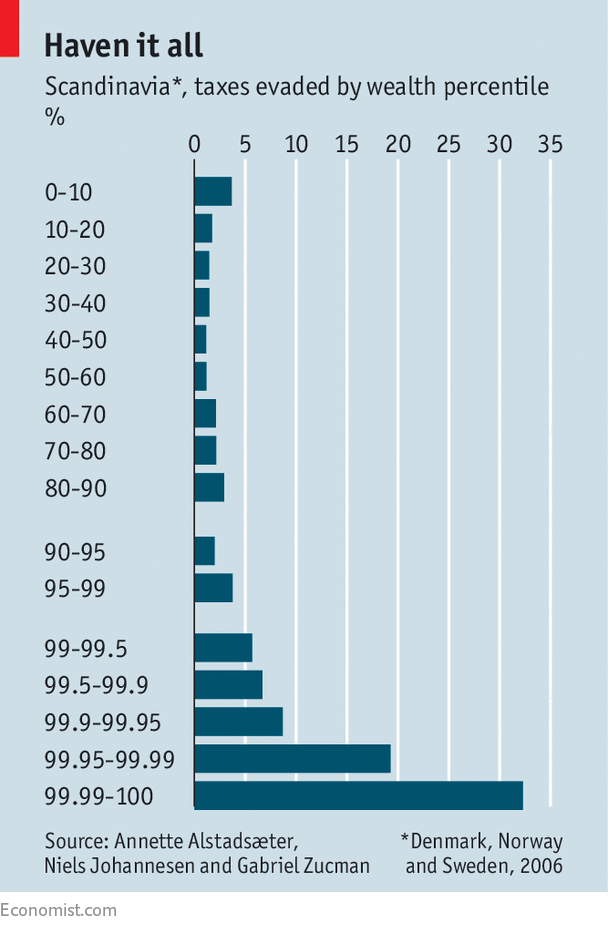
OF LIFE’s two certainties, death cannot be dodged even by the well-to-do. Taxes are another matter. Quantifying quite how much they manage to keep from the taxman, however, has always been tricky. One common approach governments take is to conduct randomised audits of tax returns. This methodology can give regulators a rough sense of overall tax revenues lost. But it is far from ideal. For instance, studies based on randomised tax audits are usually both too small and too crude to reflect accurately the financial shenanigans of the most egregious tax-dodgers: the super-rich.
A new study by Annette Alstadsæter, Niels Johannesen and Gabriel Zucman, three economists, tackles this problem by investigating two recent financial-data hoards: the “Swiss leaks”, a record of bank accounts held at HSBC in Switzerland; and the “Panama papers”, files that document the use of offshore accounts and shell companies by clients of Mossack Fonseca, a law firm in Panama. By matching the leaked information with wealth data from Denmark, Norway and Sweden, the authors are able to construct the most detailed estimate to date of the extent of tax evasion.
The race to become Islamic banking’s fintech hub

FOR all the sophistication of some of its financial centres, and despite the ubiquity of smartphones, the Middle East has been a late adopter of financial technology, or fintech. Of more than $50bn in fintech investment globally since 2010, according to Accenture, a consultancy, only 1% has gone to the Middle East and north Africa.
Khalid Al Rumaihi, head of Bahrain’s Economic Development Board, blames institutional foot-dragging and a lack of infrastructure and venture capital. Yet he insists innovation is inherent to Islamic financial tradition. The modern cheque derives from an Arabic instrument, a written vow to pay for goods on delivery, to avoid carrying money on dangerous journeys. “In the 9th century”, he says, “a Muslim businessman could cash a cheque in China drawn on his bank in Baghdad.”
Several cities are now jockeying to establish themselves as fintech hubs. Last year Cairo launched two “accelerators”—schools to nurture startups. Abu…Continue reading
America’s community banks hope for lighter regulation

A FEW weeks ago Standard Financial, a bank with assets of just $488m and a mere nine branches, merged with Allegheny Valley Bancorp, a slightly smaller neighbour in the suburbs of Pittsburgh. The main reason for the deal, says Tim Zimmerman, Standard’s chief executive, was the rising cost of regulation—though competition from PNC, a $371bn colossus based in the city, also played a part. “Without the regulatory overreach…since the crisis,” Mr Zimmerman says, “we’d probably both have gone along on our own, I think.”
Standard is one of America’s 5,400 community banks: local lenders, funded chiefly by deposits, who pride themselves on knowing their turf by the inch and their customers by name. Their size can range up to $10bn in assets, but most are much smaller: over 5,000 banks and savings institutions have less than $1bn and more than 1,500 under $100m. They account for 92% of federally insured banks. Though they make only 16% of all loans, they provide 43% of…Continue reading
Will President Trump rescue failing pension funds?
TO THE exasperation of budget hawks, Donald Trump has long made clear that he will not reform Social Security (public pensions). But maintaining these entitlements does not fully protect workers’ retirement income. For many, pension promises from their employers are more important. These can shrink or vanish when firms fail. And, like Social Security, the programme that protects retirees against such losses—the Pension Benefit Guaranty Corporation—is going bust.
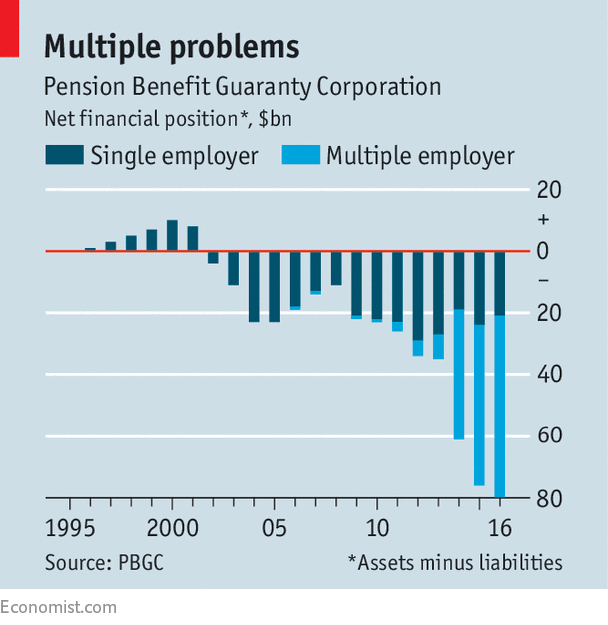
The PBGC levies premiums on defined-benefit pension plans in order to bail out those that fail (up to a maximum payout per worker). On current trends, one of its insurance schemes will probably run dry by 2025. The problem is so-called “multi-employer” funds (see chart). These involve multiple firms, usually under an agreement with an industry-wide union. They cover about 10m Americans, roughly 1m of whom are in a plan that admits it is probably broke. The biggest struggler is the Central States fund, which covers about 400,000…Continue reading